


Himachal Pradesh HC: Burden to Prove Encroachment Lies on the Claimant; Court Cannot Create Evidence Through Local Commissioners
 Copy Link
 Share
 Save
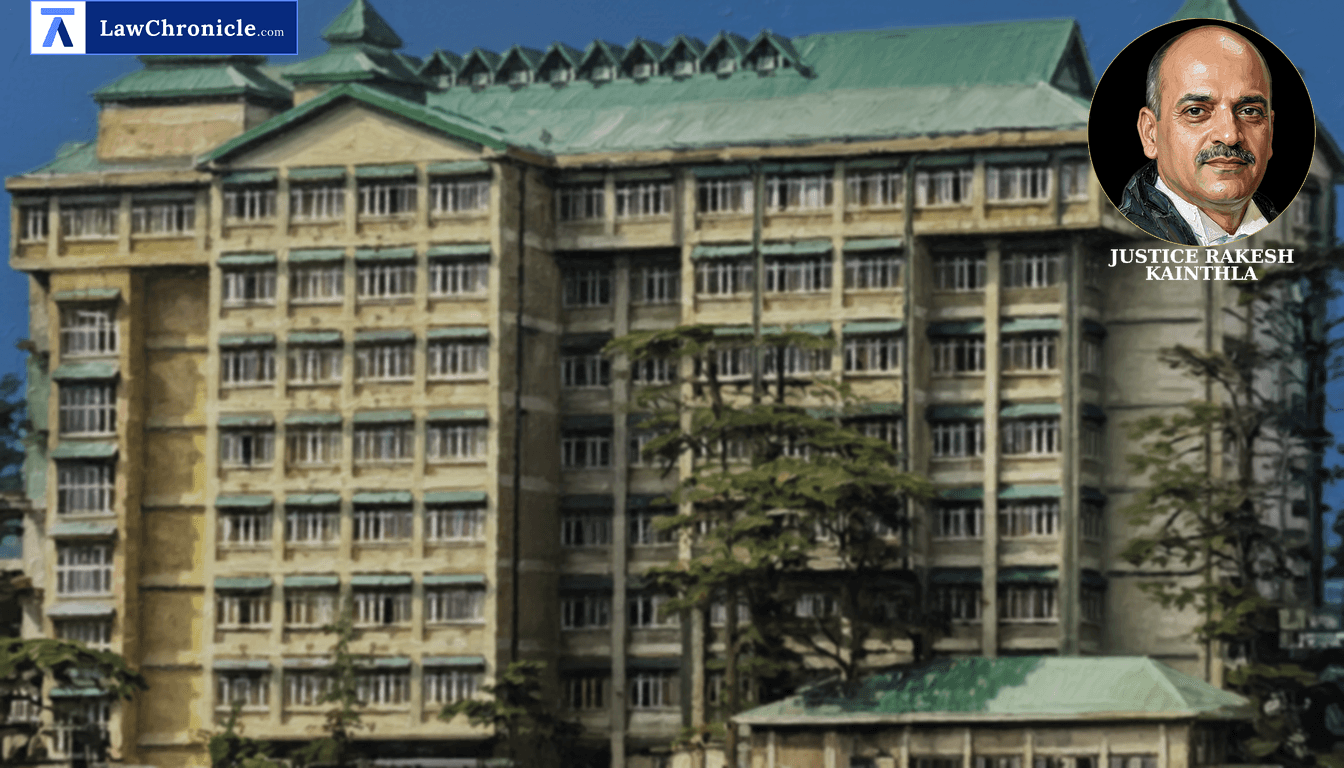
The High Court of Himachal Pradesh has reinforced a critical evidentiary principle in property disputes, ruling that a party alleging encroachment must stand on its own legs and cannot move the court to appoint a Local Commissioner solely to garner evidence to patch up weak parts of its case.
Justice Rakesh Kainthla, presiding over the matter, dismissed a regular second appeal and multiple applications for additional evidence, highlighting that the power under Section 107 of the Himachal Pradesh Land Revenue Act, 1953 remains with statutory revenue authorities and fresh demarcations cannot be ordered unless previous ones are legally set aside.
Court Rejects Suo Motu Appointment of Local Commissioner
The appellant had challenged the dismissal of his counterclaim for a mandatory injunction against the respondents. He argued that in boundary disputes, the courts should exercise their jurisdiction to appoint a Local Commissioner suo motu to elucidate the matter. However, the Court distinguished between a 'boundary dispute' and a 'simpliciter claim of encroachment'.
The Court, in its reasoning, observed: "It is well settled that if a suit is filed on the ground that the other party has encroached upon the land of the plaintiff, the plaintiff has to prove his case and show by satisfactory evidence that his land has been encroached by the defendant, and it is not necessary to appoint a Local Commissioner for that purpose... The plaintiff or the defendant has to stand on its own legs, and provisions of Order 26, Rule 9 of the Code of Civil Procedure, 1908 cannot be used to garner or gather evidence for them through the Court process."
Finality of Prior Demarcation Reports
A pivotal aspect of the case was the appellant's own admission that he had obtained a prior demarcation which showed no encroachment. Citing Radha Swami Satsang Beas Vs. State of H.P. ( "ILR 1984 (HP) 317": 1984 CaseBase(HP) 19) and State of H.P. v. Mangat Ram, the Court held that a revenue officer's report under the Himachal Pradesh Land Revenue Act, 1953 is final and a fresh demarcation is impermissible unless the previous one is set aside through revisional powers.
The Court has the following directions:
"The present appeal fails and is dismissed. The appeal stands disposed of, so also the pending application(s), if any. Records of the learned Courts below be sent down forthwith."
Key Takeaways
- Burden of Proof Unshifted: A party alleging encroachment must provide independent evidence such as revenue reports and cannot rely on the Court's power to appoint commissions to build its case.
- Preclusion of Fresh Demarcation: Once a statutory demarcation is conducted by a competent Revenue Officer, it remains binding until set aside by a superior authority; litigants cannot repeatedly seek new demarcations to find a favorable result.
- Limits on Additional Evidence: Appellate courts will not allow additional evidence under Order 41 Rule 27 of Code of Civil Procedure, 1908 if it is intended merely to fill lacunae or omissions that the litigant failed to address during the trial.
Ratio
In a suit for mandatory injunction based on alleged encroachment, the burden of proof rests entirely on the claimant. The Court is not expected to create evidence for a party by appointing a Local Commissioner under Order 26 Rule 9 of the Code of Civil Procedure, 1908 when the claimant has failed to exercise due diligence in obtaining statutory demarcations. Furthermore, a fresh demarcation cannot be ordered under the Himachal Pradesh Land Revenue Act, 1953 without setting aside the previous valid demarcation report.
Background:
The dispute began when the plaintiffs (respondents) filed a suit for a permanent prohibitory injunction to protect their ownership of land purchased in 1974. The defendant (appellant) filed a counterclaim alleging that the plaintiffs had encroached upon a portion of his land purchased in 1993. The Trial Court decreed the plaintiffs' suit and dismissed the counterclaim, noting that the defendant's own evidence admitted a prior demarcation found no encroachment.
The first Appellate Court partly modified the decree, setting aside the injunction in favor of the plaintiffs due to lack of specific evidence on a 'strip' of land, but upheld the dismissal of the defendant's counterclaim. In the High Court, the appellant sought the appointment of a Local Commissioner and the introduction of new maps prepared by an architect as additional evidence. Relying on N. Kamalam v. Ayyasamy and the North Eastern Railway Administration. vs. Bhagwan Das, the High Court refused these requests, noting that Order 41 Rule 27 of Code of Civil Procedure, 1908 is not a 'panacea' for unsuccessful litigants to patch up weak cases.
Case Details:
Case No.: RSA No. 500 of 2006
NeutralCitation: 2026:HHC:30103
Case Title: Yoginder Lal Sharma Versus Sushma Mahajan & anr.
Appearances:
For the Petitioner(s): Mr R.K. Bawa, Senior Advocate, with Mr Abhinav Thakur, Advocate.
For the Respondent(s): Mr Y.P. Sood, Advocate.
Source: 2026 CaseBase(HP) 76
Similar Articles


 Breaking News


