


Himachal Pradesh HC: Statutory Delay in Testing Drugs Within 60 Days Vitiates Prosecution
 Copy Link
 Share
 Save
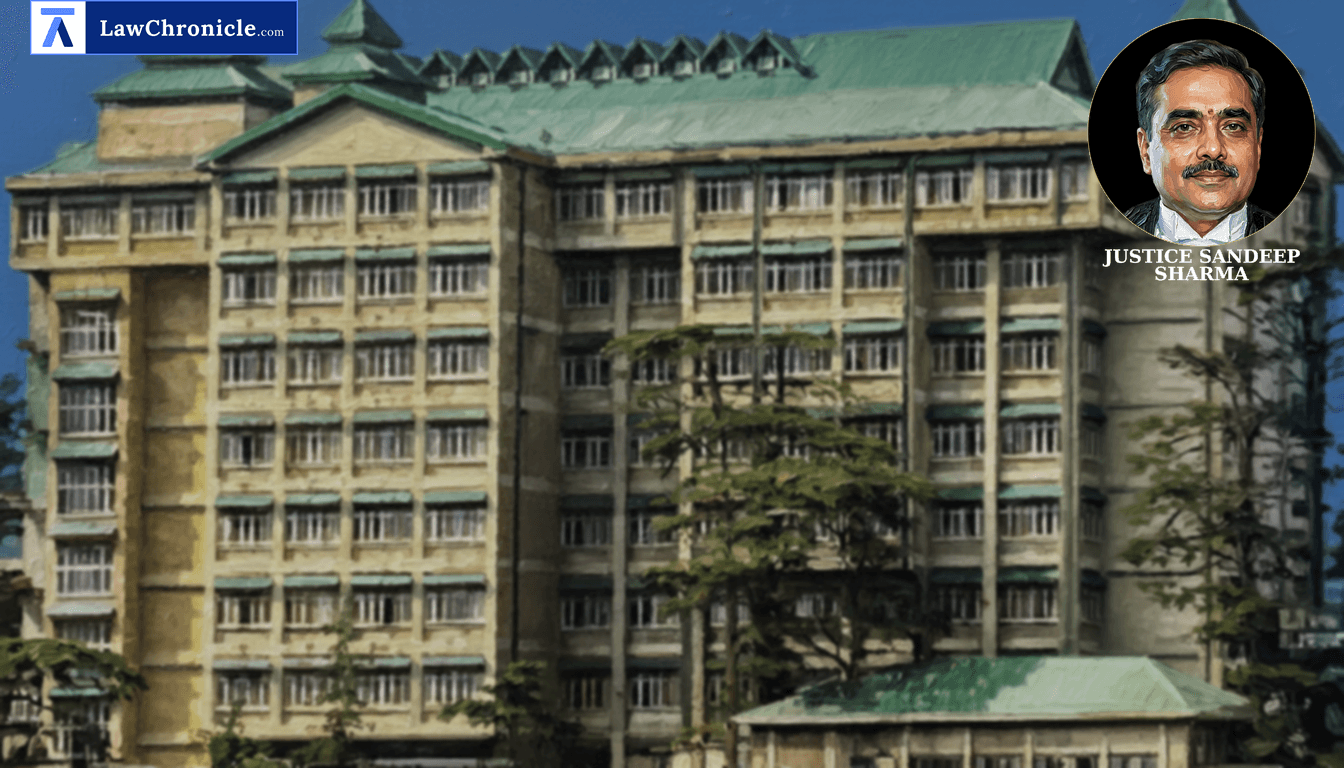
In a decisive blow to administrative delays in drug regulatory enforcement, the Himachal Pradesh High Court has quashed criminal proceedings where drug samples were not analyzed within the mandatory 60-day window, ruling that such lapses strip the accused of their vital right to re-testing. The judgment reinforces that proprietary owners cannot be held vicariously liable for manufacturing defects without specific averments of their day-to-day involvement, especially when competent technical staff are officially designated.
A single-judge bench of Justice Sandeep Sharma adjudicated the petitions filed under Section 528 of B.N.S.S (corresponding to Section 482 of Code of Criminal Procedure). The Court was tasked with determining the legality of criminal complaints initiated under the Drugs and Cosmetics Act, 1940 following reports that certain drug batches were 'Not of Standard Quality.'
Court Mandates Strict Adherence to Testing Timelines
The Court observed that the mandatory 60-day period for test and analysis, as prescribed under the Drugs and Cosmetics Rules, 1945, was violated. In one instance, despite drawing samples in July 2017, they were forwarded for analysis only in February 2018. The Court emphasized that such delays are fatal to the prosecution because the shelf life of the drugs often expires before the accused can exercise their right to challenge the Government Analyst's report.
The Court has the following directions:
"The present petitions are allowed. Complaint Case Drugs and Cosmetics Act/ 0000001/2023 (CNR No. HPMA 020126592023) and Complaint Case Drugs and Cosmetics Act/2/2023 (CNR No. HP38010015182023), along with all other consequential proceedings pending in the Court of learned Additional Chief Judicial Magistrate, Mandi, District Mandi and learned Chief Judicial Magistrate, Nurpur, District Kangra, are quashed and set aside qua the petitioner(s). The petitioner(s) are discharged henceforth."
Observations on Vicarious Liability and Rule 45
Referring to Section 34 of the Drugs and Cosmetics Act, 1940, the bench noted that the complaint was silent on the specific role of the proprietor regarding manufacturing processes. The Court, in its reasoning, observed: "It could thus clearly be seen that this Court has held that merely reproducing the words of the section without a clear statement of fact as to how and in what manner a director of the company was responsible for the conduct of the business of the company, would not ipso facto make the director vicariously liable."
Furthermore, the Court relied on M/s G.G. Nutrition and Others Vs. State of Maharashtra and Another to reiterate that testing beyond the statutory period prescribed under Rule 45 of Drugs and Cosmetics Rules, 1945 is a ground for quashing. The Court found that allowing the trial to continue after the drug's expiry would be a "futile exercise" and an abuse of the process of law.
Key Takeaways:
Mandatory 60-Day Testing Window
Failure of the Government Analyst to test drug samples within 60 days as per Rule 45 of Drugs and Cosmetics Rules, 1945 can lead to the dismissal of the entire criminal case.
Right to Re-analysis is Inviolable
If the prosecution is launched so late that the drug has already expired, the accused’s right to seek a second opinion from the Central Drugs Laboratory is lost, vitiating the trial.
Proprietors Not Automatically Liable
Owners of pharmaceutical firms cannot be prosecuted for manufacturing defects unless the complaint specifically explains their daily involvement in the production line.
Ratio Decidendi:
The primary responsibility to aver that an accused is in charge of and responsible for the firm's daily affairs lies strictly with the complainant. Furthermore, non-compliance with the 60-day statutory timeline for drug analysis under Rule 45 of Drugs and Cosmetics Rules, 1945, resulting in the loss of the accused's right to re-test the sample before its expiry, renders the prosecution an abuse of the process of law.
Background:
The dispute originated from drug samples (Propin 40 and Injection Dexamethasone Sodium Phosphate IP) drawn by Drug Inspectors in 2017. Reports from the Government Analyst in Kolkata and Chandigarh later declared these samples 'Not of Standard Quality' due to issues with sterility and particulate matter. However, the complaints were filed in mid-2023, years after the samples were drawn and well after their 2018 expiry dates.
The petitioners argued that the complaints were barred by limitation under Section 468 of Code of Criminal Procedure and that the Drug Inspectors failed to forward samples 'forthwith' as required by Section 23(4) of the Drugs and Cosmetics Act, 1940. The Court scrutinized the delay, noting that the 'valuable right' of the accused to challenge the report was extinguished by the state's lethargy. Consequently, the High Court exercised its inherent powers to prevent the petitioners from facing a protracted and ultimately doomed trial.
Case Details:
Case No.: Cr.MMO Nos.1336 and 472 of 2024
NeutralCitation: 2026:HHC:27994
Case Title: M/s Crystal Pharmaceuticals and Another v. State of Himachal Pradesh
Appearances:
For the Petitioner(s): Mr. Sanjay Jain, Mr. Akshay Jain, Mr. Anuj Nag and Mr. Hakam Bhardwaj, Advocates
For the Respondent(s): Mr. Ravi Chauhan and Mr. Anish Banshtu, Deputy Advocates General
Source: 2026 CaseBase(HP) 22
Similar Articles

 Breaking News


