Illiteracy and Unexplained Cuttings on Will Vitiate Testamentary Disposition: SC
 Copy Link
 Share
Share Save
Save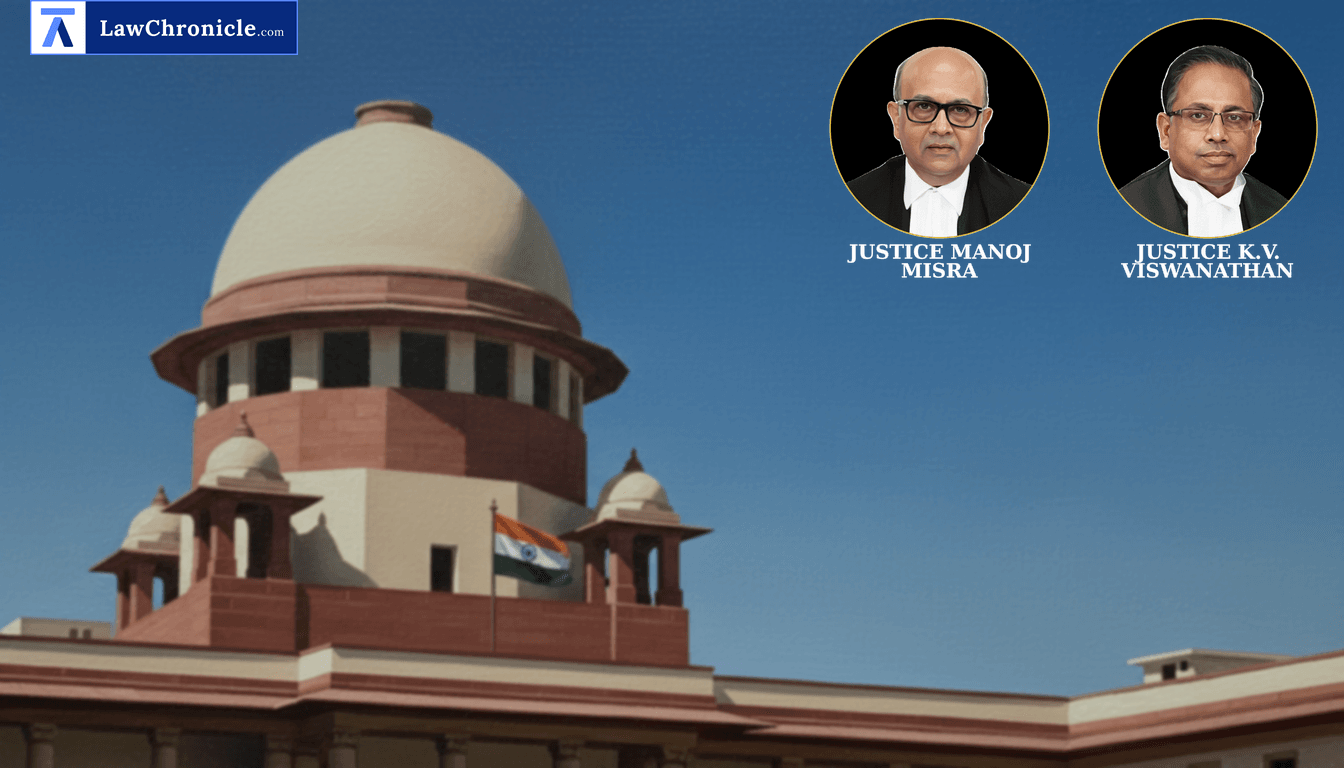
The Supreme Court has reinforced the 'judicial conscience' test for testamentary documents, ruling that the disinheritance of a caring spouse in favor of non-relatives by an illiterate testator, coupled with unexplained alterations in registration records, creates an insurmountable cloud of suspicion. The verdict clarifies that a Will’s validity rests not merely on the mechanical proof of signatures but on the propounder's ability to demonstrate that the testator fully understood the nature and effect of the dispositions.
Justice Manoj Misra and Justice K.V. Viswanathan, while setting aside a High Court judgment, emphasized that the burden on the propounder is particularly heavy when the testator is an illiterate agriculturist and the disposition appears inherently unnatural. The bench observed that the High Court exceeded its jurisdiction under Section 100 of the Code of Civil Procedure, 1908 by interfering with the concurrent findings of fact established by the lower courts.
The Requirement of Judicial Conscience in Proving Wills
The Court, in its reasoning, observed: "Proof of will is not just an exercise to prove the signature of the testator on the Will and its attestation in terms of Section 63 of the Indian Succession Act, 1925; rather it is an exercise to satisfy the Court’s conscience that the testator had signed the Will with free will being aware of its contents and after understanding the nature and effect of the dispositions in the Will. Where there are suspicious circumstances regarding the execution of the Will, the propounder must explain those circumstances and dispel all reasonable doubts regarding its execution."
The bench further noted that although Indian Evidence Act, 1872 does not require a doctor to be present during execution, the cumulative effect of suspicious circumstances like disinheriting a widow, incorrect recitals regarding relationship, and uninitialed cuttings in the Registration Act, 1908 records cannot be ignored.
Analysis of Suspicious Circumstances and Registration Irregularities
Unnatural Disposition and Disinheritance of the Widow
The Court scrutinized the claim that the testator had provided his wife with ornaments and cash, finding no evidence to support such a claim as a ground for total disinheritance. Referring to H. Venkatachala Iyengar v. B.N. Thimmajamma & Ors. ( "1959 Supp (1) SCR 426: AIR 1959 SC 443: 1958 SCC OnLine SC 31": 1958 CaseBase(SC) 175), the bench noted that while a testator may cut off near relations, the propounder must remove suspicious circumstances to obtain probate. In this case, the legatees were unable to prove the alleged nephew-uncle relationship or that they had provided service to the testator, especially since one was a student and the other was in service away from the village at the relevant time.
Impact of Unexplained Cuttings in Registration Endorsements
A critical factor was the presence of cuttings at the back of the Will where the name of the presenter was changed from 'Laxmi Kant Bassi' to 'Chhajju' without initials from the Sub-Registrar. The Court observed: "In the absence of any initials of the Sub Registrar on the cuttings so effected, and for want of positive evidence with respect to the said cuttings being effected at the time of its registration, possibility cannot be ruled out that these cuttings were made conveniently at a later time or the testator had not at all appeared before the Sub Registrar when the said registration was done." This procedural lapse deprived the propounder of the presumption of valid execution under Registration Act, 1908.
Background:
The dispute involved a suit filed by the widow of late Chhajju Ram, an illiterate agriculturist who died in 1992. The defendants (respondents herein) claimed the property based on a registered Will dated November 6, 1974. The Trial Court and First Appellate Court concurrently held that the Will was shrouded in suspicion due to the disinheritance of the wife, the non-relative status of the beneficiaries, and the tampered registration endorsement. The High Court of Himachal Pradesh had reversed these findings, primarily relying on the testimony of one attesting witness and the fact of registration. The Supreme Court, relying on Rani Purnima Debi & Anr. v. Kumar Khagendra Narayan Deb & Anr. and Shivakumar & Ors. v. Sharanabasappa & Ors. ( "(2021) 11 SCC 277": 2020 CaseBase(SC) 1501), held that the High Court should not have disturbed the findings of fact unless they were perverse.
Key Takeaways:
Higher Onus for Illiterate Testators
Propounders must provide heightened proof that an illiterate testator fully grasped the contents and legal impact of the Will, especially if it departs from natural succession.
Registration Is Not an Absolute Shield
Even a registered Will can be discarded if the registration process itself shows signs of tampering or if the endorsements lack proper authentication by the registering officer.
Limits of Second Appeal Jurisdiction
High Courts cannot re-appreciate facts or 'judicial conscience' findings under Section 100 of the Code of Civil Procedure, 1908 unless a substantial question of law is truly established.
Ratio Decidendi:
The valid execution of a Will is not proved by mere mechanical compliance with Section 63 of the Indian Succession Act, 1925 and Section 68 of the Indian Evidence Act, 1872. Where the disposition is unnatural such as the exclusion of a dependent spouse in favor of strangers by an illiterate testator the propounder must offer a cogent and truthful explanation to satisfy the judicial conscience of the Court. Unexplained alterations in registration records negate the presumption of validity otherwise associated with registered documents.
Case Details:
Case No.: CIVIL APPEAL No.10990 OF 2016
NeutralCitation: 2026 INSC 669
Case Title: SARDARI LAL VS. BISHAN DASS & ORS.
Appearances:
For the Petitioner(s): Ms. Radhika Gautam, Advocate
For the Respondent(s): Shri Rajesh Gupta, Advocate
Source: 2026 CaseBase(SC) 627
 Breaking News