Inaccurate Records Fuel Sex Selection: SC Stresses Strict PCPNDT Compliance
 Copy Link
 Share
Share Save
Save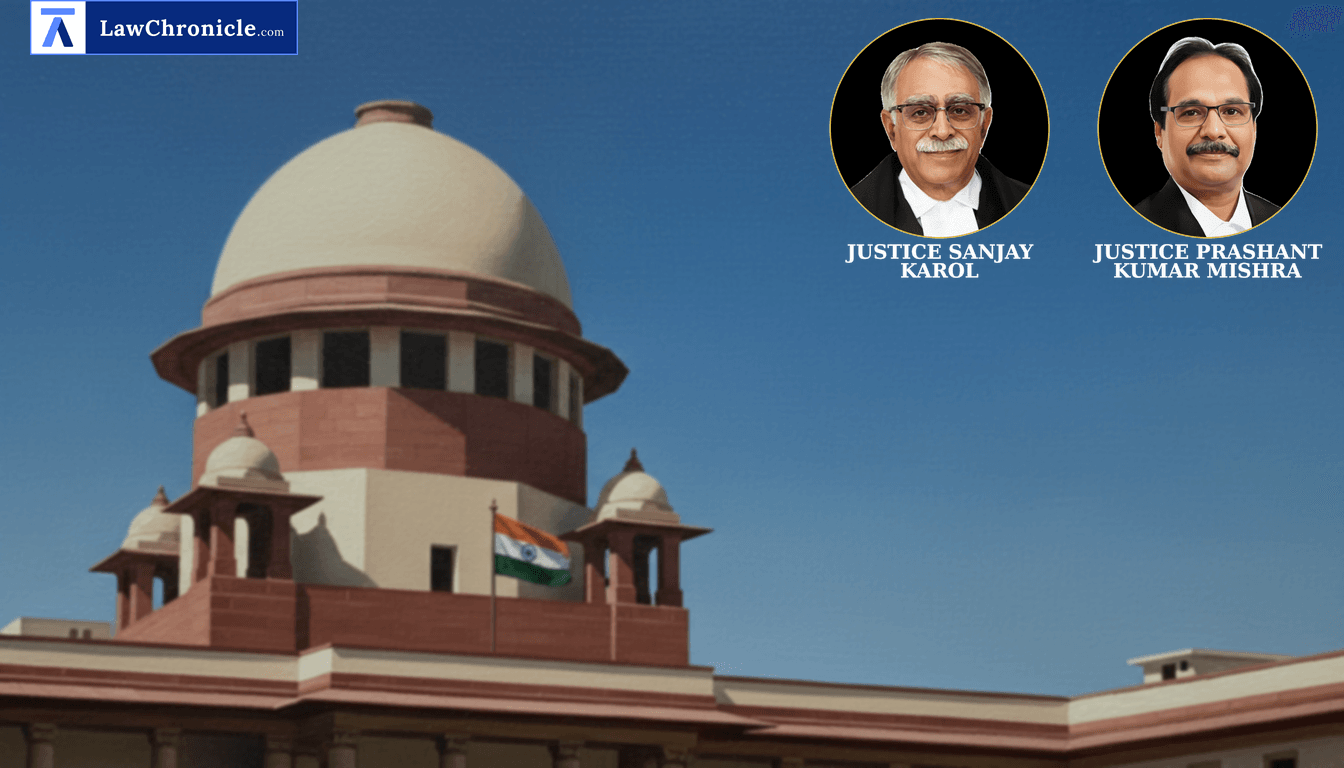
In a significant ruling aimed at curbing female foeticide, the Supreme Court emphasized that strict adherence to record-keeping under the Pre-Conception and Pre-Natal Diagnostic Techniques (Prohibition of Sex Selection) Act, 1994 is mandatory, as any inaccuracy serves as a 'springboard' for sex selection. A bench comprising Justice Sanjay Karol and Justice Prashant Kumar Mishra heard the appeal challenging the criminal proceedings initiated against a medical practitioner for alleged violations of statutory documentation requirements.
Integrity of Form ‘F’ and Judicial Rationale
While delivering the judgment, the Court highlighted that the objective of the Pre-Conception and Pre-Natal Diagnostic Techniques (Prohibition of Sex Selection) Act, 1994 is to ensure every woman can experience the joy of motherhood without the shadow of gender bias. The Court, in its reasoning, observed: "Non-maintenance of record is springboard for commission of offence of foeticide, not just a clerical error. In order to effectively implement the various provisions of the Act, the detailed forms in which records have to be maintained have been provided for by the Rules. These Rules are necessary for the implementation of the Act and improper maintenance of such record amounts to violation of provisions of Sections 5 and 6 of the Act, by virtue of proviso to Section 4(3) of the Act."
Referring to the historical context and the social menace of declining sex ratios, the Court relied on the principles established in Voluntary Health Assn. of Punjab v. Union of India ( "(2013) 4 SCC 1": 2013 CaseBase(SC) 223), noting that female foeticide crucifies the woman of the future. The bench further cited Federation of Obstetrics & Gynaecological Societies of India v. Union of India ( "(2019) 6 SCC 283": 2019 CaseBase(SC) 1444) to reiterate that the contents of Form ‘F’ are mandatory and cannot be read down as mere technicalities.
Observations on Declining Sex Ratios and State Policy
The Court took judicial notice of national surveys and global reports, observing that while the national sex ratio has shown signs of improvement, the progress remains uneven. The bench noted that continued efforts through various government schemes like 'Beti Bachao Beti Padhao' and 'Janani Suraksha Yojana' are essential to counter deep-seated patriarchal preferences. The Court remarked that till a widespread change in mentality occurs, the strict enforcement of the Pre-Conception and Pre-Natal Diagnostic Techniques (Prohibition of Sex Selection) Act, 1994 remains indispensable.
Background:
The case originated when authorities conducted a search at the appellant’s sonography center, leading to the seizure of equipment and the issuance of a notice under Section 20(1) of the Pre-Conception and Pre-Natal Diagnostic Techniques (Prohibition of Sex Selection) Act, 1994. An Advisory Committee concluded that prima facie violations existed regarding the maintenance of records, specifically in Form ‘F’. The appellant challenged the cognizance taken by the Judicial Magistrate First Class, Ardhapur, under Section 23 of the Act for violating Sections 4(3), 5, 6, and 29 of the Pre-Conception and Pre-Natal Diagnostic Techniques (Prohibition of Sex Selection) Act, 1994 along with Rules 9, 8(5), and 18(9) of the Pre-Conception and Pre-Natal Diagnostic Techniques (Prohibition of Sex Selection) Rules, 1996.
The appellant’s primary contentions were that the Civil Surgeon was not the 'Appropriate Authority' and that the blanks in Form ‘F’ were merely technical, inadvertent errors. However, both the Revisional Court and the High Court of Judicature at Bombay, Aurangabad Bench, rejected these arguments. The High Court held that the District Civil Surgeon was duly notified as the competent authority and that whether the record lapses were intentional was a matter for trial. The Supreme Court upheld this view, dismissing the appeal and affirming that technical errors in such a critical statute cannot be overlooked.
Case Details:
Case No.: Criminal Appeal No. of 2026 (Arising out of SLP (Crl.) No. 9574 of 2018)
NeutralCitation: 2026 INSC 635
Case Title: Dr. Ramesh v. State of Maharashtra & Anr.
Source: 2026 CaseBase(SC) 565
 Breaking News