


Insurer Not Liable For Statutory Penalty Under Employees Compensation Act: Himachal Pradesh HC
 Copy Link
 Share
 Save
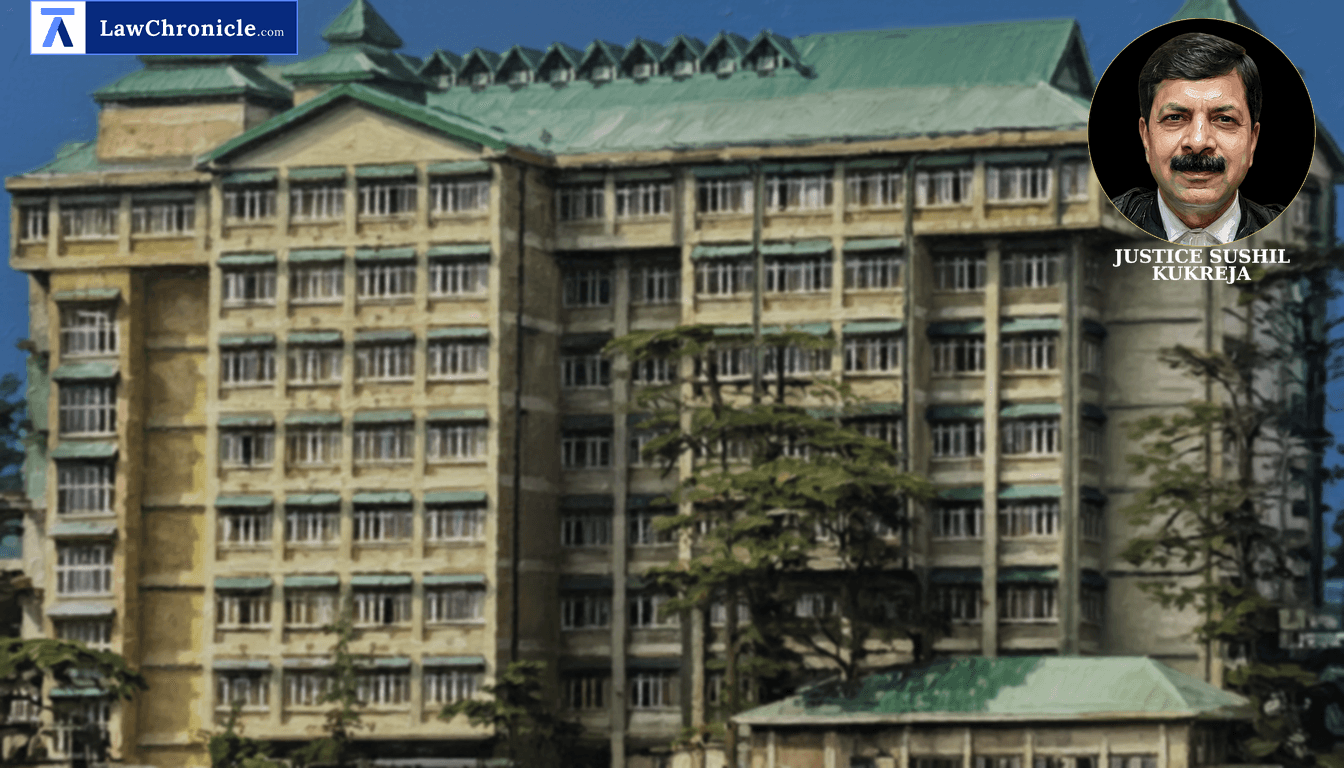
In a decisive clarification of liability under social security laws, the Himachal Pradesh High Court has ruled that insurance companies cannot be held responsible for paying penalties arising from an employer's default, shift the financial burden of statutory non-compliance solely onto the insured employer. The judgment reinforces the principle that while insurers must cover the principal compensation and interest, the punitive consequences of delayed payments under the Employees Compensation Act, 1923 remain a personal liability of the employer.
Justice Sushil Kukreja, presiding over the Shimla bench, adjudicated upon two cross-appeals arising from an order passed by the Commissioner under the Employees Compensation Act, 1923, Anni. The Court was tasked with determining the extent of an insurer's liability regarding penalties and the appropriate quantum of compensation for the family of a deceased driver.
Key Takeaways
Insurer Exonerated from Penalty
Insurance companies are only liable for the principal compensation and interest; statutory penalties for payment defaults must be borne exclusively by the employer.
Statutory Interest vs. Punitive Penalty
Following settled legal precedents, the Court distinguished between 'interest' as a compensatory element and 'penalty' as a punitive measure for delayed discharge of statutory duties.
Enhanced Compensation via Consensus
Through a consensus-driven approach at the admission stage, the Court revised the monthly income and calculation metrics, leading to a substantial enhancement in the total compensation payable to the claimants.
Insurer Liability Limited to Principal and Interest
The Court closely examined the interplay between Section 3 and Section 4-A of the Employees Compensation Act, 1923. While the Commissioner had originally directed the insurance company to pay 50% of the awarded amount as a penalty, the High Court set this aside, placing the liability on the employer. The Court, in its reasoning, observed: "In Ved Prakash Garg vs. Premi Devi & others ( "(1997) 8 SCC 1": 1997 CaseBase(SC) 257), the Hon’ble Apex Court observed that the insurance company is liable to pay not only the principal amount of compensation payable by insured employer but also interest thereon, if ordered by the Commissioner to be paid by the insured employer. On conjoint operation of Sections 3 and 4A (3)(a) of the Act, insurance company is liable to meet claim for compensation along with interest as imposed on insured employer by the Act. It has, however, been held that it was the liability of the insured employer alone in respect of additional amount of compensation by way of penalty under Section 4-A(3)(b) of the Act."
The Court has following directions:
"The impugned award dated 22.08.2024, passed by the learned Commissioner below is modified to the extent that the petitioners (appellants in FAO(MV) No.167 of 2025) herein) are held entitled to the total compensation in the sum of Rs.14,84,733/-. The entire awarded amount except the penalty amount shall be paid by the appellant-Insurance Company. The insurance company is exonerated from paying the amount of penalty, which shall be paid by employer/ respondent No.2."
Ratio
The liability of an insurance company under the Employees Compensation Act, 1923 is restricted to the principal compensation amount and the interest accrued thereon. An insurer is not liable to reimburse or pay the additional amount of compensation imposed by way of penalty under Section 4-A(3)(b) of the Act, as such penalty is a consequence of the employer’s personal failure to fulfil statutory obligations.
Background
The case originated from a fatal motor accident on January 20, 2020, involving an Alto car. The deceased, Ten Singh, who was employed as a driver by one Anoop Ram, died on the spot along with the owner. The legal heirs of the deceased filed a petition for compensation under Section 22 of the Employees Compensation Act, 1923. The Commissioner at Anni initially awarded compensation with 12% interest and a 50% penalty, holding the insurance company liable for the total amount.
Both the claimants (seeking enhancement) and the Tata AIG General Insurance Company (challenging the award) moved the High Court. During the proceedings, the parties reached a consensus to take the deceased's monthly income as Rs. 8,000/-. Relying on Ved Prakash Garg vs. Premi Devi & others ( "(1997) 8 SCC 1": 1997 CaseBase(SC) 257), the Court reduced the penalty to 20% of the awarded amount and shifted the burden of its payment from the insurance company to the employer, Kala Devi.
Case Details:
Case No.: FAOs No.167 & 179 of 2025
Neutral Citation: 2026:HHC:37755
Case Title: Anjali Devi & others Vs. Tata AIG General Insurance & another
Appearances:
For the Petitioner(s): Mr. Naresh Sharma, Advocate (in FAO 167/2025); Mr. Jagdish Thakur, Advocate (in FAO 179/2025)
For the Respondent(s): Mr. Jagdish Thakur, Advocate for R-1; Mr. Dheeraj K. Verma, Advocate for R-2 (in FAO 167/2025)
Source: 2026 CaseBase(HP) 7991
Similar Articles

 Breaking News


