

Intra-Court Appeal Lies Against Single Judge Contempt Orders: Supreme Court
 Copy Link
 Share
Share Save
Save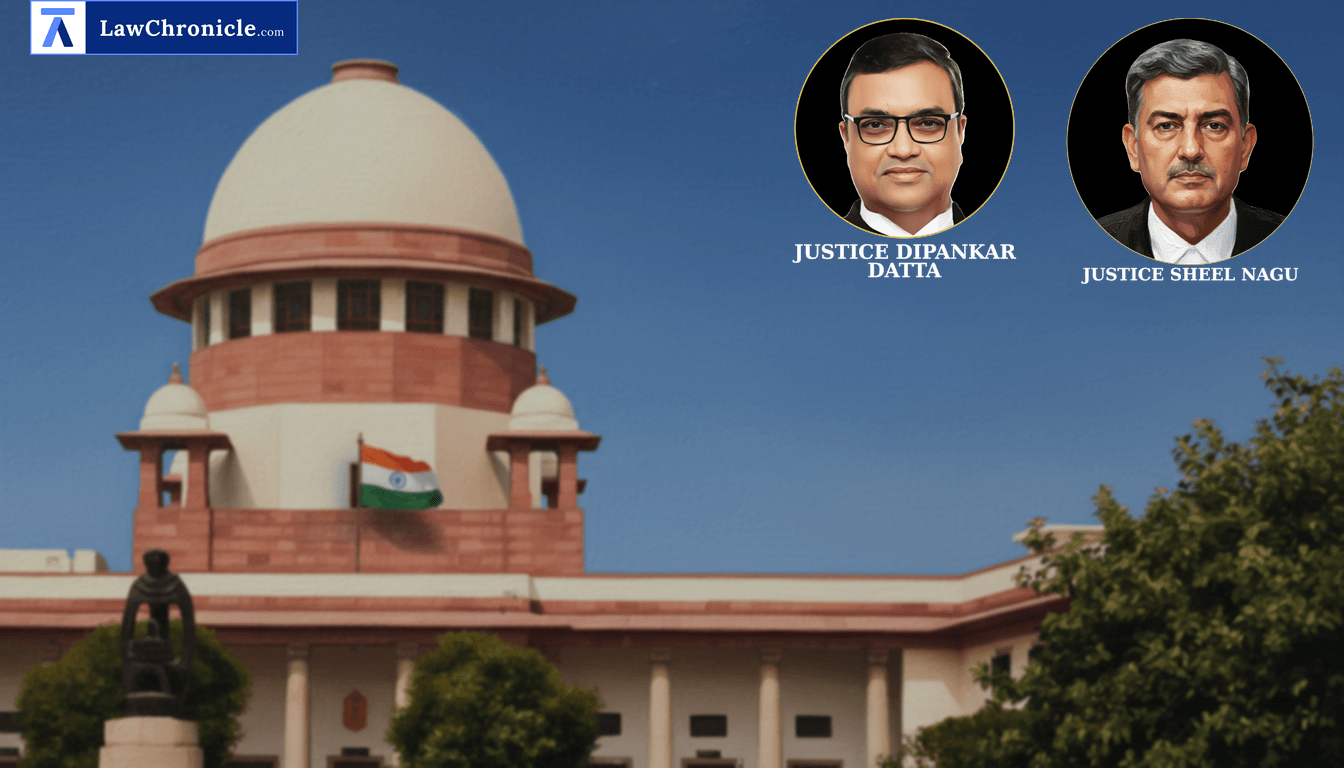
Expanding the procedural safeguards for litigants facing contempt proceedings, the Supreme Court has ruled that intra-court appeals remain maintainable against Single Judge interlocutory orders that travel beyond the original dispute or decide substantive rights. The Apex Court also questioned the precedent barring intra-court appeals in writ matters with a criminal substratum, referring the issue to a larger bench to preserve constitutional access to justice.
A bench comprising Justice Dipankar Datta and Justice Sheel Nagu adjudicated an appeal challenging an interim order passed by a Single Judge of the Allahabad High Court in a pending contempt application. The High Court had rejected a compliance affidavit filed by state authorities and directed the personal appearance of the officer for framing charges.
Key Takeaways
- Maintainability of Intra-Court Appeals: Litigants can file a Special Appeal against Single Judge interlocutory orders in contempt petitions if the court adjudicates on the merits of the main dispute or determines substantive rights.
- Scope of Civil Contempt Jurisdiction: Proceedings for civil contempt under Article 215 of the Constitution of India, 1950 are sui generis special civil proceedings, not an exercise of ordinary criminal jurisdiction.
- Precedent Referred to Larger Bench: The court expressed doubt regarding the correctness of Ram Kishan Fauji v. State of Haryana ( "(2017) 5 SCC 533": 2017 CaseBase(SC) 91), referring to a larger bench the question of whether writ petitions touching upon criminal elements lose their intra-court appeal remedy.
Court Observations and Directions
Summarizing the core legal position on when a Single Judge order in a contempt application can be challenged, the apex court clarified that an intra-court appeal lies where the court travels beyond the parent order or determines disputed questions of law and fact.
In analyzing whether civil contempt proceedings amount to criminal jurisdiction barring intra-court appeals under High Court rules, the Apex Court, in its reasoning, observed:
"...since proceedings for ‘civil contempt’ are not resolved in exercise of ‘criminal jurisdiction’, the precedents holding to the contrary may no longer be good law... Contempt jurisdiction being sui generis, in our considered view, any attempt to compartmentalise it into rigid procedural categories for the purpose of determining the availability of an intra-court appeal must be eschewed."
Ratio
Civil contempt proceedings under Article 215 of the Constitution of India, 1950 constitute a sui generis special civil jurisdiction rather than an exercise of criminal jurisdiction. Consequently, an intra-court appeal lies against an order of a Single Judge passed in a civil contempt petition, prior to the actual imposition of punishment, if the order determines substantive rights, decides the merits of the underlying dispute, or issues directions beyond the parent judgment.
Background
The dispute originated when respondents filed a writ petition seeking recruitment to the post of Assistant Prosecution Officers. The writ court directed the consideration of their candidature. Pursuant to this, the appellant rejected their candidature vide an order dated 2nd September 2026. Alleging contempt, the respondents approached the High Court. The Single Judge rejected the compliance affidavit and ordered the personal appearance of the officer to frame charges.
Aggrieved, the appellant approached the Supreme Court under Article 136 of the Constitution of India, 1950, contending that no Special Appeal lay under Rule 5 of Chapter VIII of the Allahabad High Court Rules, 1952 against contempt proceedings. The appellant relied upon J.S. Parihar v. Ganpat Duggar ( "(1996) 6 SCC 291": 1996 CaseBase(SC) 1680) and Lalith Mathur v. L. Maheswara Rao to argue that contempt courts cannot review the validity of compliance orders, as well as Niaz Mohd. v. State of Haryana ( "(1994) 6 SCC 332": 1994 CaseBase(SC) 58), Kapildeo Prasad Sah v. State of Bihar ( "(1999) 7 SCC 569": 1999 CaseBase(SC) 125), and Ashok Paper Kamgar Union v. Dharam Godha regarding wilful disobedience.
Addressing maintainability, the Supreme Court examined Midnapore Peoples' Coop. Bank Ltd. v. Chunilal Nanda ( "2006 (5) SCC 399": 2006 CaseBase(SC) 1231) and Ajay Kumar Bhalla v. Prakash Kumar Dixit ( "2024 (12) SCC 159": 2024 CaseBase(SC) 382), reiterating that directions issued on the merits of a dispute in contempt proceedings are amenable to intra-court appeals if permitted by High Court rules. The Bench also referred to S.A.L. Narayan Row v. Ishwarlal Bhagwandas ( "AIR 1965 SC 1818": 1965 CaseBase(SC) 185), P. Mohanraj v. Shah Bros. Ispat (P) Ltd. ( "(2021) 6 SCC 258": 2021 CaseBase(SC) 891), and U.N. Bora v. Assam Roller Flour Mills Assn. ( "(2022) 1 SCC 101": 2021 CaseBase(SC) 1199) to explain the distinct nature of civil contempt, distinguished High Court of Judicature at Allahabad v. Raj Kishore Yadav, and aligned its interpretation of High Court rules with Sheet Gupta v. State of U.P. and Abhishek Gupta v. Dinesh Kumar ( "2025 SCC OnLine SC 2739": 2025 CaseBase(SC) 1435), while noting the High Court's view in Subhash Chandra v. Srikant Goswami. The Supreme Court observed that precedents such as Hub Lal Yadav v. Mahendra and Jagdamba Prasad v. Balgovind holding contempt to be purely criminal jurisdiction were no longer sound.
Furthermore, the Bench critically analyzed Ram Kishan Fauji v. State of Haryana ( "(2017) 5 SCC 533": 2017 CaseBase(SC) 91), which barred intra-court appeals under the Letters Patent in writ matters emanating from a criminal substratum. Citing Vinita M. Khanolkar v. Pragna M. Pai ( "(1998) 1 SCC 500": 1997 CaseBase(SC) 323), Hari Vishnu Kamath v. Ahmad Ishaque ( "(1954) 2 SCC 881": 1954 CaseBase(SC) 122), Pritam Singh v. State ( "AIR 1950 SC 169": 1950 CaseBase(SC) 35), and the constitutional guarantee of access to justice in Anita Kushwaha v. Pushap Sudan ( "(2016) 8 SCC 509": 2016 CaseBase(SC) 448), the Bench held that writ jurisdiction under Article 226 is sui generis and cannot be compartmentalized into ordinary criminal jurisdiction. Consequently, the Supreme Court referred the ratio of Ram Kishan Fauji v. State of Haryana ( "(2017) 5 SCC 533": 2017 CaseBase(SC) 91) for reconsideration by a larger bench, while permitting the appellant to file a Special Appeal before the High Court within two weeks.
Case Details:
Case No.: Civil Appeal No. of 2026 [Arising out of SLP (C) No. 33319 of 2026]
Neutral Citation: 2026 INSC 1128
Case Title: Sanjay Prasad v. Madhusudan Dwivedi & Ors.
Source: 2026 CaseBase(SC) 8268
 Breaking News