Is Right to Protest a Fundamental Right? Find Out
 Copy Link
 Share
Share Save
Save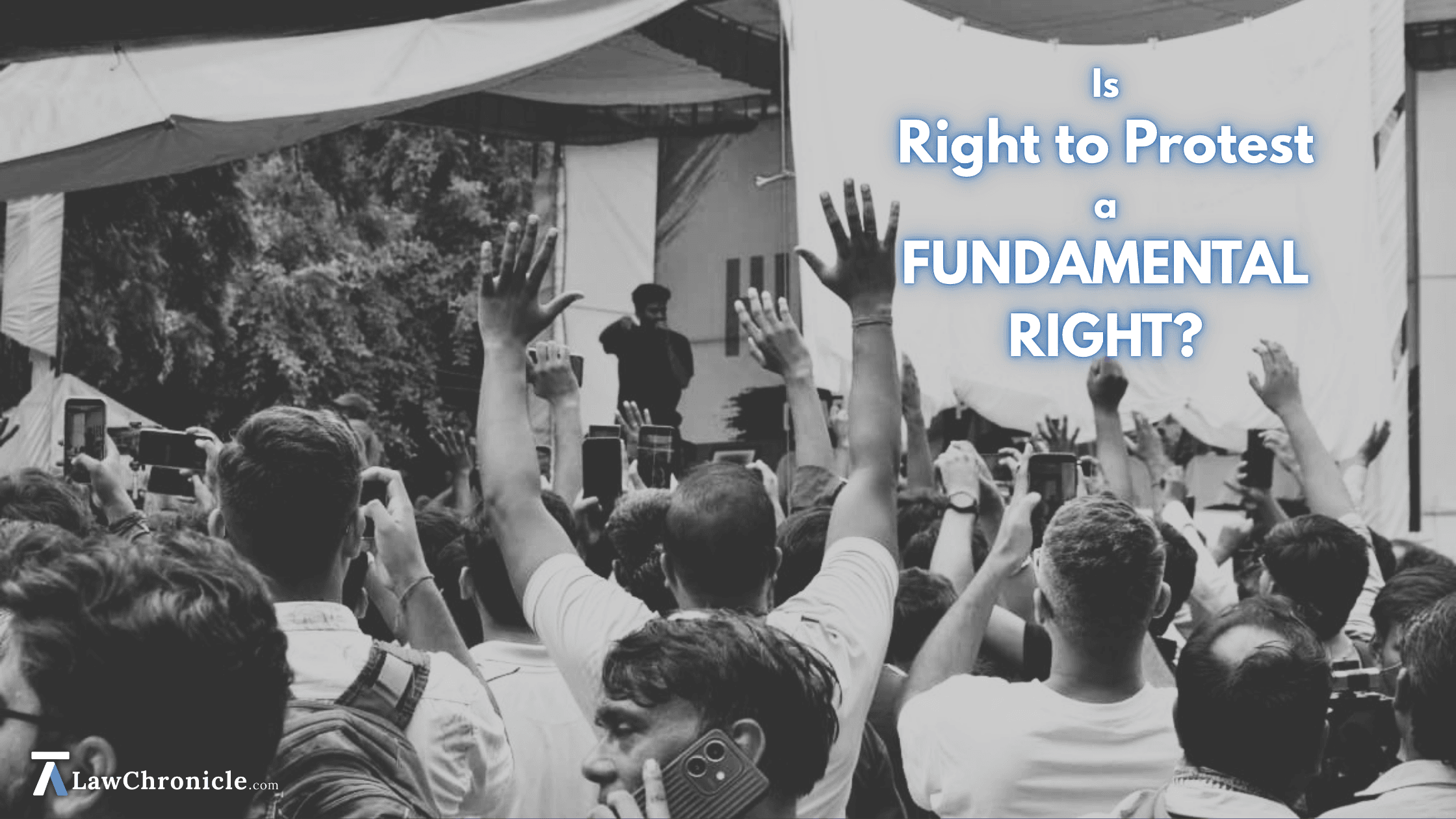
Every few months, India watches a new protest take shape. Whether it is farmers on the highways, workers outside factory gates, or students at Jantar Mantar. It naturally raises the question: does the Constitution actually protect the right to protest, or is it just something authorities tolerate until they don't? Is right to protest a fundamental right? The short answer to this fundamental query is that right to protest is a fundamental right in India. However, it is not absolute but comes with certain limits. Here's the complete legal picture of protests in India.
Right to Protest Under Article 19
The Indian Constitution does not use the word "protest" anywhere in its text. Instead, the right flows from two provisions of Article 19(1) of the Constitution:
- Article 19(1)(a): The right to freedom of speech and expression, which covers raising slogans, holding placards, and voicing dissent.
- Article 19(1)(b): The right to assemble peaceably and without arms, which covers the act of gathering as a group to demonstrate.
Read together, the two clauses form the constitutional foundation for peaceful protest in India. Courts have repeatedly held that dissent and democracy go hand in hand, and that citizens cannot be silenced simply because their views are inconvenient to those in power. However, neither clause is absolute, and both are expressly "subject to reasonable restrictions" under Article 19(2) and 19(3).
Protest Is a Fundamental Right, But Not Absolute One
Yes, the right to protest is a fundamental right in India. It is recognized as flowing directly from Articles 19(1)(a) and 19(1)(b), and courts have consistently affirmed that peaceful assembly and dissent are essential features of a functioning democracy. But being a fundamental right does not mean being an unrestricted one.
Similar to the right to free speech itself, the right to protest can be regulated. Not banned outright, but shaped by conditions of time, place, and manner, to protect public order and the rights of others.
Right to Protest: Key Supreme Court Judgments
Indian courts have shaped the contours of this right to protest as a fundamental right through several landmark judgments:
Ramlila Maidan Incident v. Union of India (2012 CaseBase(SC) 745)
This case arose from the midnight police crackdown on Baba Ramdev's supporters at Ramlila Maidan, Delhi. The Supreme Court held that citizens have a fundamental right of peaceful assembly and protest that cannot be taken away by arbitrary executive or legislative action. The Apex Court had also criticized the manner in which the assembly had been dispersed.
Mazdoor Kisan Shakti Sangathan v. Union of India (2018 CaseBase(SC) 1038)
This dispute concerned repeated prohibitory orders and a National Green Tribunal ban on demonstrations at Jantar Mantar Road, a traditional protest site near Parliament. The Supreme Court upheld the fundamental right to peaceful assembly under Article 19(1)(b), set aside the blanket ban, and directed the Delhi Police to frame clear, objective guidelines for regulating, not prohibiting, protests in the area.
Amit Sahni v. Commissioner of Police (Shaheen Bagh case, 2020 CaseBase(SC) 550)
Delivered in the aftermath of the Shaheen Bagh protest against the Citizenship (Amendment) Act, this Supreme Court judgment drew a sharp line between the right to protest and the right of the public to unobstructed movement. The Court held that while dissent is protected, an indefinite occupation of a public road causing continuous inconvenience to commuters could not be treated as an acceptable form of protest. The Court observed that demonstrations expressing dissent must be confined to designated spaces.
Is the Right to Protest a Human Right?
Beyond domestic constitutional law, the right to peaceful protest is internationally recognized as a human right. Article 20 of the Universal Declaration of Human Rights (UDHR) protects the right to peaceful assembly. Article 21 of the International Covenant on Civil and Political Rights (ICCPR), to which India is a signatory, guarantees the right of peaceful assembly subject only to restrictions that are necessary in a democratic society. UN human rights bodies have consistently treated the freedom to assemble and protest as inseparable from freedom of expression and association. So, while Indian law frames it as a fundamental right under the Constitution, the same conduct is simultaneously protected as a human right on the international stage, reinforcing that protest is not a favour granted by the State, but an entitlement owed to citizens.
Restrictions on the Right to Protest
Article 19(2) and 19(3) allow the State to impose "reasonable restrictions" on speech and assembly on specific grounds, including:
- Sovereignty and integrity of India
- Security of the State
- Public order
- Decency or morality
- Contempt of court, defamation, or incitement to an offence
In practice, these restrictions are enforced through tools such as Section 144 of the erstwhile Code of Criminal Procedure (now Section 163 of the Bharatiya Nagarik Suraksha Sanhita, 2023), which allows a magistrate to prohibit assemblies in a given area to prevent disturbances, and permission requirements imposed by local police for public gatherings. Courts have repeatedly cautioned that such restrictions must be reasonable, proportionate, and not used as a blanket tool to suppress dissent; arbitrary or indefinite bans have been struck down, as seen in the Mazdoor Kisan Shakti Sangathan ruling.
When Does Protesting Become Illegal?
A protest can cross the line from a constitutionally protected activity into an unlawful act in several situations:
- Violence or use of arms: Article 19(1)(b) protects only assembly "peaceably and without arms", any resort to violence, vandalism, or weapons takes the gathering outside constitutional protection.
- Unlawful assembly under the Bharatiya Nyaya Sanhita: a gathering of five or more persons with a common object to commit an offence, resist law enforcement, or forcibly seize property can be treated as an unlawful assembly, inviting penal consequences.
- Violation of prohibitory orders: continuing to assemble after a valid Section 163 BNSS order (or its predecessor, Section 144 CrPC) has been imposed in the area.
- Indefinite obstruction of public spaces: as clarified in the Shaheen Bagh ruling, permanently blocking roads, highways, or essential public infrastructure exceeds the protection available for peaceful dissent.
- Incitement or hate speech: slogans or speech that incite violence, hatred, or public disorder are not shielded merely because they occur during a protest.
In short, the right to protest protects the peaceful, disciplined expression of dissent, not disruption for its own sake.
Why Is Protesting Important to Democracy?
Protest functions as a safety valve in any democratic system. Elections happen once every few years, but the concerns of citizens do not wait that long, protest gives people a way to be heard in the interim, whether the issue is a new law, a price rise, or a local grievance. Courts have repeatedly traced this right back to India's freedom struggle, where satyagraha and civil disobedience were themselves forms of protest that shaped the nation's constitutional values. A functioning democracy needs dissent as much as it needs consensus: it tests government decisions, surfaces the concerns of those without institutional power, and keeps the space between elections accountable rather than silent. That is precisely why the Constitution protects it, not as a concession, but as a structural feature of self-governance.
Right to Protest IS a FUNDAMENTAL RIGHT
The right to protest in India is unambiguously a fundamental right, rooted in Articles 19(1)(a) and 19(1)(b) of the Constitution and echoed in international human rights law. But it is a qualified right, one that Indian courts have consistently balanced against public order, the rights of others, and the practical realities of shared public spaces. Knowing where that line sits is what separates constitutionally protected dissent from conduct; the law will not protect.
 Breaking News