Justice BV Nagarathna: Famous Judgments, Bold Dissents and Road to First Woman CJI
 Copy Link
 Share
Share Save
Save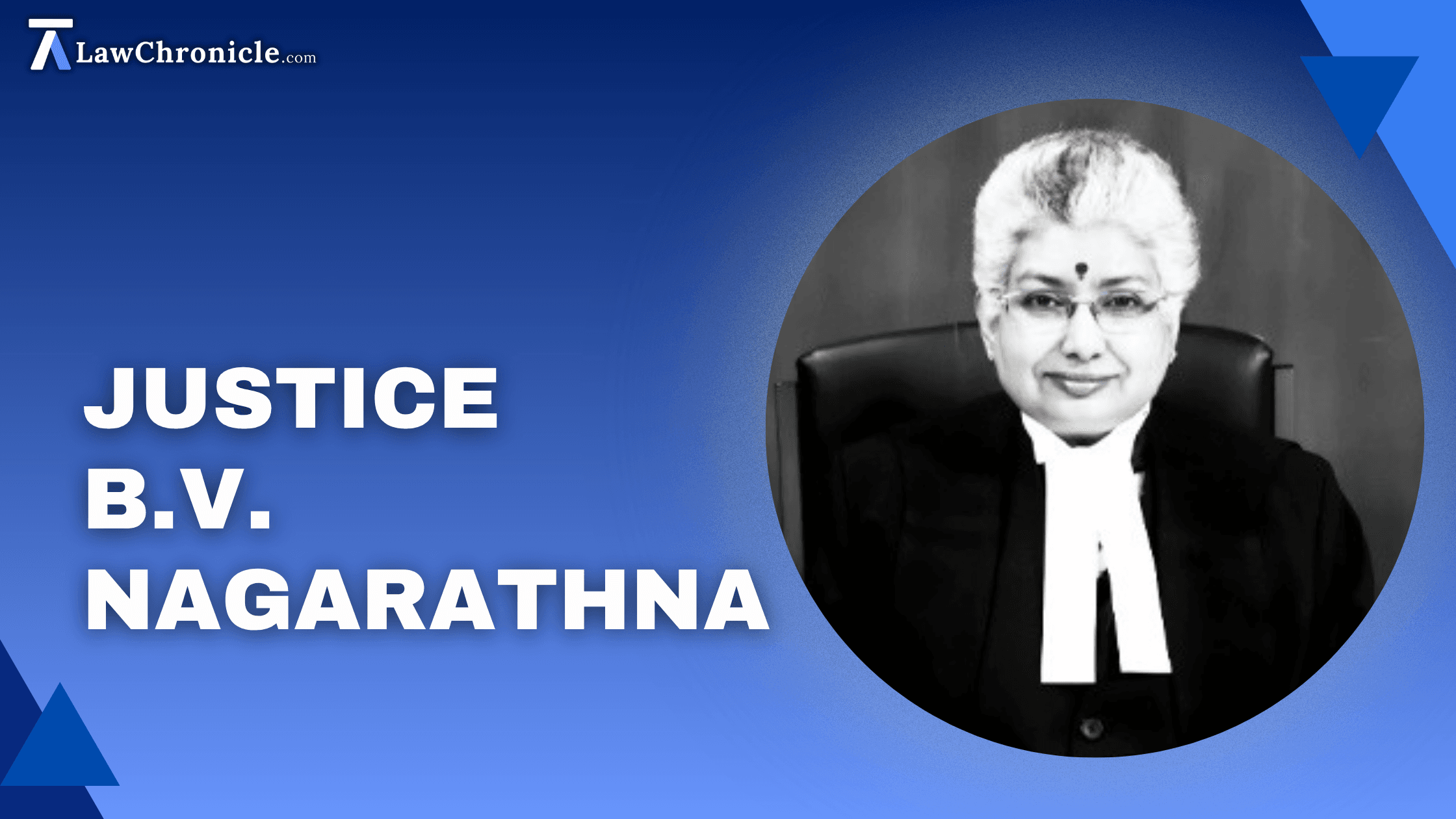
Justice Bangalore Venkataramiah Nagarathna, more famous as Justice BV Nagarathna, is a sitting judge of the Supreme Court of India, in office since 31st August 2021. Following the principle of seniority, Justice Nagarathna is expected to become India's first woman Chief Justice in 2027.
She earlier served as a judge of the Karnataka High Court between 2008 and 2021. She was elevated to the Supreme Court of India along with eight other judges following a collegium recommendation in August 2021. Justice BV Nagarathna is an inspiration for all, and this article seeks to throw some light upon her journey of being a Karnataka girl who climbed the judicial ladder, while the rest of us hold our breaths to witness her becoming the Chief Justice of India.
Early Life and Education
Justice BV Nagarathna was born on 30th October 1962 in Bengaluru, Karnataka. She is the daughter of Justice E.S. Venkataramiah, who served as the 19th Chief Justice of India between June and December 1989.
She received her schooling at Sophia High School, Bangalore, and later at Bharatiya Vidya Bhavan, New Delhi. She went on to complete her Bachelor of Arts (Honours) in History in 1984 from Jesus and Mary College, Delhi University. She subsequently obtained her law degree (LL.B.) from the Campus Law Centre, Faculty of Law, University of Delhi, and graduated in July 1987.
Legal Career
Justice Nagarathna enrolled with the Bar Council of Karnataka on 28th October 1987 and began her legal practice at KESVY & Co., Advocates, in Bengaluru. After working there for about seven years, she started an independent practice in July 1994, which she continued until her elevation to the Karnataka High Court in 2008.
As a practicing advocate, she handled a wide range of matters, including administrative law, constitutional law, commercial law, family law, insurance law, service law, land and rent laws, contracts, and arbitration and conciliation. She frequently represented the Karnataka State Legal Services Authority and the High Court Legal Services Committee, and was also appointed amicus curiae in certain cases.
She was appointed as an Additional Judge of the Karnataka High Court on 18th February 2008, and became a Permanent Judge on 17th February 2010. During her tenure at the Karnataka High Court, she also served as President of the Karnataka Judicial Academy and President of the Bangalore Mediation Centre, Bengaluru. Over her thirteen-year term at the Karnataka High Court, she disposed of over 23,000 cases.
She contributed a chapter on the Courts of Karnataka to the book “Courts of India”, published by the Supreme Court of India, and later chaired the committee responsible for its Kannada translation, which was released in April 2021.
The 2009 Detention Incident
In November 2009, Justice Nagarathna, then a judge of the Karnataka High Court, along with Justice Venkate Gopala Gowda and the then Chief Justice of the Karnataka High Court, P.D. Dinakaran, was forcibly detained within the High Court premises by a group of protesting lawyers. The incident followed a boycott of courts declared by a lawyers' association, which was protesting allegations of corruption against Justice Dinakaran. The judges were later released by the protesting lawyers.
Following the incident, Justice Nagarathna publicly stated, "We cannot be cowed down like this. We have taken the oath of the Constitution."
Elevation to the Supreme Court
On 17th August 2021, the Supreme Court Collegium, then headed by Chief Justice N.V. Ramana, recommended Justice Nagarathna's name along with those of eight other judges for elevation to the Supreme Court. She was appointed a Judge of the Supreme Court of India on 26th August 2021 and took oath on 31st August 2021. She was appointed alongside Justice Hima Kohli and Justice Bela M. Trivedi, the largest cohort of women judges ever appointed to the Supreme Court at the same time.
Justice BV Nagarathna Famous Judgments
While serving at the Supreme Court and the Karnataka High Court, Justice Nagarathna has authored a significant number of judgments across constitutional, criminal, civil, tax, and service law. Some of the most discussed judgments by Justice BV Nagarathna include:
Vivek Narayan Sharma v. Union of India (2023)
Justice Nagarathna was the sole dissenting judge in a 4:1 majority decision by the Constitution Bench that examined the legality of demonetization by the Union government in 2016. While the majority upheld demonetization, she held that the measure, though well-intentioned, could not lawfully have been carried out merely through a gazette notification. She clarified that her disagreement was confined to legal grounds rather than the objectives behind the policy.
Mineral Area Development Authority v. Steel Authority of India (2024)
Through a nine-judge Constitution Bench ruling on whether royalty paid by mining operators amounts to a tax, Justice Nagarathna dissented from the 8:1 majority, holding that royalty under the Mines and Minerals (Development and Regulation) Act, 1957, is in the nature of a tax, and that States lack legislative competence to impose additional levies on mineral rights beyond this framework.
State of U.P. v. Lalta Prasad Vaish (2024)
On the related nine-judge Bench question of States' power to regulate industrial alcohol, Justice Nagarathna was again the lone dissenting voice in an 8:1 verdict, taking the view that the misuse of industrial alcohol as intoxicating liquor could also be regulated by State legislatures.
Property Owners Association v. State of Maharashtra (2024)
As part of the nine-judge Bench that examined whether private property can be treated as a 'material resource of the community' under Article 39(b) of the Constitution, Justice Nagarathna joined the majority view, delivered by Chief Justice D.Y. Chandrachud, holding that all private properties cannot automatically be classified as such resources.
Bilkis Yakub Rasool v. Union of India (2024)
Authoring the judgment for a division Bench with Justice Ujjal Bhuyan, Justice Nagarathna struck down the Gujarat government's remission granted to eleven convicts in the Bilkis Bano gangrape case. It was held that Gujarat was not the appropriate government to grant remission, since the conviction had been handed down by a Special Court in Maharashtra.
Kaushal Kishor v. State of Uttar Pradesh (2023)
Through a five-judge Constitution Bench examining free-speech restrictions on public functionaries, Justice Nagarathna wrote a separate opinion offering a different perspective on certain issues, while agreeing with the majority's reasoning on others, in a case arising from remarks made by a Samajwadi Party leader concerning the Bulandshahr gang-rape case.
Neeraj Dutta v. State (Govt. of NCT of Delhi) (2023)
Justice BV Nagarathna authored the unanimous opinion holding that a public servant can be convicted of bribery under the Prevention of Corruption Act, 1988, on the basis of circumstantial evidence, even without direct evidence such as a tainted currency-note recovery.
Justice BV Nagarathna’s Karnataka HC landmark Cases
- During her tenure at the Karnataka High Court, Justice BV Nagarathna was part of a bench in Advocates Association Bangalore v. Union of India (2012), called on the Union government to examine regulation of broadcast media in India in light of rising concerns over fake news, while also cautioning against excessive government control and favouring self-regulation by the industry.
- In State of Karnataka & Others v. Jagadev Biradar (2016), Justice BV Nagarathna ruled that Karnataka's 'lifetime tax' on vehicles purchased outside the state was unconstitutional
- In Shri Mookambika Temple v. Raviraja Shetty (2019), she was part of a bench that held temples are not commercial institutions for the purposes of gratuity-related labour laws.
Justice BV Nagarathna's Chances of Becoming Upcoming Chief Justice
Justice Nagarathna's career has attracted particular attention because, if the convention of seniority in appointing the Chief Justice of India is followed, she is set to become the 54th Chief Justice of India on 25 September 2027. With that, she would become the first woman to hold the office of Chief Justice of India. However, her tenure would be a brief one, spanning around 36 days, since her own retirement from the Supreme Court is due on 29th October 2027.
Commentators had flagged this possibility as early as May 2020, when her potential elevation to the Supreme Court was first reported, with several noting that it would place her in line to become the first female Chief Justice of India. Her appointment to the Supreme Court in August 2021 reinforced this trajectory. If she does assume the office in 2027, it would also make her and her father, former Chief Justice E.S. Venkataramiah, the first father-daughter duo to have both served as Chief Justice of India, while already having served as the first father-daughter duo to have both served as judges of the Supreme Court of India.
Personal Life
As already discussed, Justice Nagarathna's father, E.S. Venkataramiah, served as the 19th Chief Justice of India in 1989. She is married to B.N. Gopala Krishna who is practicing as an Advocate before the Karnataka High Court.
 Breaking News