


Karnataka HC: Companies Cannot Hide Behind Recategorized Directors To Escape Tender Disqualifications
 Copy Link
 Share
 Save
The Karnataka High Court has fortified the power of state instrumentalities to look beyond corporate veils in public procurement, ruling that a company remains ineligible for tenders if its de facto promoters are financial defaulters, regardless of recent technical redesignations as 'professional directors'. This decision reinforces that creditworthiness in commercial contracts is a substance-over-form enquiry, preventing entities from circumventing integrity clauses through superficial board restructurings.
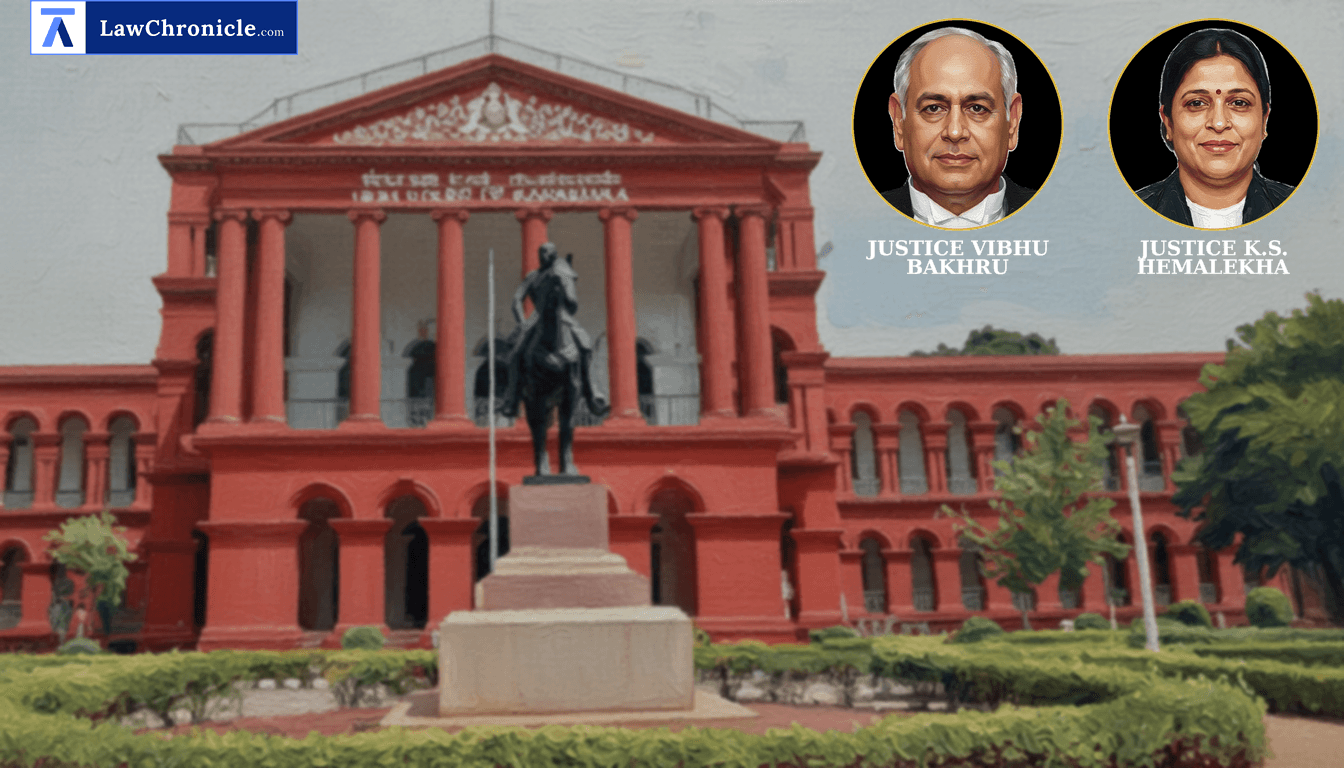
A bench of Chief Justice Vibhu Bakhru and Justice K.S. Hemalekha dismissed an appeal filed by Manipal Technologies Limited against a single-judge order that declined to stay its disqualification from a Bank of Baroda tender. The dispute arose when the bank excluded the company based on a negative credit history associated with one of its long-standing directors.
The Intersection of Corporate Control and Tender Eligibility
The Court scrutinized the disqualification of the appellant under the Companies Act, 2013-governed tender for printing self-service passbooks. The bank had invoked a specific eligibility clause Point No. 14 which barred companies whose promoters or directors were willful defaulters or had accounts classified as Non-Performing Assets (NPA). The appellant argued that the concerned director had been recategorized as a 'Professional Director' just before the bid submission, thus insulating the company from his individual financial defaults.
Rejecting this technicality, the Court held that the commercial identity of a closely held company is inextricably linked to the persons in control. The Court, in its reasoning, observed: "A company is not a natural person capable of directing its own affairs; its affairs are managed and controlled by its directors, and their standing and credibility are thus relevant in assessing the company’s credentials. Whilst, in the legal sense, a company has an identity separate from its shareholders and directors, it is well accepted that, in the commercial sense, corporatisation is only a method of carrying on a commercial enterprise."
Judicial Restraint in Contractual and Commercial Matters
The bench reiterated that the scope of judicial review under Article 226 of the Constitution of India, 1950 is significantly narrow in tender disputes. It noted that the terms of an invitation to tender belong to the realm of contract, where the government must enjoy 'fair play in the joints'. Citing the Tata Cellular vs. Union of India ( "(1994) 6 SCC 651": 1994 CaseBase(SC) 278) and Raunaq International Ltd. vs. I.V.R. Construction Ltd. ( "(1999) 1 SCC 492": 1998 CaseBase(SC) 70), the Court emphasized that unless a decision is patently arbitrary or mala fide, courts must not substitute their own wisdom for that of the tendering authority.
Addressing the appellant's attempt to distance itself from the director's NPA status, the Court found that the director exercised substantial 'de facto' control over the company. Referring to the definition of 'control' under Section 2(27) of the Companies Act, 2013 and the principles laid down in Arcelormittal India Private Limited vs. Satish Kumar Gupta and Others ( "(2019) 2 SCC 1": 2018 CaseBase(SC) 641), the bench noted that the director’s executive powers remained unchanged despite the label 'professional'.
Final Ruling and Directions
The High Court upheld the bank's decision to treat the director as a 'Promoter Director' for the purpose of the restrictive tender clause. The Court has following directions:
"We find no ground to interfere with the impugned order. The appeal is dismissed with the aforesaid observations. The pending interlocutory application/s also stand disposed of."
Key Takeaways
Substance Over Form in Governance
Technical redesignation of directors in filings with the Registrar of Companies will not shield a company from disqualification if those individuals continue to exercise de facto control.
Expansive Definition of 'Promoter'
In the context of public tenders, 'Promoter' is not strictly limited to names in a prospectus but includes anyone capable of positively influencing management or policy decisions as per Companies Act, 2013.
Binding Nature of Tender Conditions
Bidders who participate in a tender process without objecting to specific clauses at the pre-bid stage are estopped from challenging those conditions after being disqualified under them.
Judicial Deference to Experts
Courts will maintain the 'Wednesbury' standard of reasonableness, interfering only when a tender authority’s decision is so irrational that no responsible authority could have reached it.
Ratio
The commercial credentials and creditworthiness of a company must be evaluated from the standpoint of a prudent businessman, which includes scrutinizing the background of the persons in de facto control. For the purposes of exclusionary tender clauses, the term 'Promoter Director' encompasses individuals exercising executive management and policy-making authority, and their personal financial defaults can legally render the corporate entity ineligible for public contracts.
Case Details:
Case No.: WRIT APPEAL NO. 1602 OF 2026 (GM-TEN)
Case Title: Manipal Technologies Limited Vs. Bank Of Baroda
Appearances:
For the Petitioner(s): Sri K.G. Raghavan, Senior Advocate For Sri Raghuram Cadambi, Advocate
For the Respondent(s): Sri K. Shashi Kiran Shety, Advocate General/ Senior Advocate A/W Sri Vignesh Shetty, Advocate For C/R-1 & Smt. Amrutha B.R., Advocate For R-3
Source: 2026 CaseBase(KAR) 248
Similar Articles




 Breaking News


