


Karnataka HC: Revenue Authorities Cannot Decide Complex Title Disputes
 Copy Link
 Share
 Save
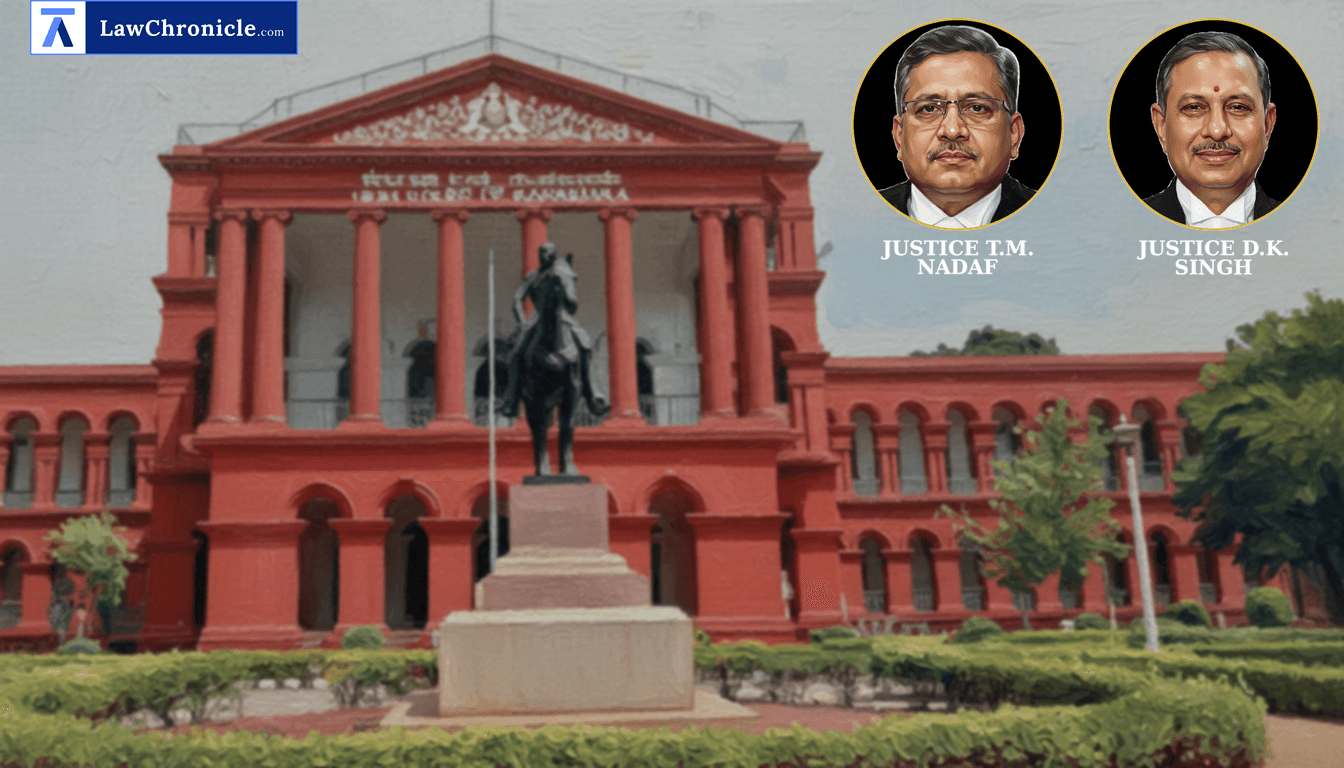
The High Court of Karnataka has reaffirmed that revenue authorities like the Tahsildar or Deputy Commissioner lack the jurisdiction to decide complex title disputes, which remain the exclusive domain of civil courts.
A division bench of Justice D K Singh and Justice T.M. Nadaf delivered this ruling while hearing a writ appeal challenging a Single Judge's decision that had quashed several revenue proceedings involving land claimed by both a private individual and the Ministry of Defence. The Court emphasized that revenue entries are not proof of title and cannot be used to indirectly seek the cancellation of grants.
Revenue Jurisdiction and the Power of Civil Courts
The Court noted that proceedings under Section 136(3) of the KARNATAKA LAND REVENUE ACT, 1964 are limited to the correction of entries and not for the determination of the genuineness of a grant made decades ago. The bench observed that when a dispute involves a challenge to the title itself, the parties must be relegated to a civil court under the proviso to Section 135 of the KARNATAKA LAND REVENUE ACT, 1964.
In its reasoning, the Court observed: "...the Revenue Authorities, be it the Tahsildar, the Assistant Commissioner or the Deputy Commissioner have no jurisdiction to decide the title dispute between the parties and it is exclusive domain of the competent Civil Court to adjudicate the disputed facts and question of title and ultimately, if any decree is passed by the competent Civil Court, it shall be binding not only on the private parties but also on the revenue authorities."
Suspicious Conduct of Revenue Officials
Court Scrutinizes Tahsildar’s Order
A notable aspect of the case involved an order passed by a Tahsildar in 2015. During the hearing, the High Court summoned the retired officer to verify the veracity of his order. The bench expressed dismay when the officer was unable to read a single line of the order, which was written in English, or explain the legal provisions under which it was passed. The Court remarked that such orders appear to be the "creation by some unseen hands playing behind the scene."
Background:
The dispute concerned 2 acres of land in Savarline Village. The appellant claimed the land was granted to his father in 1954, while the Defence Estate Officer and the Parachute Regiment Training Centre (Indian Army) claimed the land was part of a larger tract acquired for the military in 1907.
Initial proceedings were initiated under Section 136(3) of the KARNATAKA LAND REVENUE ACT, 1964 to examine revenue entries. After various rounds of litigation, including contempt proceedings, the Special Deputy Commissioner remanded the matter to the Tahsildar, who confirmed the grant in favor of the appellant's father. This was challenged by the Defence authorities. The Single Judge eventually quashed the revenue orders, holding that such disputes must be settled in civil court, a view which the Division Bench has now upheld by dismissing the writ appeal.
Case Details:
Case No.: WRIT APPEAL NO. 392 OF 2024
Case Title: SRI. A. VENKATESH v. THE STATE OF KARNATAKA AND OTHERS
Appearances:
For the Petitioner(s): SRI. D.R. RAVISHANKAR, SR. ADVOCATE FOR SRI. SARAVANA S., ADVOCATE
For the Respondent(s): SRI. MOHAMMED JAFFAR SHAH, AGA FOR R1 TO R5, SRI. M.N.KUMAR, CGC FOR R6 AND R7
Source: 2026 CaseBase(KAR) 205
Similar Articles

 Breaking News


