


Kerala HC: Review Power Cannot Be Used as an Appeal in Disguise
 Copy Link
 Share
 Save
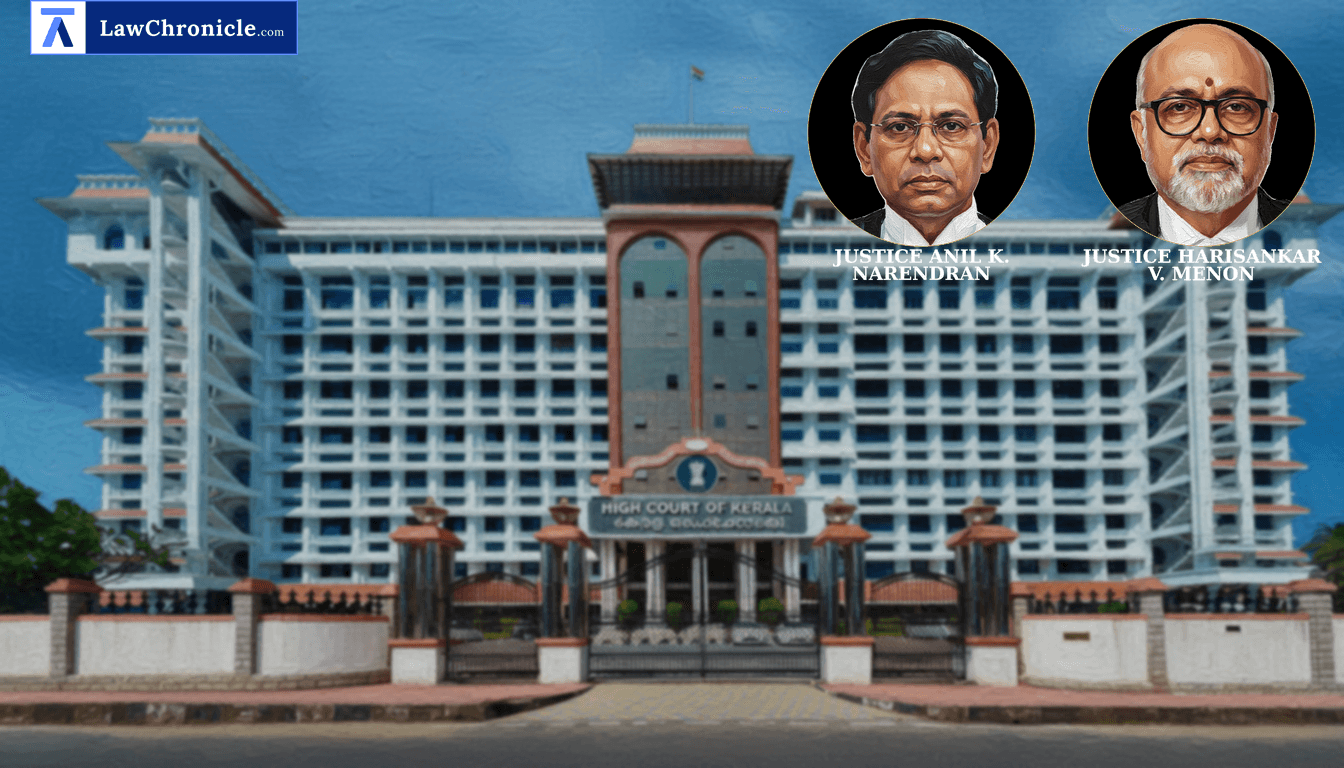
The High Court of Kerala has reinforced the limited scope of judicial review, ruling that the non-production of an Apex Court judgment during initial hearings does not constitute an 'error apparent on the face of record' to justify a rehearing. This decision underscores that review jurisdiction under Code of Civil Procedure, 1908 is strictly for correcting patent mistakes and cannot be invoked to substitute an alternative legal view or re-examine the entire merits of a case.
A Division Bench comprising Justice Anil K. Narendran and Justice Harisankar V. Menon delivered this order while dismissing a review petition filed by employees of the Fishery Survey of India. The petitioners sought to overturn a previous judgment that denied them financial upgradation under the Assured Career Progression (ACP) Scheme for failing to meet the educational qualifications required for the promotional post of Bosun (Uncertified).
The Limits of Review Jurisdiction
During the proceedings, the petitioners argued that a subsequent realization of a judgment by the Hon'ble Supreme Court in SLP(C) Nos.8219-8226 of 2019, which suggested that educational qualifications are not a prerequisite for ACP benefits, should warrant a review. However, the Court rejected this contention, noting that the petitioners failed to present this case during the original hearing.
The Court, in its reasoning, observed: "The petitioners have no case that they sought to rely on the judgment of the Apex Court at Annexure A produced along with the review petition, at the time of hearing of the original petition. In other words, the petitioners seek a rehearing of the entire lis, which, in our opinion, is outside the scope of the review jurisdiction under Order XLVII Rule 1 of the Code of Civil Procedure, 1908."
Judicial Precedents on Review Limits
The Bench relied on established principles that distinguish a review from an appeal. Citing Thungabhadra Industries Ltd v. Government of Andhra Pradesh and Northern India Caterers (India) Ltd. v. Lt. Governor of Delhi ( "(1980) 2 SCC 167": 1979 CaseBase(SC) 387), the Court noted that a review is not a tool for a 'second innings' of litigation. Further, placing reliance on Lily Thomas v. Union of India ( "(2000) 6 SCC 224": 2000 CaseBase(SC) 816), the Court reiterated that while a mistake can be corrected, the power of review cannot be used to swap one legal view for another, even if two views are possible.
Regarding the merits of the financial upgradation claim, the Court observed that the initial decision was consistent with the law laid down in Union of India v. P.K.Santhosh Kumar ( "[2024(1) KHC 581]": 2023 CaseBase(KER) 33474) and M.N.Raghunatha Kurup and others v. Union of India and others. Since the petitioners did not possess the mandatory qualifications for the promotional hierarchy, the denial of benefits was held to be legally sound.
Final Order and Directions
The Court has following directions:
"In the light of the afore, we find no justification for entertaining this review petition, and the same would stand dismissed."
Key Takeaways
Review is not an Appeal
Lower courts and litigants must understand that a review petition is not a platform to re-argue the case or present new legal authorities that were missed earlier.
Correction vs. Substitution
The Court clarified that judicial review is reserved for patent errors and not for substituting a different legal interpretation or correcting a perceived 'erroneous exposition of law.'
Compliance with Qualifications
The ruling affirms that for the grant of benefits under the ACP Scheme, fulfilling the prescribed educational qualifications for the promotional post remains a critical hurdle unless specifically exempted.
Ratio
The power of review under Order XLVII Rule 1 of the Code of Civil Procedure, 1908 is not an inherent power to rehearing a case on merits; a judgment cannot be reviewed merely because a relevant precedent of the Supreme Court was not placed before the Court at the time of the original hearing. A review petition cannot be treated as an appeal in disguise.
Background:
The dispute originated when the petitioners, working as Cooks, sought financial upgradation to the scale of Bosun (Uncertified) under the ACP and MACP Schemes. The Central Administrative Tribunal (CAT), Ernakulam, rejected their claims in 2018, leading to an Original Petition before the High Court. The High Court initially dismissed their plea on July 10, 2024, holding that since they didn't meet the educational criteria for Bosun, they weren't eligible for the pay scale. The petitioner filed the current review petition, citing a 2023 Supreme Court order and a 2025 Kerala High Court Division Bench decision which they claimed supported their eligibility regardless of qualifications. The High Court ultimately found no 'error apparent' and dismissed the review petition.
Case Details:
Case No.: RP NO. 288 OF 2025
NeutralCitation: 2026:KER:54079
Case Title: V.N. Chakrapani & Anr. V. Union Of India & Others
Appearances:
For the Petitioner(s): Shri.T.C.Govindaswamy, Smt.Kala T.Gopi (Advocates)
For the Respondent(s): Sri.T.V.Vinu, Central Government Counsel
Source: 2026 CaseBase(KER) 437
Similar Articles



 Breaking News


