


Know Why Supreme Court put an end to Ex Post Facto Environmental Clearance Norm
 Copy Link
 Share
 Save
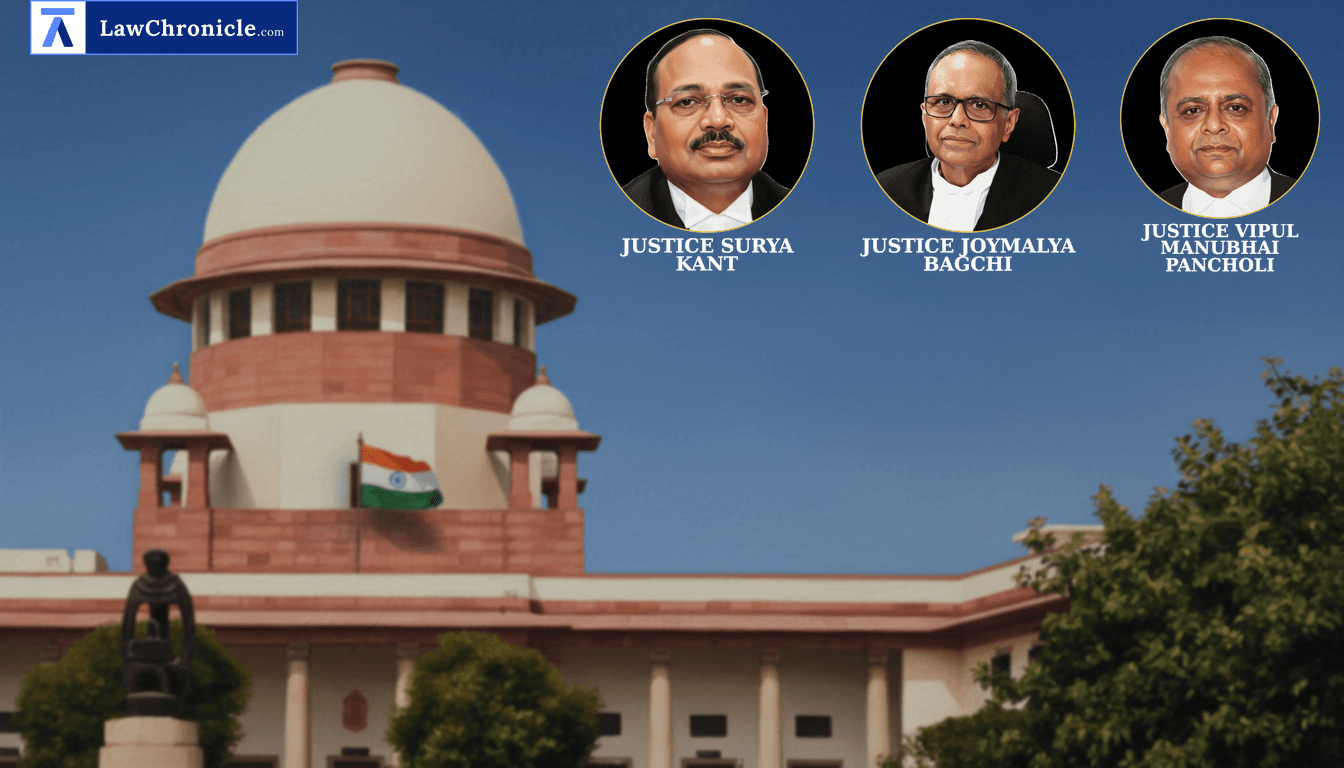
In a landmark environmental ruling, the Supreme Court quashed the 2021 Office Memorandum permitting perpetual ex post facto environmental clearances. The Apex Court held that administrative instructions cannot replace mandatory prior clearance norms under delegated legislation. Balancing ecological protection with public interest, the Supreme Court prospectively invalidated the memorandum. The judgment protects existing clearances and pending applications to prevent the destruction of crucial public infrastructure.
A three-judge Bench comprising Chief Justice Surya Kant, Justice Joymalya Bagchi, and Justice Vipul M. Pancholi addressed the delicate balance between the right to a pollution-free environment and the right to development. The Court was called upon to re-examine the validity of the 10.03.2017 Notification and the 07.07.2021 Office Memorandum issued by the Ministry of Environment, Forest and Climate Change, following the recall of its earlier decision in Vanashakti v. Union of India ( "2025 INSC 718": 2025 CaseBase(SC) 824).
EIA Notification vs Office Memorandum
Evaluating the legal status of the prior environmental clearance regime, the Supreme Court clarified that the requirement under the EIA Notification, 2006, issued under Section 3 of the Environment (Protection) Act, 1986, is non-negotiable and mandatory. The Court observed that while the unamended statutory framework mandated prior clearances, it was silent on the regulatory consequences for non-compliance beyond penal provisions.
The Court held that the 2017 Notification was a valid, narrowly tailored, time-bound delegated exercise under Section 3 of the Environment (Protection) Act, 1986 read with Section 21 of the General Clauses Act, 1897. However, it drew a sharp distinction between such a time-bound statutory amnesty and the 2021 Office Memorandum. The 2021 OM, being a mere executive instruction, created a perpetual parallel regime for ex post facto environmental clearance as a regularization without any cut-off date, thereby altering the substantive criteria of the 2006 Notification.
On Ex Post Facto Environmental Clearance
While declaring the 2021 OM invalid for failing the tests of reasonable classification and proportionality under Articles 14 and 21 of the Constitution of India, 1950, the Court exercised its extraordinary powers to give its decision prospective effect. It protected completed and ongoing public infrastructure projects, such as medical colleges, hospitals, and airports, noting that demolition would cause greater environmental and societal harm.
Directions on Post Facto Environmental Clearance
The Supreme Court issued the following directions to the authorities
"a. ECs granted to project proponents under the 2017 Notification and the 2021 OM till date shall remain valid, unless otherwise challenged on merits.
b. All pending applications made by project proponents under the 2017 Notification or the 2021 OM shall be taken to their logical conclusion in accordance with law.
c. Any application dismissed, returned or delisted solely with reference to the stay order dated 02.01.2024 and/or the judgment in Vanashakti-I may be reconsidered by the authority concerned in light of the observations made in this judgment, particularly the prospective quashing of the 2021 OM.
d. No fresh application for grant of EC under the aforesaid instruments shall be entertained.
e. The government is restrained from issuing administrative orders in future for grant of EC in respect of projects which have commenced in contravention of the prior EC regime under the 2006 Notification."
The Court, in its reasoning, observed: "The 2021 OM is an administrative order and envisages a perpetual regime for grant of EC to projects undertaken without prior EC. It substantially alters the nature of enquiry as well as the criteria for grant of EC under the 2006 Notification. 2021 OM thereby supplants an earlier delegated legislation through an administrative instruction, which is impermissible in law. Even otherwise, being a perpetual amnesty scheme applicable to all permissible projects, it fails to lay down an intelligible differentia for selection of projects for grant of post facto EC having rational nexus to supervening public interest and is thereby ultra vires the object of 1986 Act..."
Key Takeaways
Executive Instructions Cannot Dilute Statutory Norms: Administrative instructions like office memoranda cannot override, supplant, or dilute mandatory prior clearance requirements established under delegated legislation.
Prospective Overruling Protects Public Interest: To avoid counterproductive ecological harm and the loss of thousands of crores in public utility projects, the quashing of the 2021 OM operates prospectively.
Decriminalisation Does Not Condon Illegality: Civil penalties introduced under Section 15 of the Environment (Protection) Act, 1986 by the Jan Vishwas Act, 2023, enforce compliance but do not grant an automatic right to regularise illegal constructions.
Strict Bar on Future Administrative Ex Post Facto Approvals: The Central Government is permanently restrained from issuing future executive orders allowing ex post facto environmental clearances outside a valid, published statutory notification.
Ratio
The requirement for ex post facto environmental clearance under the EIA Notification, 2006, is a mandatory rule rooted in the precautionary principle under Article 21 of the Constitution of India, 1950. Executive instruction cannot create an open-ended, perpetual ex post facto regularisation scheme to supplant delegated legislation. While the delegatee authority possesses the statutory power under Section 3 of the Environment (Protection) Act, 1986 read with Section 21 of the General Clauses Act, 1897 to issue a narrowly tailored, time-bound statutory amnesty in supervening public interest, open-ended administrative amnesties fail the tests of reasonable classification and proportionality and are ultra vires the law.
Background of Environmental Clearance Law
The controversy traces back to environmental challenges against executive measures designed to grant ex post facto environmental clearances to projects operating in breach of the 2006 EIA Notification. The 2017 Notification offered a six-month window for non-compliant projects to apply for clearance subject to environmental damage assessments and remediation plans. Subsequently, following directions from the NGT in S.P. Muthuraman v. Union of India, the MoEFCC issued the 2021 OM to establish a Standard Operating Procedure for handling violation cases on a continuous basis.
The Madras High Court in Fatima v. Union of India prospectively quashed the 2021 OM. In parallel writ proceedings before the Supreme Court, a two-judge Bench in Vanashakti v. Union of India ( "2025 INSC 718": 2025 CaseBase(SC) 824) struck down both the 2017 Notification and 2021 OM. Upon a review petition filed by CREDAI, a three-judge Bench in Confederation of Real Estate Developers of India v. Vanashakti recalled Vanashakti v. Union of India ( "2025 INSC 718": 2025 CaseBase(SC) 824) due to failure to consider relevant precedent and coordinate Bench rulings.
In re-evaluating the jurisprudence, the Supreme Court harmonized earlier lines of authority. It reconciled strict rulings like Common Cause v. Union of India ( "(2017) 9 SCC 499": 2017 CaseBase(SC) 705) and Alembic Pharmaceuticals Ltd. v. Rohit Prajapati ( "(2020) 17 SCC 157": 2020 CaseBase(SC) 1631) with cases where post-facto relief was granted on proportionality grounds, such as Electrosteel Steels Ltd. v. Union of India, Pahwa Plastics (P) Ltd. v. Dastak NGO, and D. Swamy v. Karnataka State Pollution Control Board ( "(2023) 20 SCC 469": 2022 CaseBase(SC) 1069). Referring to Municipal Corporation of Greater Mumbai v. Pankaj Babulal Kotecha ( "2025 SCC OnLine SC 1263": 2025 CaseBase(SC) 804) and Fatima v. Union of India, the Court reaffirmed that environmental courts must adopt a balanced approach. It also referenced landmark environmental precedents including M.C. Mehta v. Union of India ( "(1987) 1 SCC 395": 1987 CaseBase(SC) 158), State of Himachal Pradesh v. Ganesh Wood Products, Indian Council for Enviro-Legal Action v. Union of India ( "(1996) 3 SCC 212": 1996 CaseBase(SC) 2434), Confederation of Real Estate Developers of India v. Vanashakti, Subhash Kumar v. State of Bihar ( "(1991) 1 SCC 598": 1990 CaseBase(SC) 308), Asha John Divianathan v. Vikram Malhotra ( "2021 SCC OnLine SC 147": 2021 CaseBase(SC) 797), Electrotherm (India) Ltd. v. Patel Vipulkumar Ramjibhai, Goel Ganga Developers India Pvt. Ltd. v. Union of India, Keystone Realtors Pvt. Ltd. v. Anil V. Tharthare, and M.K. Ranjitsinh v. Union of India ( "2024 INSC 280": 2024 CaseBase(SC) 695) to underscore that the precautionary and polluter pays principles must be reconciled with sustainable development.
Ultimately, the Supreme Court upheld the 2017 Notification as a valid, one-time statutory measure but prospectively quashed the 2021 OM. Pending applications under both instruments were ordered to be processed to their logical end, while any future administrative post facto clearance schemes were explicitly prohibited.
Case Details:
Case No.: Writ Petition (C) No. 1394 of 2023
NeutralCitation: 2026 INSC 761
Case Title: Vanashakti v. Union of India
Appearances:
For the Petitioner(s): Shri Gopal Sankaranarayanan, Shri Sanjay Parikh, Shrishti Agnihotri, Advocates
For the Respondent(s): Tushar Mehta (Solicitor General), Aishwarya Bhati (Additional Solicitor General), Shri Abhishek Manu Singhvi, Shri P. Wilson, Senior Advocates
Source: 2026 CaseBase(SC) 705
Similar Articles




 Breaking News


