Landmark Cases that Evolved Women’s Rights in India
 Copy Link
 Share
Share Save
Save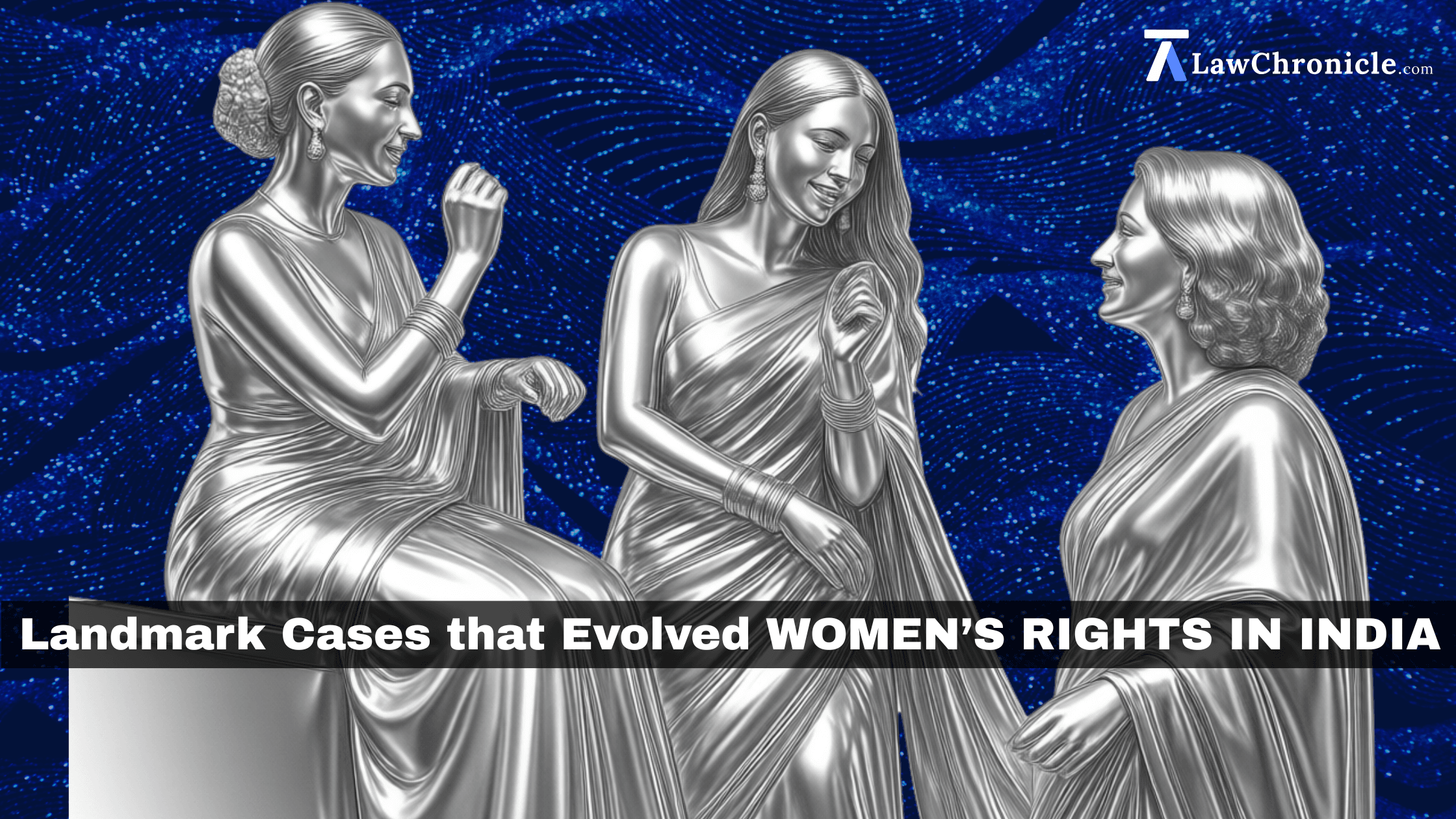
Over the years, Indian judiciary has played a crucial role in evolution of rights of women through a series of landmark constitutional and statutory interpretations. While the Constitution of India guarantees equality before law and prohibits discrimination among men and women, the social realities of a patriarchal society time and again necessitated judicial intervention to give meaning to law. Constitutional Courts gave landmark judgments on women’s rights in India, striking down regressive personal laws, upholding women's reproductive autonomy, right to choose a partner, progressively expanding the horizons of gender justice. The following is a comprehensive analysis of landmark judgments that have defined and redefined women's rights in India.
Landmark Judgments that Transformed Women’s Rights in India
1. Shayara Bano v. Union of India (2017)
A woman got divorced by her husband through a letter containing the word "talaq" written three times. The Supreme Court of India struck down the practice of instant triple talaq (talaq-e-biddat) as unconstitutional by a majority of 3:2. The Court held the practice manifestly arbitrary and violated right to equality guaranteed under Article 14 of the Constitution by allowing Muslim husbands to unilaterally and irrevocably dissolve a marriage without any opportunity of reconciliation. The Court emphasized that what is bad in the Holy Quran cannot be good in Shariat law, and what is bad in theology is equally bad in law. This judgment was followed by the enactment of The Muslim Women (Protection of Rights on Marriage) Act, 2019, which criminalized instant triple talaq.
2. Joseph Shine vs Union Of India (2018 CaseBase(SC) 774)
A five-judge Constitutional Bench of the Supreme Court unanimously struck down Section 497 of the Indian Penal Code, 1860 which criminalised adultery. The Court held that Section 497 was unconstitutional as it treated women as the property of their husbands and denied them agency and autonomy. Chief Justice Dipak Misra observed that any provision of law that treats women with inequality or that is founded on stereotypical notions of women's role in society must be struck down. The judgment reaffirmed women's dignity as an independent constitutional value and their right to equality under Articles 14, 15, and 21 of the Constitution.
3. The Secretary, Ministry Of Defence vs Babita Puniya & Ors. (2020 CaseBase(SC) 111)
In this case, the Supreme Court allowed Permanent Commission to women officers in the Indian Army who were serving on Short Service Commission. The Court categorically rejected the Union Government's argument of women being physiologically and psychologically unsuitable for command roles and permanent service. The Court called such reasoning reflective of deep-seated stereotypes. Justice D.Y. Chandrachud, speaking for the bench, held that the constitutional guarantee of equality is not merely formal, and that the State, while acting as an employer, is also bound by constitutional morality. The judgment upheld Permanent Commission to all women Short Service Commission officers in the Army, regardless of their years of service, with consequential benefits including promotions and pension.
4. Vineeta Sharma vs Rakesh Sharma & Ors. (2020 CaseBase(SC) 380)
2005 Amendment on daughters' rights in ancestral property under the Hindu Succession Act, 1956 accompanied some ambiguity regarding applicability and enjoyability. The Court held that a daughter, by birth, becomes a coparcener in her own right in the same manner as a son, and that this right is not contingent on the father being alive on or after the date of the 2005 amendment. The judgment overruled the earlier decision in Prakash v. Phulavati (2015 CaseBase(SC) 854), which had held that the amendment had prospective effect and was not applicable if the father had died before 2005. The Supreme Court clarified that since coparcenary rights are conferred by birth, the amendment must be given full retroactive effect.
5. Hiral P. Harsora And Ors. vs Kusum Narottamdas Harsora And Ors. (2016 CaseBase(SC) 691)
The Supreme Court expanded the scope of Protection of Women from Domestic Violence Act, 2005. The Court struck down the words "adult male" from the definition of "respondent" under Section 2(q) of the Act, holding that the restriction of complaints only against adult male persons was arbitrary and violated Article 14 of the Constitution. The Court reasoned that domestic violence can be perpetrated by any member of a household irrespective of gender or age, such as mothers-in-law and sisters-in-law, etc.
6. Shakti Vahini vs Union Of India And Others (2018 CaseBase(SC) 9)
The Supreme Court came down heavily on honour killings and the persecution of couples entering inter-caste or inter-religious marriages. The Court held that the right to choose one's life partner is an integral facet of personal liberty under Article 21 of the Constitution. It further added that no individual, family, or community body has the authority to interfere with or prevent such a choice. The Court condemned khap panchayats and other extra-constitutional assemblies that issue diktat against such marriages as illegal and unconstitutional. The Apex Court even issued comprehensive directions to the Centre and State governments to prevent honour killings, including safe houses setup for couples in distress, nodal officers, and sensitization of law enforcement agencies.
7. Shafin Jahan vs Asokan K. M. And Others (2018 CaseBase(SC) 536)
Popularly known as the Hadiya case, the Supreme Court in this case upheld an adult woman’s right to convert to a religion of her choice and marriage with a person of her choice. The Court observed that the right to marry is a fundamental right and the choice of an adult is not subject to the approval of parents or the State. Chief Justice Dipak Misra emphasised that the ability of each person to lead a life of his or her choosing is an essential aspect of liberty, whether it is faith or life partner.
8. Air India v. Nargesh Mirza (1981 CaseBase(SC) 391)
Air India v. Nargesh Mirza was one of the earliest Supreme Court decisions to strike down service conditions that were overtly discriminatory against women. Air India's service regulations required air hostesses to retire upon marriage (if within four years of service), upon the first pregnancy, or upon reaching the age of 35, whichever occurred earliest. These conditions did not apply to male cabin crew. The Supreme Court held these regulations to be arbitrary, unreasonable, and violative of Article 14 and Article 21 of the Constitution. The provision requiring retirement upon pregnancy was specifically held to be an insult to Indian womanhood and manifestly unreasonable, as it penalised women for a natural biological process. The Court struck down the offending regulations and directed Air India to revise its service conditions to bring them in line with constitutional requirements.
9. Vishaka And Others vs State Of Rajasthan And Others (1997 CaseBase(SC) 1720)
The brutal gang rape of Bhanwari Devi, a social worker in Rajasthan, who was attacked allegedly for preventing a child marriage, paved the way for Vishaka case. In the absence of any legislation on sexual harassment at the workplace, the Supreme Court, invoked Article 32 to lay down a set of binding guidelines, known as the Vishaka Guidelines, to protect women from sexual harassment at the workplace. The Court held that sexual harassment of women at the workplace violates their fundamental rights to equality (Article 14), non-discrimination (Article 15), and life with dignity (Article 21). These guidelines had the force of law until they were superseded by the Sexual Harassment of Women at Workplace (Prevention, Prohibition and Redressal) Act, 2013.
10. Mohd. Ahmed Khan vs Shah Bano Begum And Others (1985 CaseBase(SC) 214)
One of the most debated and politically significant judgments on personal law in India did not miss its mention in Bollywood (Haq movie featuring Yami Gautam). In this case, a 73-year-old Muslim woman, was divorced by her husband after 46 years of marriage through triple talaq and denied maintenance. The Supreme Court, in a unanimous decision, found her entitled to maintenance under Section 125 of the Code of Criminal Procedure, 1973, a secular provision applicable to all citizens irrespective of religion. The Court observed that there was no conflict between the provisions of the CrPC and Muslim personal law on the question of maintenance. Though the Court upheld her right to financial support beyond the iddat period, the decision was overturned by the enactment of the Muslim Women (Protection of Rights on Divorce) Act, 1986, restricting the right of divorced Muslim women to maintenance.
 Breaking News