


Lapses in Chain of Custody and Case Property Identification Vitiate Excise Conviction: HP High Court
 Copy Link
 Share
 Save
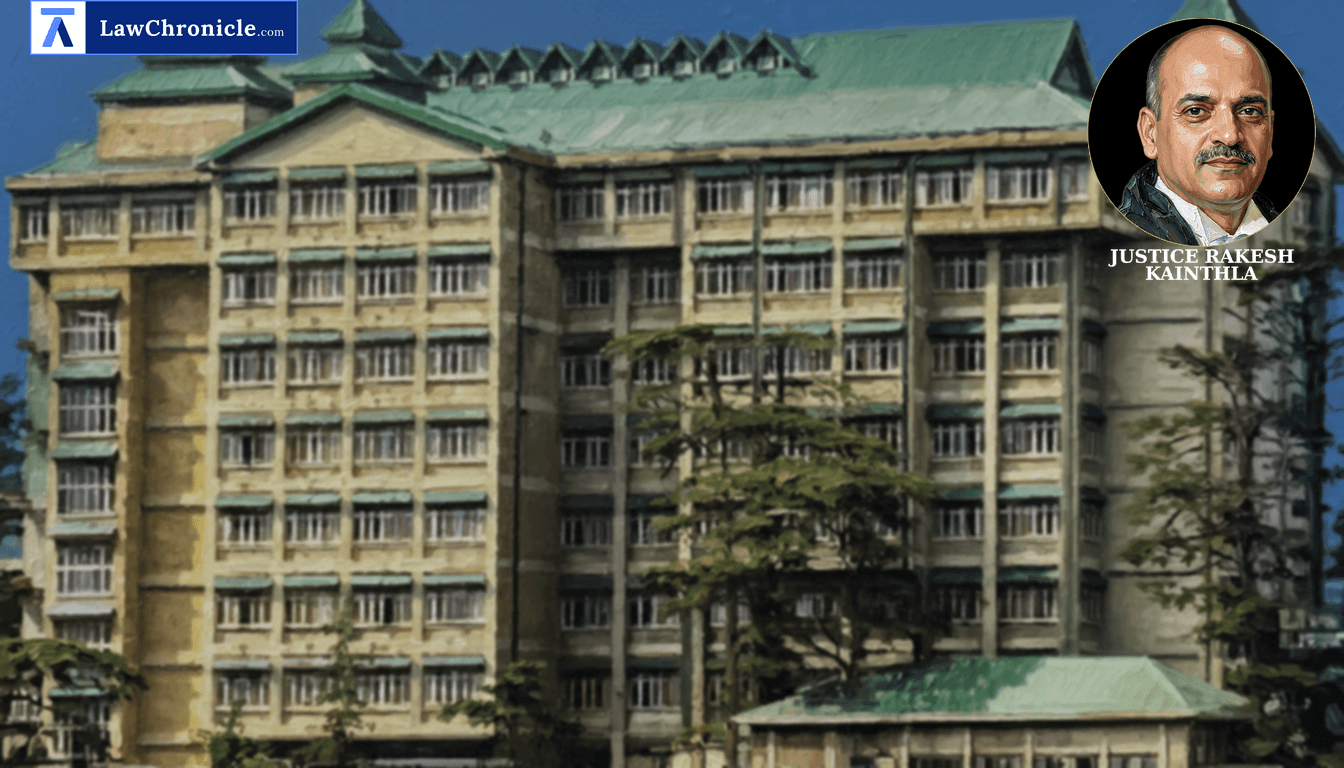
The Himachal Pradesh High Court has set aside the conviction of a man accused of carrying illicit liquor, ruling that the failure to produce identifiable case property and the absence of link evidence regarding sample seals creates an insurmountable gap in the prosecution's narrative.
In an authoritative decision, the Court emphasized that even in cases involving official witnesses, the prosecution must satisfy the standard of inherent probability, particularly concerning the measurement of contraband at the scene and the integrity of the samples sent for chemical analysis.
A Single Judge bench of Justice Rakesh Kainthla heard the revision petition challenging the concurrent findings of the lower courts. The petitioner sought the setting aside of the judgment delivered by the Sessions Judge which had upheld the trial court's conviction under Section 61(1)(a) of the Punjab Excise Act, 1914.
Key Takeaways
Strict Proof of Quantity
Courts cannot rely on quantity claims if the prosecution fails to explain how bulk liquid in tubes was measured into specific bottle counts at the scene of the crime.
Identification of Case Property
The absence of identification slips or unique marks on seized articles like rubber tubes makes their production in court legally suspect.
Missing Link Evidence
Failure to produce the Malkhana register or the Road Certificate (RC) to prove the movement of sample seals to the laboratory constitutes a fatal flaw in the chain of custody.
Presumption of Licit Origin
Unless the chemical analyst's report specifically distinguishes the liquor from that manufactured in licensed distilleries, it cannot be presumed as 'illicit' for the purposes of sentencing.
Legal Scrutiny of Revisional Jurisdiction
The Court noted the parameters of revisional jurisdiction under Section 397 of the Code Of Criminal Procedure, 1973 (now Section 438 of Bharatiya Nagarik Suraksha Sanhita, 2023), referencing Kuntegowda v. Thurubaiah ( "2026 SCC OnLine SC 1485": 2026 CaseBase(SC) 721). It observed that while a revisional court should not substitute its view, it must intervene if the lower court's findings are perverse or based on non-consideration of material evidence.
In its reasoning, the Court observed: "No prosecution witness has explained as to how the police were able to measure the contents of the tubes and find that the large tube contained 30 bottles and the small tube contained 20 bottles of illicit liquor. Nobody stated that the police had 82 empty bottles or a large container with them. The place of the incident was a jungle, and it was difficult to procure such a large number of bottles or a container into which the contents of the tubes could be poured."
Fatal Lapses in Chain of Custody
The Court highlighted that the prosecution failed to prove the integrity of the case property. Citing Amandeep Singh & Ors. Vs State of HP ( "2010 (3) Shim LC 39": 2010 CaseBase(HP) 257) and Pawan Kumar v. State of H.P. ( "(2019) 4 SCC 182: (2019) 2 SCC (Cri) 39: 2019 SCC OnLine SC 359": 2019 CaseBase(SC) 2284), the bench noted that the non-production of identifiable seized articles renders the case fragile. Furthermore, the absence of the Malkhana register and Road Certificate meant there was no proof that the sample seal reached the laboratory untampered, a principle supported by Kishan Chand & Another Vs. State and State of H.P. Vs. Rakesh Kumar ( "2018 (1) HLJ 73": 2016 CaseBase(HP) 55).
The Court further held that by sending only two sample bottles for analysis, the prosecution at most proved possession of two bottles, which is within the permissible limit under the state's notification. This followed the ratios in Mahajan v. State of Himachal Pradesh, Dharampal vs. State, and State Vs. Jagjit Singh.
The Court has the following directions:
"In view of the above, the revision is allowed, and the judgment of conviction dated 20.12.2010 and order of sentence dated 23.12.2010... are ordered to be set aside. The petitioner/accused is acquitted of the charge framed against him. Fine amount, if deposited, be refunded to the petitioner/accused. Bail bonds, if any, furnished by the accused stand discharged. In view of the provisions of Section 437-A of the Code of Criminal Procedure (Section 481 of Bhartiya Nagarik Suraksha Sanhita, 2023) the petitioner/accused is directed to furnish bail bonds in the sum of ₹25,000/- with one surety in the like amount to the satisfaction of the learned Trial Court within four weeks."
Ratio
In excise matters, the prosecution must establish an unbroken chain of custody from the point of recovery to the laboratory analysis, including the specific movement of the sample seal. Failure to explain the measurement of liquid quantity at the spot, combined with the lack of unique identification marks on the case property and missing link evidence like Road Certificates, entitles the accused to the benefit of the doubt. Furthermore, the prosecution must prove through chemical analysis that the liquor is of illicit origin compared to licensed distillery products to attract higher penalties.
Background
The case originated from an incident in April 2007, where the police allegedly caught the petitioner in a jungle carrying a bag containing two rubber tubes filled with liquor. The prosecution claimed there were 50 bottles of illicit liquor in total. The Trial Court convicted the accused based on the testimony of official witnesses, and the Appellate Court upheld the decision, stating that independent witnesses were not necessary for recoveries in lonely places.
However, the High Court found that both lower courts failed to consider critical evidentiary gaps, such as the missing Malkhana entries and the fact that the tubes produced in court had no identification slips. Relying on State v. Bikar Singh and Ram Singh v. State of Haryana ( "1987, SCC Online P&H 368": 1987 CaseBase(SC) 395), the Court concluded that the prosecution had not established that the liquor was illicit or exceeded the legal possession limit.
Case Details:
Case No.: Cr. Revision No. 4081 of 2013
Neutral Citation: 2026:HHC:45119
Case Title: Pawan Kumar Versus State of HP
Appearances:
For the Petitioner(s): Mr Bimal Gupta, Senior Advocate, with Ms Simran, Advocate
For the Respondent(s): Mr Pawan Kumar Nadda, Additional Advocate General
Source: 2026 CaseBase(HP) 9468
Similar Articles

 Breaking News


