Legal Aid Is Not A Mere Ritual: SC Mandates Meaningful Representation
 Copy Link
 Share
Share Save
Save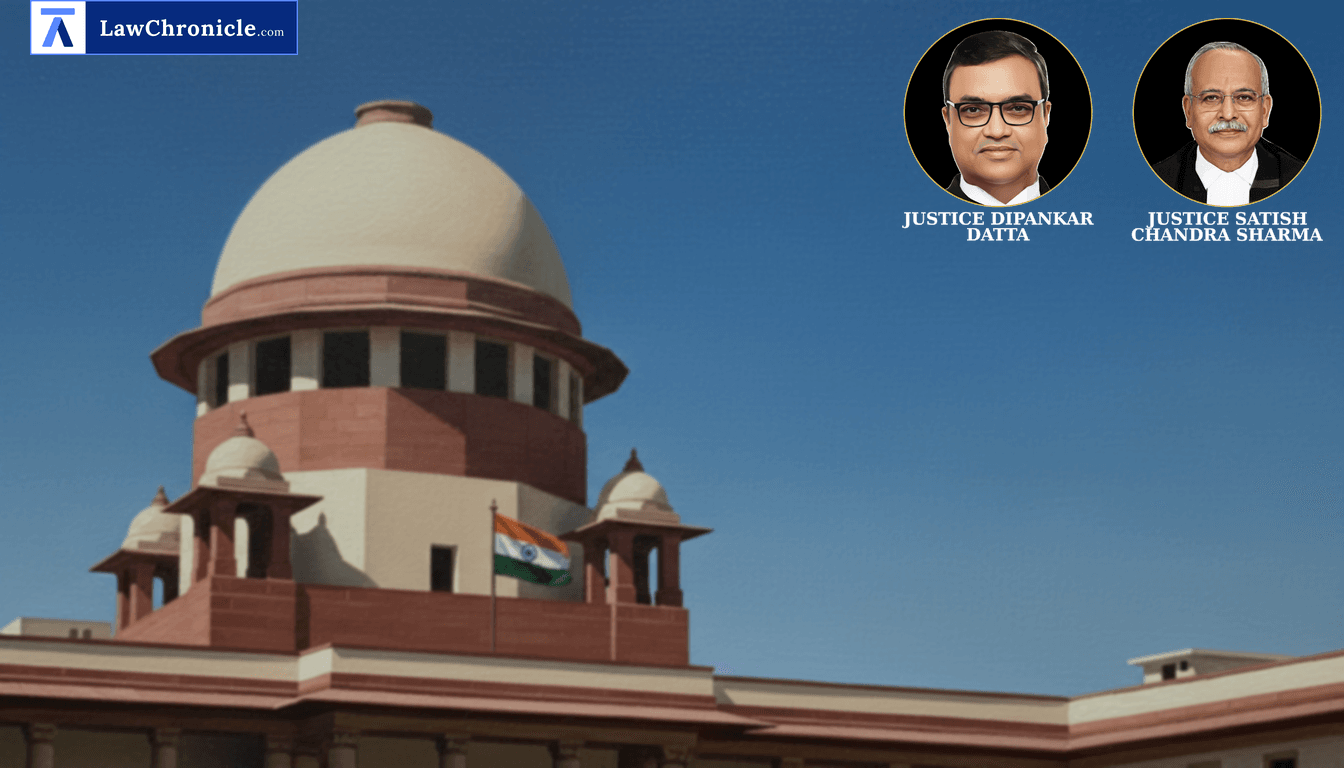
The Supreme Court in Nandkishore Mishra v. The State of Madhya Pradesh, emphasizing the constitutional right to effective legal representation, underscored that legal aid for an incarcerated accused must be a substantive exercise rather than a mere token formality. The Court set aside a High Court judgment that had dismissed a murder appeal just six days after appointing an amicus curiae, without ensuring that the appellant was informed or that the counsel had sufficient time to prepare.
A bench comprising Justice Dipankar Datta and Justice Satish Chandra Sharma heard the challenge against a verdict delivered by the Madhya Pradesh High Court. The appellant, a 74-year-old man, contended that he was denied a fair hearing as his appeal was decided in the absence of his chosen advocate and without any meaningful interaction with the court-appointed amicus curiae.
Meaningful Legal Assistance Over Tokenism
The Supreme Court observed that while the High Court acted with the bona fide intention of disposing of the matter expeditiously, it failed to provide the appellant with a real opportunity to participate in his own defense. The Court highlighted that for a person languishing in a correctional home, the sudden appointment of an amicus curiae and a subsequent hearing within less than a week does not meet the standards of natural justice.
The Court, in its reasoning, observed: "This acquires added significance in light of the consistent view taken by this Court that legal aid to an accused person must not be a mere ritual or a token formality, but a substantive and meaningful exercise that ensures effective assistance of counsel. While there can be no doubt about the bona fide intention of the High Court in appointing an amicus to represent convict whose advocate is not present to argue his appeal with a view to advancing the cause of justice, it would perhaps have better served the ends of justice had a formal notice been issued to the appellant informing him of the hearing and the arrangement made for his representation."
Adherence to Established Guidelines
The bench noted that the procedure adopted by the High Court ignored vital directions established in precedents like Anokhi Lal vs. State of Madhya Pradesh and Bhola Mahto v State of Jharkhand. These cases mandate that an amicus must be given reasonable time to prepare and must be allowed to meet and confer with the accused.
Background:
The appellant was convicted of murder under Section 302 of the Indian Penal Code, 1860 and sentenced to life imprisonment in December 2022. He had been in custody since October 2020. During the pendency of his appeal before the High Court under Section 374(2) of the Code of Criminal Procedure, 1973, his engaged advocate failed to appear on 20th November 2025 due to medical reasons. Consequently, the High Court appointed an amicus curiae and scheduled the hearing for the following week. On 26th November 2025, after hearing the amicus and the State counsel, the High Court dismissed the appeal.
The appellant moved the Supreme Court, arguing that he was never notified of his advocate's absence or the appointment of the amicus. He claimed the amicus never met him in the correctional home, leading to an ineffective presentation of his case. The State could not produce evidence that any notice regarding the new arrangement was served upon the appellant.
Finding a gross violation of the principles of natural justice and non-compliance with the directions in Bhola Mahto v State of Jharkhand, the Supreme Court partly allowed the appeal. It set aside the impugned order and remanded the matter back to the High Court for a de novo hearing, ensuring that all points on merit remain open for argument while the appellant continues to remain in custody pending the disposal of the appeal.
Case Details:
Case No.: Criminal Appeal No. 2026 (Arising out of SLP (CRL) No. 3371 OF 2026)
Case Title: NANDKISHORE MISHRA VS. THE STATE OF MADHYA PRADESH
Source: 2026 CaseBase(SC) 455
 Breaking News