Legal Irony: An MACT Judge’s Unusual Encounter with Motor Accident Law
 Copy Link
 Share
 Save
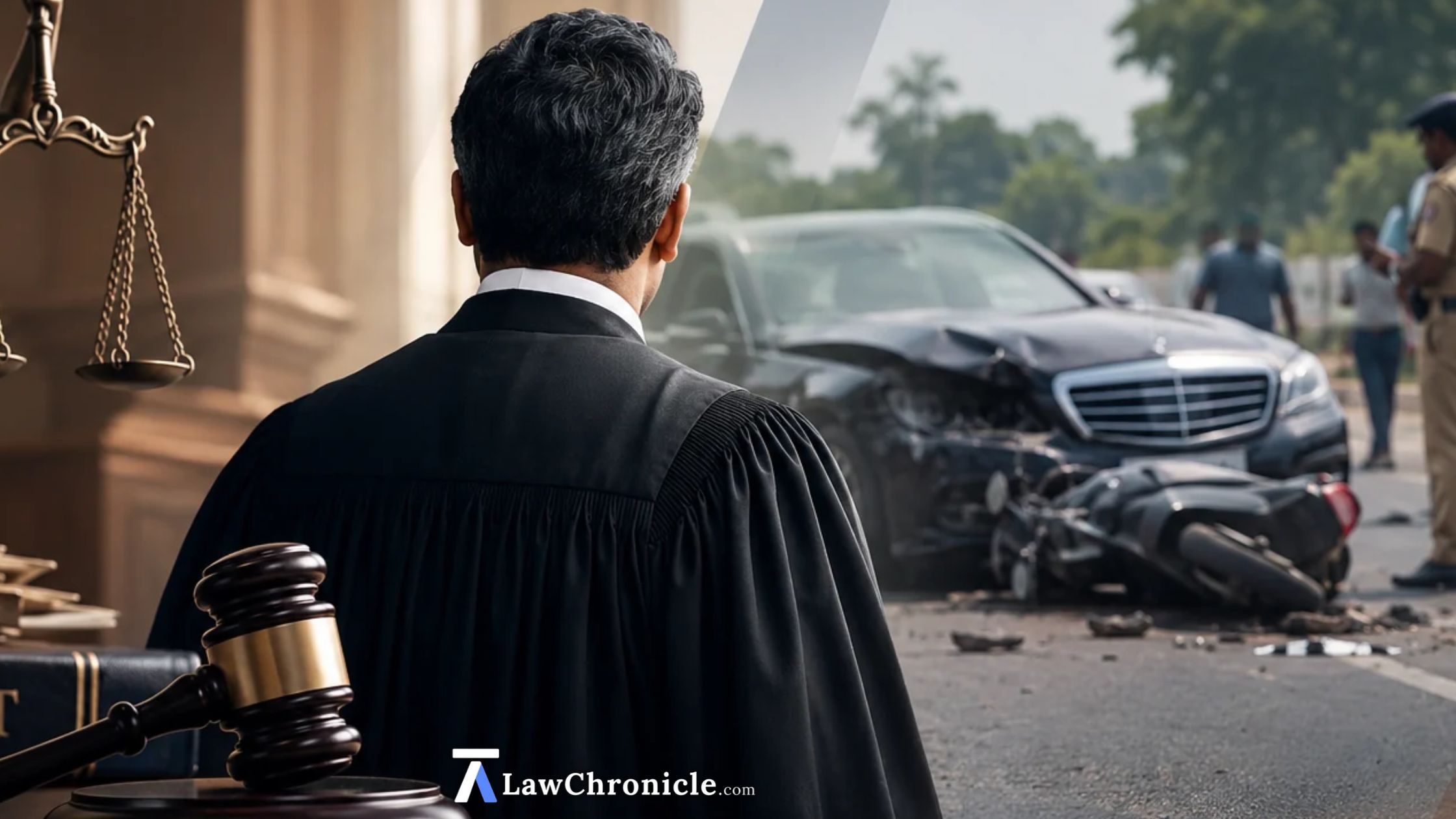
Law sounds a very boring subject to the world. But those within the Legal Fraternity know that every now and then, they find themselves overwhelmed by one of the matters that sounds "terrific", "ironic", or simply "Who would have thought that way?". The recent proceedings before Kerala High Court involving a judge of the Motor Accident Claims Tribunal (MACT) are one of those examples. A judicial officer who spends his working days deciding the consequences of road accidents, found himself named in an FIR arising from one.
The matter is at a very early stage, the allegations are yet to be tested, and every accused person, a judge included, is presumed innocent. However, it is a case that cannot miss out on discussion to understand how circumstances can flip.
Kerala Crash Case
As per reports, a Mercedes-Benz allegedly driven by a 17-year-old hit a scooter on 25th October, 2026. The scooter rider lost his life. The minor boy is the son of an Additional District Judge posted at the MACT in one of the districts of Kerala.
Reports suggest that the police registered an FIR that names the judge as an accused. It invokes Section 105 of the Bharatiya Nyaya Sanhita, 2023, along with Sections 181, 183, 199A(1) and 199A(2) of the Motor Vehicles Act, 1988. The juvenile was granted bail by the Juvenile Justice Board on October 26, while the State’s plea seeking cancellation of that bail is reportedly pending.
Today, Justice Kauser Edappagath of the Kerala High Court adjudicated an anticipatory bail plea, allowing interim protection from arrest for the said MACT Judge. He was directed to appear before the investigating officer and cooperate, with any interrogation to follow the Supreme Court’s guidelines.
For those who don't know - What is MACT in Legal?
For readers outside the legal fraternity, here is the backdrop on what MACT is and the related information.
Forum for Road Accident Victims
A Motor Accident Claims Tribunal is a specialized forum established under the Motor Vehicles Act, 1988. Its objective is to provide victims of road accidents, or the families of those killed, a faster and more accessible route to compensation than the traditional civil courts could offer. The MV Act bars ordinary civil courts from entertaining such claims, so the MACT is the primary home for them.
What a MACT Judge Actually Decides
A judge sitting in the MACT does not decide who goes to jail (that's a job of criminal courts). Instead, the tribunal deals with questions such as:
- Was the accident caused by the rash or negligent driving of a motor vehicle? Claimants must establish this on the civil standard of proof, the balance of probabilities, and not proof beyond reasonable doubt.
- Who is liable to pay? The driver, the registered owner and the insurance company are typically all before the tribunal. Insurers frequently raise defenses, such as the absence of a valid driving license or a breach of policy conditions.
- How much is “just compensation”? The MACT assesses loss of income, dependency, medical expenses, pain and suffering, loss of consortium and funeral costs, among other heads.
- Who must satisfy the award? Often the insurer, subject to its statutory and contractual obligations.
In short, an MACT judge is a specialist in the human and financial aftermath of road accidents. The bench hears grieving widows, orphaned children and ageing parents whose breadwinner never came home.
The Layers of Irony
-
From Adjudicator to Accused
The most obvious twist is the reversal of roles. A judge who routinely examines how an accident happened, who was responsible and who must answer for it, is now the person from whom answers are being sought of a similar nature. The very vocabulary he handles professionally, such as negligence, liability, the owner’s responsibility and compensation, now frames a case that touches himself.
2. The Law on Minors and Motor Vehicles
MACT proceedings regularly confront a familiar scenario, for a vehicle driven by someone who should not have been behind the wheel, including minors and unlicensed drivers. In such matters, a question that recurs is whether the owner or guardian allowed, or failed to prevent, the vehicle being driven by that person.
Section 199A of the Motor Vehicles Act provides that when a minor commits a motor vehicle offence, the guardian or the vehicle owner is presumed to be responsible and can be prosecuted and punished, subject to statutory exceptions.
3. A Judge Seeking another Judge’s Protection
Anticipatory bail is a remedy a judge may have considered countless times from the other side of the table. Here, the MACT Judge is the applicant, represented by Senior Counsel, appealing to a High Court Judge for protection from arrest. The Kerala High Court’s remarks reportedly questioned the necessity of custodial interrogation and noted that a judicial officer would be expected to cooperate with the investigation.
Two Words
The irony in Kerala Mercedes Crash Case is not that a judge is accused, but that the accusation arises from the very subject on which he adjudicates every day, who deals with the devastation caused when a motor vehicle meets a vulnerable road user. A tribunal built to compensate those who lose loved ones on the road, now sits in the background of a case where a family has lost one such loved one.
What happens next will depend on the investigation, the evidence and the courts. The plea for cancellation of anticipatory bail proceedings and the State’s response will all shape the course ahead. Until then, the case stands as a reminder that in the courtroom of law, the roles can change overnight, applying the same principles of law.
 Breaking News