Lessees Cannot File Writ To Evade Eviction Post Withdrawal of Challenge by Land Owner: Supreme Court
 Copy Link
 Share
Share Save
Save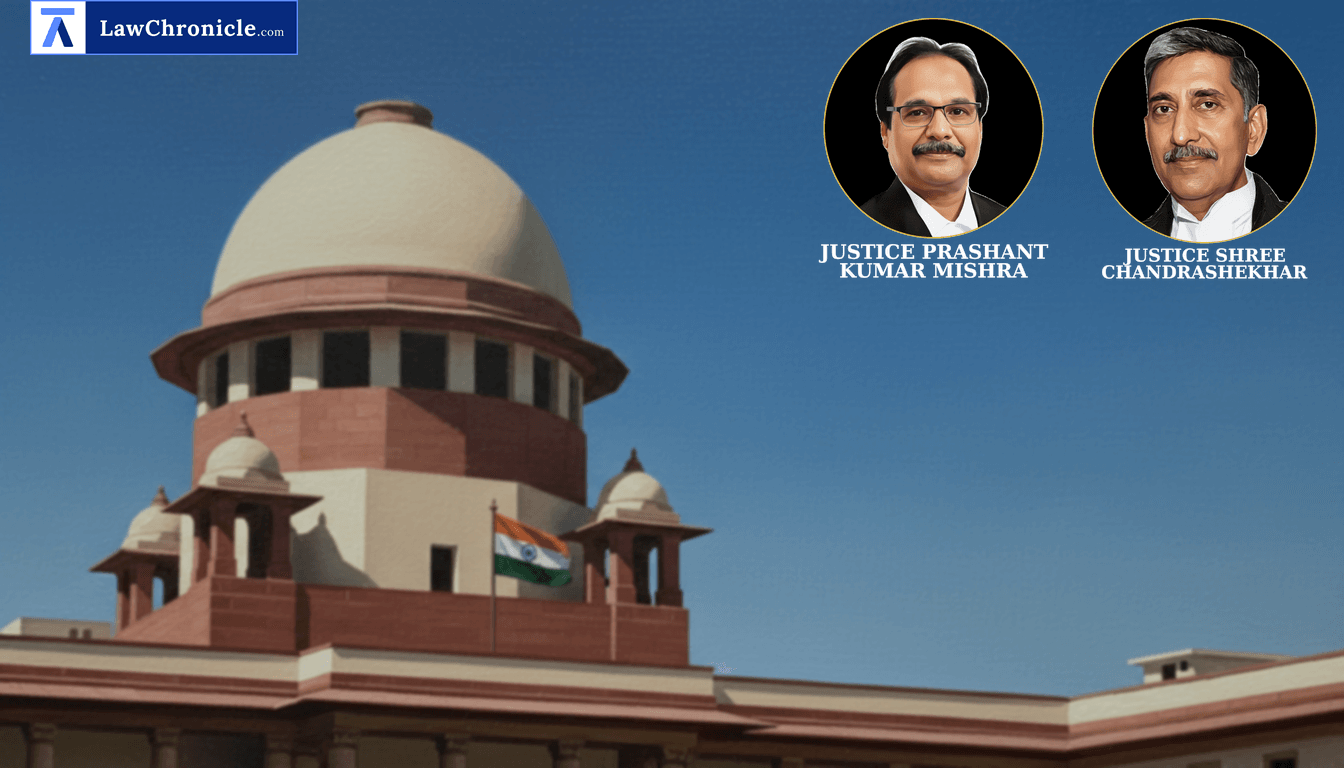
Shutting the door on proxy litigation aimed at bypassing civil remedies, the Supreme Court held that High Courts err in exercising writ powers to shield possession when serious title and factual disputes exist. The Bench emphasized that Lessees cannot invoke writ jurisdiction under Article 226 of the Constitution of India, 1950 to obtain possessory protection after the primary owner's challenge has been withdrawn with liberty limited strictly to filing a civil suit.
A Bench of Justice Prashant Kumar Mishra and Justice Shree Chandrashekhar set aside High Court orders that had temporarily restrained state authorities from taking over a premises and directed the unlocking of a function hall.
Key Takeaways
No Proxy Writ Litigation: Lessees claiming rights through an owner cannot file independent writ petitions to secure interim orders that the owner was denied.
Limits of Article 226 Jurisdiction: High Courts cannot determine questions of possession or grant possessory relief under Article 226 when complex factual disputes over government land arise.
Exhaustion of Civil Remedies: Once a litigant withdraws proceedings with liberty to approach a civil court without interim protection, parallel writ proceedings cannot be entertained.
High Court Cannot Decide Disputed Possession Under Article 226
The Supreme Court underscored that writ courts are fundamentally unsuited for adjudicating contested factual claims of possession over disputed properties. Highlighting how the lessees initiated writ proceedings immediately after the primary trust withdrew its challenge, the Apex Court observed that such filings represent a calculated maneuver to secure interim protection that could only be granted by a civil court.
The Bench discussed that “...once the Special Leave Petition preferred by the Trust was disposed of as withdrawn without interfering with the order passed by the Division Bench of the High Court on 07.09.2022 in Writ Appeal No.1243 of 2005 reserving liberty in favour of the Trust to avail the remedy of preferring a fresh suit, it was not open for the lessees to prefer a writ petition as the lessees are claiming possession through the Trust against whom the Division Bench of the High Court has already passed an order and the Special Leave Petition against the same has been withdrawn. The learned Single Judge and the Division Bench could not have exercised the writ jurisdiction in the teeth of the earlier orders passed by the Division Bench and this Court.”
Ratio
When a primary land claimant withdraws its proceedings with liberty to file a civil suit without obtaining interim protection, lessees claiming through such claimant cannot invoke writ jurisdiction under Article 226 of the Constitution of India, 1950 solely to secure possessory relief against the State.
Background
The dispute originated in June 1997 when the Mandal Revenue Officer issued a notice under Section 7 of the Andhra Pradesh Land Encroachment Act, 1905 to M/s. Kishan Chand Foundation Trust, demanding eviction from 4,678 square meters of land in Hyderabad. The Trust claimed ownership based on a 1968 registered sale deed. A civil suit filed by the Trust was dismissed on pecuniary jurisdiction grounds, and a subsequent appeal was dismissed for non-prosecution, leading to eviction orders under Section 6 of the Andhra Pradesh Land Encroachment Act, 1905.
Although a Single Judge of the High Court initially quashed the eviction notices, a Division Bench reversed this ruling on appeal, holding that writ courts under Article 226 of the Constitution of India, 1950 cannot declare possession or title amidst serious factual disputes. The Trust challenged this before the Supreme Court but eventually withdrew the petition with liberty to institute a fresh civil suit, without receiving any interim protection.
Immediately thereafter, M.A. Garden Function Hall and other lessees claiming rights through the Trust filed fresh writ petitions before the High Court. A Single Judge directed the Mandal Revenue Officer to unlock the premises and granted temporary protection against dispossession. The Division Bench affirmed this order. Allowing the State's appeal, the Supreme Court set aside both High Court orders, emphasizing that the pending civil suit must be decided strictly on its own merits.
Case Details:
Case No.: Civil Appeal No(s). 12895-12896 of 2026
Neutral Citation: 2026 INSC 995
Case Title: The State of Telangana and Others v. M.A. Garden Function Hall and Others etc.
Source: 2026 CaseBase(SC) 6998
 Breaking News