


Limitation Is No Mere Technicality; Courts Cannot Condone Delay As Act Of Generosity: Allahabad HC
 Copy Link
 Share
 Save
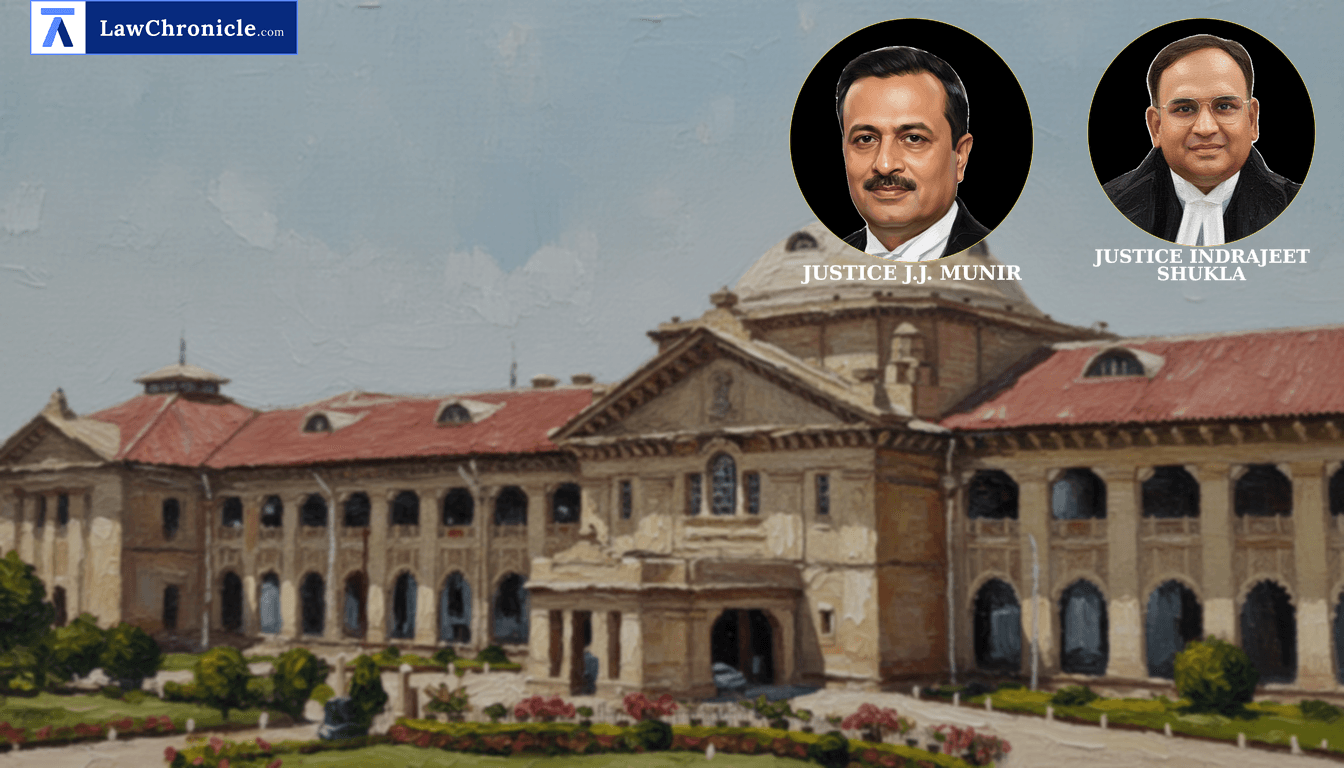
The Allahabad High Court has ruled that judicial discretion to condone delay is not a license for generosity but must be grounded in a rigorous assessment of 'sufficient cause.' The High Court held that a jurisdictional error is committed when a trial court brushes aside an inordinate delay, even decades long, without recording specific findings on the reasons for such inaction.
A bench comprising Justice J.J. Munir and Justice Indrajeet Shukla heard the appeal challenging an order that had set aside a 21-year-old ex-parte divorce decree. The Court scrutinized the balance between the 'justice-oriented' approach of hearing matters on merits and the statutory mandate of Section 3 of the Limitation Act, 1963, which compels the dismissal of time-barred applications unless delay is formally condoned.
Key Takeaways
Limitation Is A Jurisdictional Bar
Until a delay is condoned, an appeal or application is non-est in the eyes of the law, and courts cannot bypass Section 3 of the Limitation Act, 1963.
Sufficient Cause Over Duration
While the length of delay (even 21 years) is not the sole criterion, the 'acceptability' of the explanation is paramount, and courts must record specific satisfaction regarding the cause shown.
Enquiry Into Service of Summons
When setting aside ex-parte decrees under Order IX Rule 13 of the Code of Civil Procedure, 1908, courts must conduct a factual enquiry into the validity of service acknowledgments rather than relying on legal fictions.
Restoration of Finality
Rules of limitation are founded on public policy to ensure that litigation reaches a final conclusion, preventing 'unending uncertainty and consequential anarchy.'
Mandatory Condonation Before Substantive Orders
The High Court observed that the Trial Court had allowed the restoration application without adverting to a single word on the point of limitation, despite a 21-year delay. The Bench emphasized that the 'sufficient cause' mentioned in the statute must receive a liberal construction to advance substantial justice, but this cannot be allowed a 'totally unfettered free play.'
The Allahabad High Court, in its reasoning, observed: "It is a settled law that a Court can exercise jurisdiction only if application or appeal is within limitation or the delay in filing is condoned and the proceedings deemed to be within limitation by fiction of law. But, in the case in hand, the Trial Court had completely brushed aside the point of limitation though, apparently it was clear that application for setting aside ex-parte decree had been filed after 21 years."
Ratio
The exact rule of law established is that the issue of condonation of delay under Section 5 of the Limitation Act, 1963 must be decided as a jurisdictional prerequisite before the Court proceeds to pass any interim or substantive order on the merits. A court cannot disregard the plea of limitation or condone delay merely as an act of generosity; it must record a reasoned satisfaction that 'sufficient cause' existed, as the law of limitation is founded on public policy and the maxim 'interest reipublicae ut sit finis litium.'
Background
The dispute originated from a marriage in 1981, following which the appellant-husband obtained an ex-parte divorce decree in 1990 on grounds of adultery. The respondent-wife moved an application under Order IX Rule 13 of the Code of Civil Procedure, 1908 only in 2011, after a gap of 21 years, claiming she was never served summons. While the trial court record suggested service was sufficient based on an acknowledgment, the wife disputed this, asserting she was an illiterate lady who had no knowledge of the decree.
The Additional Principal Judge, Family Court, Ballia, allowed her application and set aside the divorce decree, prompting the husband to appeal under Section 19 of the Family Courts Act, 1984. The appellant argued that the delay was not explained on a day-to-day basis and relied on Thirunagalingam vs. Lingeswaran & Anr ( "2025 INSC 672": 2025 CaseBase(SC) 401) to show that the wife had constructive knowledge of his second marriage. The High Court, while acknowledging precedents like N. Balakrishanan Vs. M. Krishnamurthy ( "(1998) 7 SCC 123": 1998 CaseBase(SC) 331) and Ram Nath Sao alias Ram Nath Sahu and others Vs. Gobardhan Sao and others which advocate for substantial justice over technicalities, found the trial court's order 'cryptic and laconic.' The ALlahabad High Court also referenced Dwarka Prasad (D) through LRs v. Prithviraj Singh to clarify that a separate application for delay is not mandatory if the main application contains sufficient explanation, but the trial court must still adjudicate on that explanation.
Case Details:
Case No.: FIRST APPEAL No. - 120 of 2020
Case Title: Lallu Ram Versus Shiv Kumari Devi
Appearances:
For the Petitioner(s): Arvind Srivastava Iii, Advocate
For the Respondent(s): Rajesh Kumar Srivastava, Advocate
Source: 2026 CaseBase(ALL) 888
Similar Articles
 Breaking News


