Location of Sub-Tehsil is Executive Policy Beyond Judicial Review: Himachal Pradesh HC
 Copy Link
 Share
Share Save
Save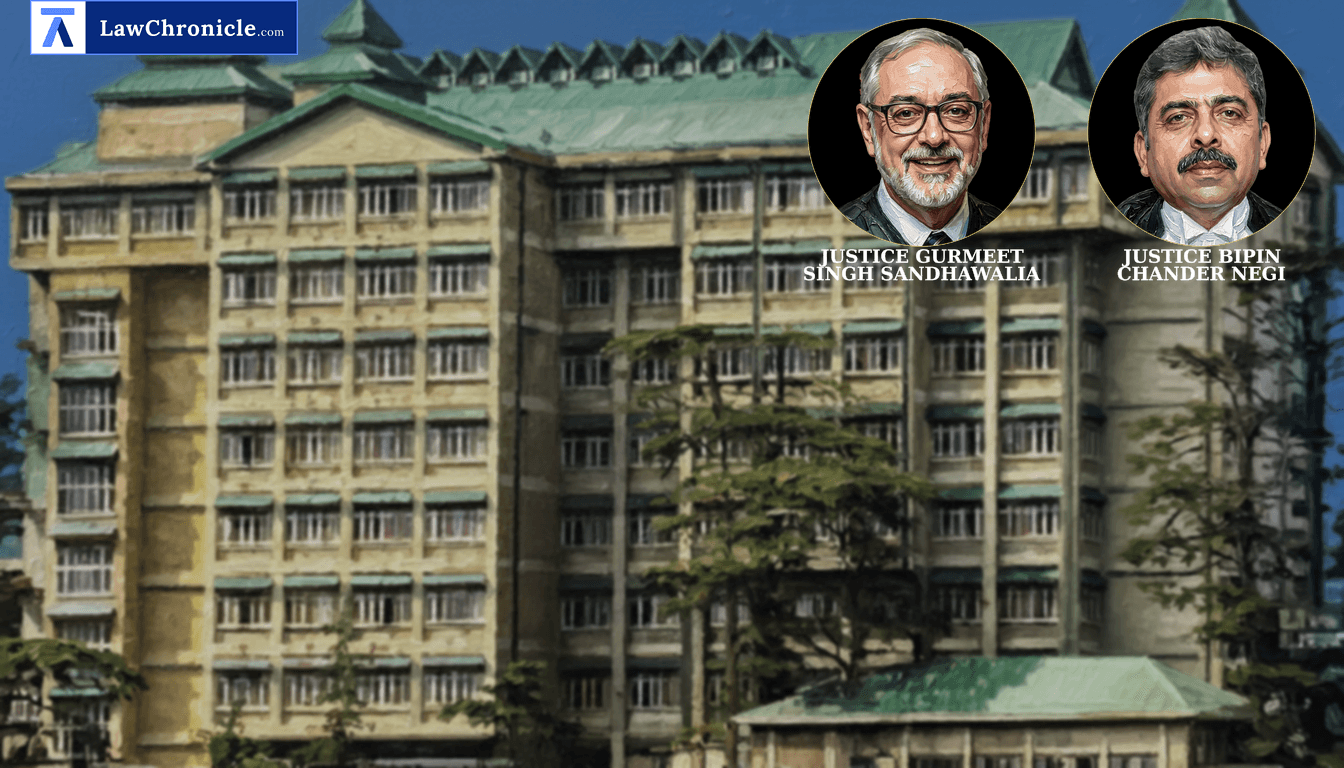
Courts cannot sit in appeal over the State's administrative choice for locating government offices, as such decisions involve complex geographical and financial factors beyond judicial expertise. In a firm reassertion of the limits of judicial review, the High Court of Himachal Pradesh dismissed a challenge to the creation of a new Sub-Tehsil, holding that the judiciary lacks the mandate to evaluate the comparative merits of one location over another for administrative headquarters.
Deciding a Letters Patent Appeal against a Single Judge's order, a Bench comprising Chief Justice G.S. Sandhawalia and Justice Bipin Chander Negi affirmed that the creation and location of administrative units like Sub-Tehsils are matters of policy. The appellant had challenged a notification creating a Sub-Tehsil at Bagshad instead of Tattapani, expressing fears that a camp office at the latter might eventually be closed.
Key Takeaways
Judicial Restraint in Policy Matters
Courts will not interfere in purely administrative decisions regarding the location of government offices unless there is a clear breach of justiciable guidelines.
Executive Prerogative Upheld
Decisions on administrative headquarters are based on public demand, geographical conditions, and financial liabilities, which fall within the State's discretion.
Presumption of Reasonableness
Government actions are presumed to be reasonable and in the public interest, placing a heavy burden of proof on the petitioner to demonstrate otherwise.
Limited Scope of Mandamus
High Courts cannot issue a mandamus to shift a headquarters to a specific place, as evaluating the merits of one location over another is not a judicial function.
Limited Scope of Judicial Review in Administrative Location
The Court observed that the creation of a Sub-Tehsil is dependent upon various factors and the writ Court cannot evaluate for itself the comparative merits of a particular place. Relying on the principles established in J.R. Raghupathy and Ors. Vs. State of AP and Ors., the Bench noted that even if a breach of guidelines were assumed, the most a Court could do is direct reconsideration, not order the shifting of headquarters to a specific village.
The Court, in its reasoning, observed: "the High Court had no jurisdiction to sit in appeal over the decision of the State Government to locate the Mandal Headquarters at a particular place. The decision to locate such Headquarters at a particular village is dependent upon various factors. The High Court obviously could not evaluate for itself the comparative merits of a particular place as against the other for location of the Mandal Headquarters."
Burden of Proof on the Challenger
Referring to Amar Singh and others vs. State of H.P. and another, the Court reiterated that there is a presumption that governmental action is reasonable. The Bench emphasized that differences of opinion between the public and the government do not equate to unreasonableness. Citing G.B. Mahajan v. Jalgaon Municipal Council ( "(1991) 3 SCC 91": 1990 CaseBase(SC) 376), the Court noted that administrative discretion involves the right to choose between multiple possible courses of action.
Ratio
The creation and location of a new Sub-Tehsil is a policy decision of the Government that is not ordinarily amenable to writ jurisdiction under Constitution of India, 1950. The judiciary lacks the jurisdiction to evaluate the comparative merits of administrative locations, as these decisions are influenced by departmental norms, geographical conditions, and financial implications. In the absence of an infraction of justiciable guidelines, the Court cannot interfere with the executive's discretion to determine the site of administrative headquarters.
Background
The dispute originated from a notification dated 24.08.2021, whereby the State created a new Sub-Tehsil at Bagshad, District Mandi. The appellant, an unregistered Samiti, sought a mandamus to instead create the Sub-Tehsil at Tattapani, arguing that Tattapani was more suitable and fearing the future closure of its camp office. The State contested this, showing that Bagshad was chosen based on long-standing public resolutions from 1999 and that creating a Sub-Tehsil at Tattapani would necessitate a new Kanungo Circle, leading to unjustified financial liability.
The Bench further noted that similar challenges regarding the shifting of a Government College or offices have been consistently dismissed, citing precedents such as Nand Lal & another vs. State of H.P. and others, Manohar Lal Sharma vs. Union of India and another ( "(2013)6 SCC 616": 2013 CaseBase(SC) 302), Mrs. Asha Sharma vs. Chandigarh Administration and others, and Adikanda Biswal And Ors. vs Bhubaneswar Development Authority. Finding no infirmity in the Single Judge's dismissal of the writ petition, the Bench dismissed the appeal.
Case Details:
Case No.: LPA No.8 of 2025
Neutral Citation: 2026:HHC:38649
Case Title: Jan Kalyan Sangharsh Samiti Vs. State of HP
Appearances:
For the Petitioner(s): Mr. Hirdaya Ram, Advocate.
For the Respondent(s): Mr. Pranay Pratap Singh, Additional Advocate General; Mr. Lal Singh Mehta, Advocate for proposed respondents.
Source: 2026 CaseBase(HP) 8005
 Breaking News