Lok Adalat Cannot Decide Disputed Land Title Claims Or Apply Class Action Principles: SC
 Copy Link
 Share
Share Save
Save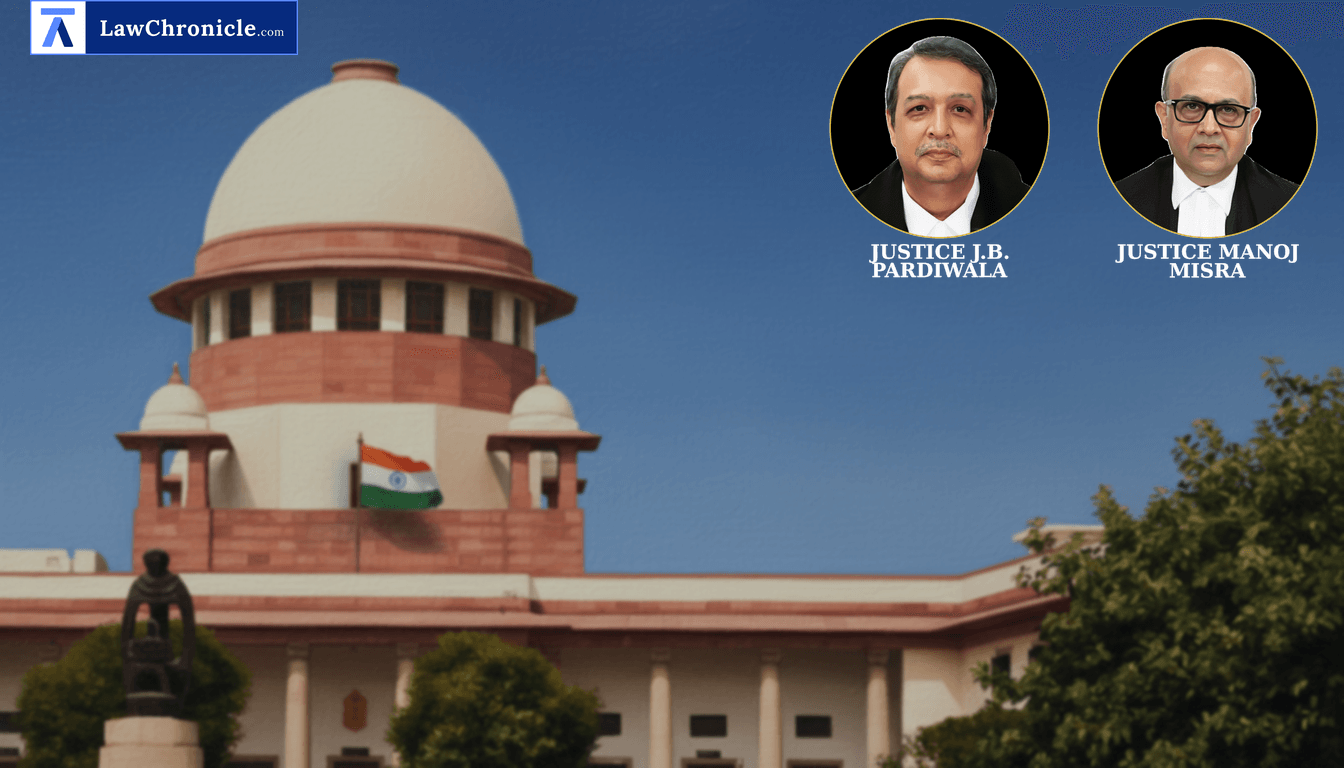
Striking at the core of procedural overreach in alternative dispute resolution mechanisms, the Supreme Court ruled that Lok Adalats lack the legal jurisdiction to adjudicate disputed land titles or bypass mandatory signatures of all competing claimants by misapplying class action principles.
A Division Bench comprising Justice J.B. Pardiwala and Justice Manoj Misra delivered the judgment while allowing an appeal against an order of the High Court of Telangana, which had wrongly affirmed Lok Adalat awards resolving title disputes through revenue enjoyment surveys without the consent of all affected landowners.
Key Takeaways
No Adjudication Powers: Lok Adalats are consensus-based forums and cannot substitute civil court adjudication to determine disputed title or legal ownership under land acquisition proceedings.
Enjoyment Surveys Non-Conclusive: Administrative enjoyment surveys capturing mere physical possession do not establish legal title or statutory entitlement to compensation.
Inapplicability of Order I Rule 8: Representative proceeding principles under the Code of Civil Procedure, 1908 cannot be invoked in Lok Adalats to bind non-consenting rival claimants sharing adverse, competing interests.
Strict Compliance with Regulations: An award passed by a Lok Adalat without the signatures of all disputed title-holders is fundamentally void and legally unenforceable.
Court's Analysis on Title Disputes and Enjoyment Surveys
The Supreme Court observed that when a statutory reference is made under Section 30 of the Land Acquisition Act, 1894, it signifies an acknowledgment that no mutual agreement exists among interested parties under Section 29. The Court held that an enjoyment survey merely captures physical occupation and cannot serve as the legal foundation for determining ownership or entitlement to public funds.
Quoting the governing statutory framework, the Court noted that once a title dispute arises, the acquiring body steps back, leaving the contest purely between rival claimants. The Court, in its reasoning, observed: "An enjoyment survey captures nothing more than the fact of physical occupation on the land at the time it is conducted. It does not purport to examine the legal title, right, or interest by virtue of which such occupation is held. In such circumstances, the findings of such survey cannot be treated as conclusive of entitlement to compensation."
Addressing the High Court's reliance on representative proceedings to sustain the non-consensual awards, the Bench rejected the application of Order I Rule 8 of the Code of Civil Procedure, 1908. The Court stated: "A representative suit under Order I Rule 8 presupposes a community of interest among the persons represented, as the interest of those who are being represented is adequately protected by those who are representing them. It would be wholly inappropriate to a proceeding where the subject matter of the dispute is the bone of contention between the claimants themselves and they are not the 'two parties' arriving at a settlement."
The Court also affirmed that Regulation 13(6) and Regulation 17(2) of the National Legal Services Authority (Lok Adalats) Regulation, 2009 strictly necessitate the execution of the award by all disputing parties. Relying on State of Punjab v. Jalour Singh ( "(2008) 2 SCC 660": 2008 CaseBase(SC) 455), the Bench reaffirmed that Lok Adalats cannot assume adjudicatory roles. Further citing G.H. Grant (Dr) v. State of Bihar, Sharda Devi v. State of Bihar ( "(2003) 3 SCC 128": 2003 CaseBase(SC) 613), Gudala Pentamma v. State of Telangana, and Kottamula Mallaiah v. The State of Telangana, the Bench emphasized that land acquisition references must be adjudicated rigorously in accordance with statutory provisions when true compromise fails.
Court Directions
The Court has following directions:
"...set aside the impugned judgment and order passed by the High Court and remit the matter to the Court of Principal District Judge, Khammam, for de novo hearing of reference as expeditiously as possible, not later than six months from the date of the pronouncement of this judgment, by duly putting all the parties concerned to notice in accordance with law. The Court must decide the apportionment reference uninfluenced by any observations."
Ratio
A Lok Adalat award resolving land compensation apportionment without obtaining the signatures and explicit consent of all conflicting title claimants is a nullity. Lok Adalats cannot determine disputed questions of title based on revenue enjoyment surveys, nor can representative action principles under Order I Rule 8 of the Code of Civil Procedure, 1908 be imported to bind non-signatory rival claimants in compromise awards.
Background
The dispute stems from the acquisition of 489.04 acres of land in Khammam district for mining operations by Singareni Collieries Company Ltd. under the Land Acquisition Act, 1894. The Land Acquisition Officer determined compensation but referred the matter under Sections 30 and 31 to the Principal District Judge, Khammam, due to rival title disputes, registered as LAOP No. 619 of 2014.
During parallel writ proceedings challenging the acquisition, the High Court Legal Services Committee initiated settlement meetings. Consequently, an enjoyment survey was conducted, and the Lok Adalat Bench at Khammam passed 16 awards in 2016 apportioning compensation. However, several pattadars and legal title-holders were neither made parties to the compromise nor signed the awards.
When non-signatory claimants challenged the awards in a second round of writ litigation, the Principal District Judge, Khammam, formally addressed a letter to the High Court acknowledging that the Lok Adalat had misunderstood directions and passed awards without resolving title disputes among inter se claimants. Despite this anomaly, the Telangana High Court dismissed the writ petition, holding that the proceedings were akin to a class action suit under Order I Rule 8 of the Code of Civil Procedure, 1908. Setting aside this ruling, the Supreme Court allowed the appeal and remitted the matter back for fresh adjudication.
Case Details:
Case No.: Civil Appeal No. 7838 of 2024
Neutral Citation: 2026 INSC 888
Case Title: Singapogu Babu Rao & Ors. v. Special Deputy Collector (Land Acquisition) & Ors.
Appearances:
For the Petitioner(s): Mr. Gaichangpou Gangmei, Advocate
For the Respondent(s): Mr. P. Parmeswaran, Advocate; Mr. Siddhartha Sinha, Advocate
Source: 2026 CaseBase(SC) 802
 Breaking News