Madras HC Enhances Compensation for Road Accident Victim in Persistent Vegetative State
 Copy Link
 Share
Share Save
Save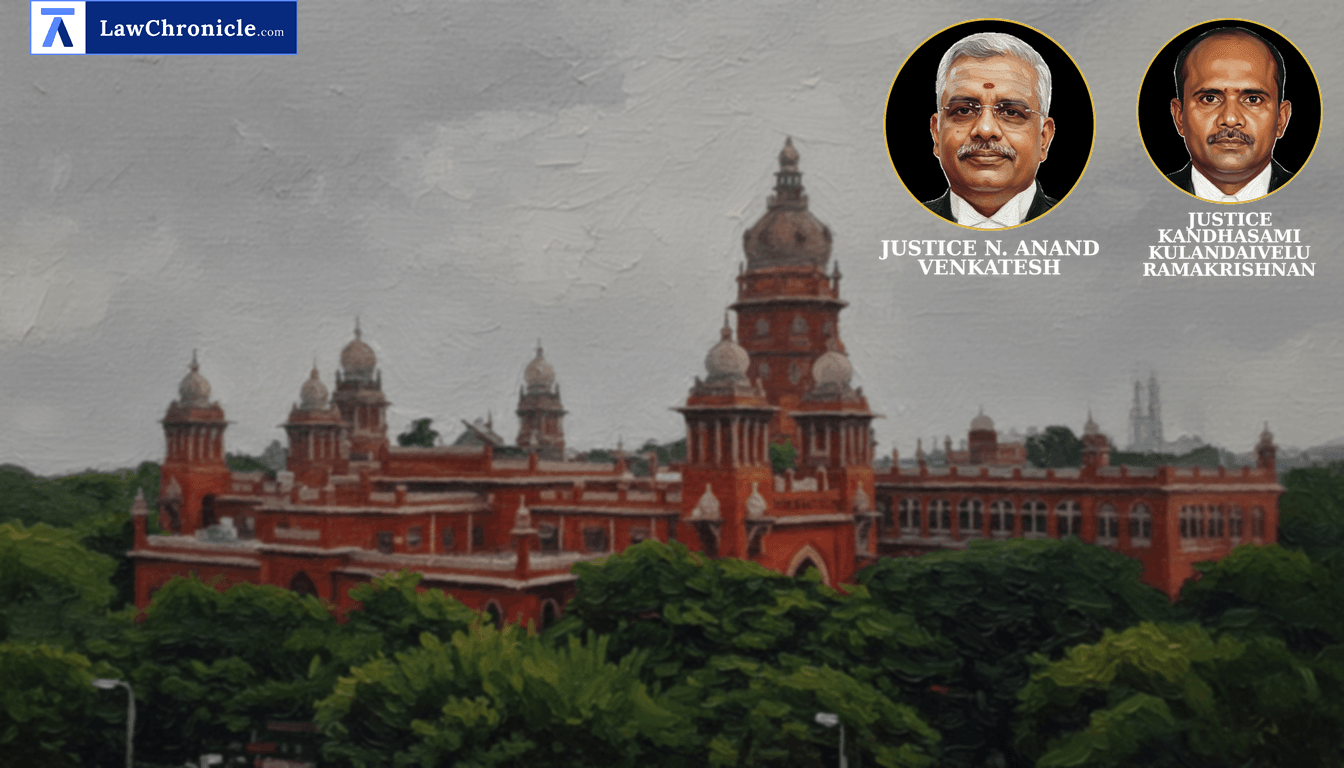
Prioritizing substantive justice over procedural technicalities, the Madras High Court enhanced the compensation awarded to a road accident victim who was left in a persistent vegetative state, invoking its plenary powers despite the absence of a cross-appeal for enhancement.
A division bench comprising Justice N. Anand Venkatesh and Justice K. K. Ramakrishnan heard the appeals filed by the Insurance Company challenging the liability and quantum of compensation in a complex case involving successive accidents. The Court noted with profound concern the "pitiable and distressing condition" of the claimant, who suffered a catastrophic spinal cord injury that left him paralyzed and dependent on artificial sustenance.
Liability and Successive Accidents
The case involved two distinct accidents occurring on the same night. The first respondent (son) initially sustained simple injuries when his car was struck by a van. While being transported to a private hospital in an ambulance, a second collision occurred with an omnibus insured by the appellant. The Court rejected the appellant's contention that the spinal injury occurred during the first accident, noting that contemporaneous medical records and the claimant’s explanation for inadvertent errors in pleadings clearly pointed to the second accident as the cause of the permanent disability.
The Duty of Counsel and Just Compensation
The Court expressed serious concern over the failure of the claimant's counsel to file a cross-appeal for enhancement of compensation, describing it as a "dereliction of professional duty." However, the bench emphasized that such inaction should not penalize a victim suffering in a "silent existence suspended between being and non-being."
The Court, in its reasoning, observed: "This is a case not merely a case of injury and is not a case of mere survival where life itself has been hollowed out and has been reduced to its barest mechanical existence, leaving behind only a breathing shell i.e. The victim breathes, yet does not live in any meaningful sense. Consciousness has receded into silence—he neither perceives nor responds to the world around him."
Enhancement Under Order XLI Rule 33 of CPC
Invoking Section 173 of the Motor Vehicles Act, 1988 and Order XLI Rule 33 of the Code of Civil Procedure, 1908, the Court held that it is duty-bound to award "just compensation" irrespective of technical pleadings. Drawing from precedents like Nagappa v. Gurudayal Singh and Surekha v. Santosh ( "(2021) 16 SCC 467": 2020 CaseBase(SC) 1026), the Court significantly increased the awards for attendant charges, pain and suffering, and loss of amenities.
The Court has the following directions:
"The appeal filed by the appellant–Insurance Company in C.M.A.(MD).No.21 of 2021 stands dismissed with modification of award in of compensation by enhancing the award amount in M.C.O.P.No.62 of 2015 from Rs.33,00,000/- to Rs.57,98,000/- with interest of 7.5 % to the enhanced amount of Rs.24,98,000/- from the date of this judgment. The first respondent in C.M.A.(MD).No.21 of 2021 is hereby directed to pay court fee for the above enhanced amount. The appellant–Insurance Company is directed to deposit the enhanced compensation amount, together with applicable interest, within the time stipulated by the Tribunal."
Case Details:
Case No.: C.M.A.(MD).Nos.21 and 181 of 2021
NeutralCitation: 2026:MHC:1797
Case Title: The Divisional Manager, United India Insurance Co.Ltd. v. Kathiresan and others
Appearances:
For the Petitioner(s): Mr.G.Prabhu Rajadurai
For the Respondent(s): Mr.R.Jim (Caveator for R1), Mr.V.Sakthivel (for R3 and R5), Mr.R.Karunanithi (for R2)
Source: 2026 CaseBase(MAD) 269
 Breaking News