Maharashtra’s 1-year Non-Dairy Paneer Ban Explained
 Copy Link
 Share
Share Save
Save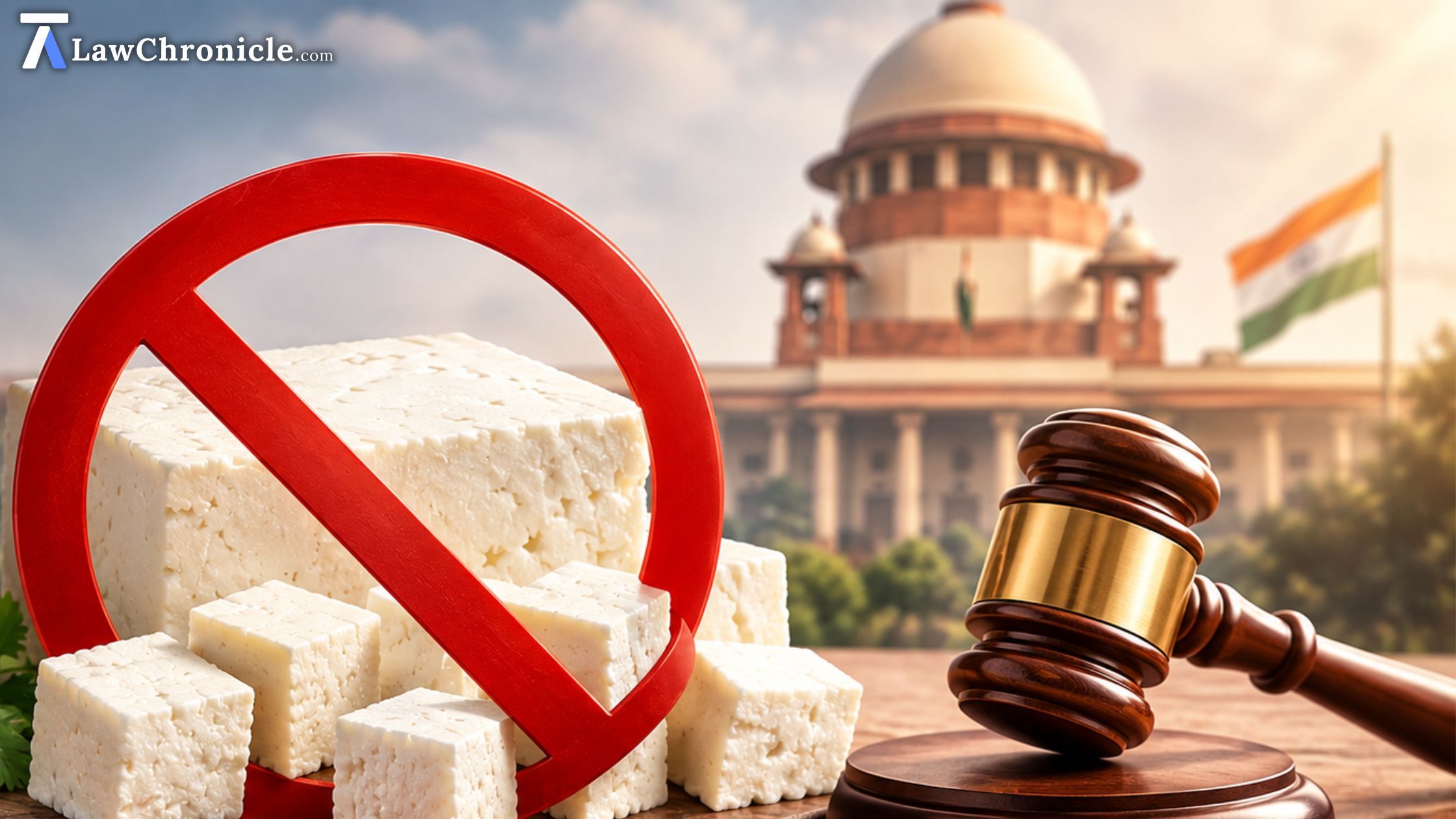
The Commissioner, Food and Drug Administration, Maharashtra State, has issued a gazette notification on non-dairy paneer ban in the State for a year. The notification prohibits manufacture, storage, distribution (including transport) and sale of analogue/non-dairy paneer across the State for a period of one year. The Order dated 30th July 2026 has been issued by Tukaram Mundhe, I.A.S., Food Safety Commissioner, in exercise of powers under Section 30(2)(a) of the Food Safety and Standards Act, 2006, read with Sections 18 and 29 of the Act.
Background
The Supreme Court of India, in Swami Achyutanand Tirth & Ors. v. Union of India & Ors. (2016 CaseBase(SC) 171), had taken note of large-scale adulteration of milk and milk products, including the use of refined/vegetable oil as a substitute for milk fat. The Apex Court had directed the Union and State Governments to implement Food Safety Laws more effectively, including by identifying high-risk areas and high-risk times such as festival seasons for intensified sampling, ensuring NABL-accredited testing infrastructure and mobile food-testing facilities, and constituting State- and district-level committees to review anti-adulteration efforts.
The Maharashtra order on non-dairy paneer ban also notes that the Central Advisory Committee constituted under the Act, at its 48th meeting held on 14 October 2025, deliberated on "Analogue in Dairy Context" products. The Committee recorded that no quality parameters are defined for analogue paneer ban, making field-level enforcement difficult, that it provides no nutritional benefit particularly to vegetarians dependent on paneer as a protein source, and that the choice between analogue and genuine paneer cannot be left to consumer discretion given prevailing awareness levels. The Committee recommended that non-standardised, nutritionally non-beneficial dairy analogues such as analogue paneer should not be permitted.
According to the Order, samples of paneer and dairy analogue collected between 1 April 2025 and 31 March 2026 were sent for analysis to notified Food Laboratories. Of 308 samples analysed as on date, 109 samples, 35.4% of those analysed, were found non-conforming, comprising 79 sub-standard and 30 unsafe samples. Analysis of extracted fat showed Butyro-refractometer (BR) readings and Iodine Values outside the limits prescribed for milk fat in a significant proportion of samples, indicating addition or substitution of vegetable (foreign) fat not naturally present in milk.
Legal Status of Paneer and Analogue Products
The Order states that paneer is a standardised food under Regulation 2.1.16 of the Food Safety and Standards (Food Products Standards and Food Additives) Regulations, 2011, defined as the product obtained from milk by precipitation with permitted acidulants: lactic acid, citric acid, malic acid, vinegar, glucono delta lactone or sour whey, and heating. Milk fat is stated to be an essential constituent, and substitution or addition of vegetable oil, vegetable fat or any non-milk fat is not permitted.
A product resembling paneer in which milk fat or milk solids are replaced wholly or partly by non-milk constituents is classified as an "analogue in dairy context" under Regulations 2.1.1(3)(f) and 2.1.1(5)(b). Such a product cannot be named, sold or served as "Paneer," and is required to carry declarations in close proximity to the product name disclosing the substitution. for example, "Contains Vegetable Fat" and "Contains no milk fat" under Regulation 2.1.1(5)(b). Any analogue/non-dairy product sold or served as paneer is stated to be misbranded, and where prepared from non-food-grade or non-conforming ingredients, unsafe within the meaning of the Food Safety Act.
The Maharashtra Govt. Order on non-dairy paneer ban also sets out the standards under Regulation 2.1.16, as amended by the Food Safety and Standards (Food Products Standards and Food Additives) Fifth Amendment Regulations, 2019, prescribing three categories of paneer by milk-fat content:
- Paneer/Chhana (regular/full-fat): Maximum moisture of 65% (Chhana) or 60% (Paneer); milk fat not less than 50% on dry-matter basis; may be sold loose or pre-packed.
- Medium Fat Paneer/Chhana: Same moisture limits; milk fat more than 20% and less than 50%; sealed package only, with prescribed declaration.
- Low Fat Paneer/Chhana: Maximum moisture of 70%; milk fat not more than 20%; sealed package only, with prescribed declaration.
No product not conforming to this Standard, and in particular no analogue/non-dairy paneer, may be named, sold or served as "Paneer."
The Order further records observations that hotels, restaurants, caterers, eateries and other food service establishments have, in numerous instances, used analogue/non-dairy paneer in place of genuine paneer without disclosure on menu cards, invoices or display boards, and that loose paneer is frequently transported and sold without packaging, label declarations, invoices, batch identification or traceability documents.
Key Directions in Maharashtra Analgue Paneer Ban Order
1. Definition: "Analogue/non-dairy paneer" is defined as any product resembling paneer in which milk fat or milk solids are replaced wholly or partly by vegetable oil, vegetable fat or other non-milk-derived constituents.
2. Prohibition on analogue/non-dairy paneer: The manufacture, processing, preparation, packing, storage, distribution (including transportation), wholesale and retail sale, and offering or exposing for sale of analogue/non-dairy paneer, by whatever name called, is prohibited throughout Maharashtra for one year from the date of publication of the Order in the Official Gazette.
3. Food service establishments: No hotel, restaurant, caterer, eatery, cloud kitchen or other food service establishment may use, prepare, serve, store, stock or sell analogue/non-dairy paneer in any dish or preparation. The Order states that use or service of such analogue paneer, including in the guise of genuine paneer, amounts to an unfair trade practice within the meaning of Section 24 of the Act and a contravention of Food Business Operator responsibilities under Section 26.
4. Labelling compliance for genuine paneer: Food Business Operators manufacturing, packing, storing, distributing or selling paneer/chhana must ensure every package bears declarations prescribed under the Food Safety and Standards (Labelling and Display) Regulations, 2020, failing which the article is liable to be treated as misbranded under Section 52 of the Act.
5. Penalties: Contravention of the Order is punishable under the applicable penal provisions of the Food Safety and Standards Act, 2006, including Sections 50, 51, 52, 55 and 59, and the offending article is liable to seizure and destruction in accordance with law.
6. Commencement and duration: The Order takes effect from the date of its publication in the Official Gazette and remains in force for one year, unless earlier rescinded, modified or extended in accordance with law.
Scope of Maharashtra Non-Dairy Paneer Ban
The Order clarifies that it is directed at non-standardised dairy analogues for which no quality parameters are prescribed by the Food Authority, and does not extend to standardised products such as frozen dessert, processed cheese and mixed fat spread, for which standards have been separately notified.
 Breaking News