Mandatory Nature of Section 37 NDPS Act Cannot Be Dispensed With: SC
 Copy Link
 Share
Share Save
Save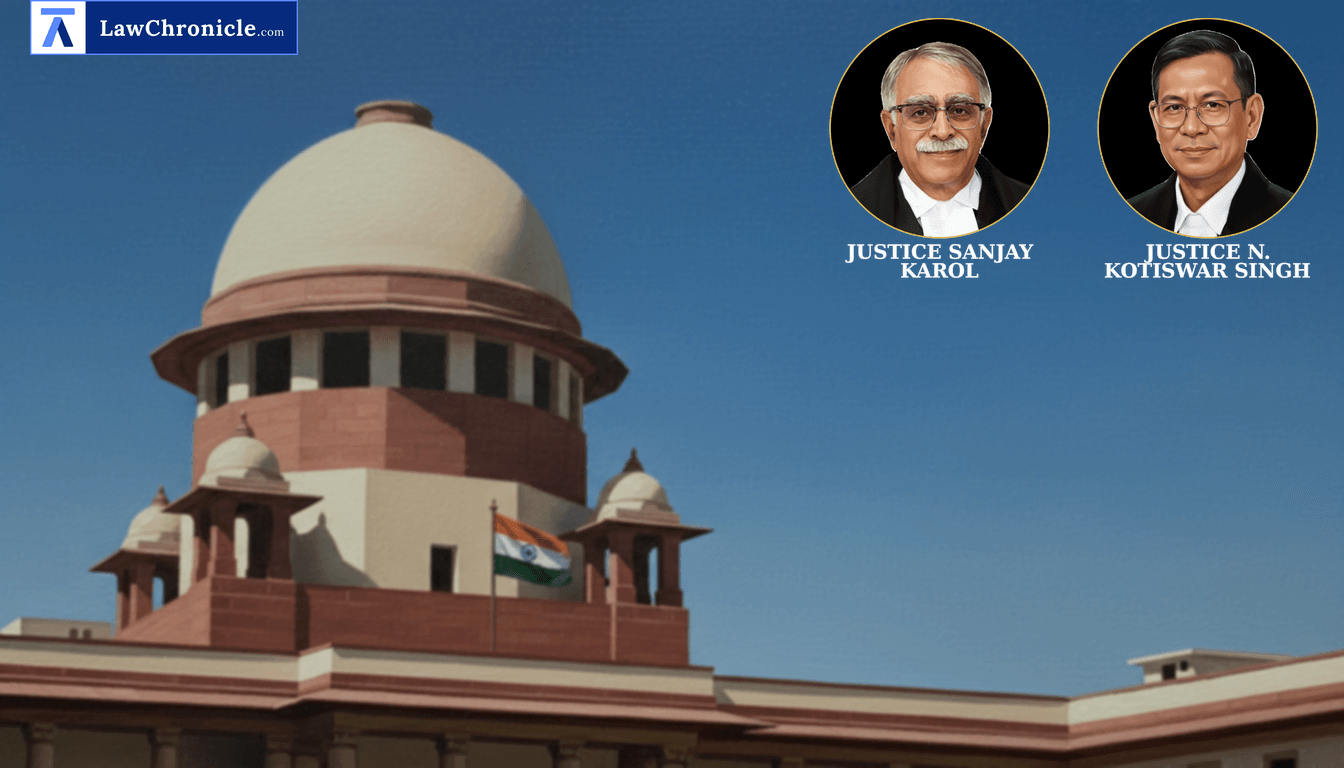
The Supreme Court has set aside a High Court order granting bail to an accused allegedly operating a drug trafficking network from prison, holding that the twin conditions under Section 37 of the Narcotic Drugs and Psychotropic Substances Act, 1985, are mandatory and cannot be overlooked merely because of prolonged incarceration.
A bench comprising Justice Sanjay Karol and Justice Nongmeikapam Kotiswar Singh heard the appeal filed by the State of Punjab against the Punjab and Haryana High Court's decision to grant regular bail to the respondent. The respondent was implicated in a case involving the recovery of 1.465 Kg of heroin, a commercial quantity, following disclosure statements from co-accused who alleged he was directing operations from Central Jail, Goindwal Sahib.
Mandatory Compliance with Section 37 NDPS Act
The Supreme Court observed that the High Court had erroneously granted bail without considering the rigorous requirements of Section 37(1)(b)(ii) of the Narcotic Drugs and Psychotropic Substances Act, 1985. The Bench noted that for offences involving commercial quantities, the court must be satisfied that there are reasonable grounds for believing the accused is not guilty and is not likely to commit any offence while on bail.
The Court, in its reasoning, observed: "Upon a bare perusal of the impugned order, it is evident that there has been no consideration at all by the High Court on the twin conditions. In such a scenario, the impugned order cannot be sustained in the eyes of law... there are antecedents involving commission of offences of the very same nature under the NDPS Act, therefore it cannot be said that he is not likely to commit such an offence while on bail."
Interplay Between Article 21 and Special Statutes
While the respondent argued that his incarceration for 1 year and 7 months warranted bail under Constitution of India, the Court held that given the maximum potential sentence of twenty years, the period was not "unreasonably long." The Court also highlighted the gravity of drug trafficking as a "war waged against the nation."
Background:
The dispute originated from an FIR registered on January 10, 2024, after police recovered heroin from a vehicle. The respondent was subsequently arrayed as an accused based on disclosures that he managed the supply via illegal mobile phones from jail. Although the High Court granted bail citing the likelihood of a long trial and the principle that antecedents alone aren't grounds for refusal, the Supreme Court relied on precedents like State of Meghalaya v. Lalrintluanga Sailo & Anr., Union of India v. Ajay Kumar Singh, and State by the Inspector of Police v. B. Ramu to reiterate that judicial discretion must stay within the bounds of statutory restrictions. The Court also referred to Ashok Dhankad v. State NCT of Delhi ( "2025 SCC OnLine SC 1690": 2025 CaseBase(SC) 731) regarding the distinction between appeals against grant of bail and cancellation of bail. Ultimately, the Bench allowed the State's appeal, noting that the mandatory nature of Section 37 cannot be dispensed with as held in Union of India v. Namdeo Ashruba Nakade.
Case Details:
Case No.: Criminal Appeal No. ____ of 2026 (@ SLP (Crl.) No. 896 of 2026)
NeutralCitation: 2026 INSC 618
Case Title: State of Punjab v. Balraj Singh @ Billa
Appearances:
For the Petitioner(s): Mr. Shadan Farasat, Senior Counsel; Mr. Rajat Bhardwaj, Additional Advocate General
Source: 2026 CaseBase(SC) 527
 Breaking News