


Manipur HC Refuses To Halt Multi-Crore Infrastructure Project Over Tender Objections
 Copy Link
 Share
 Save
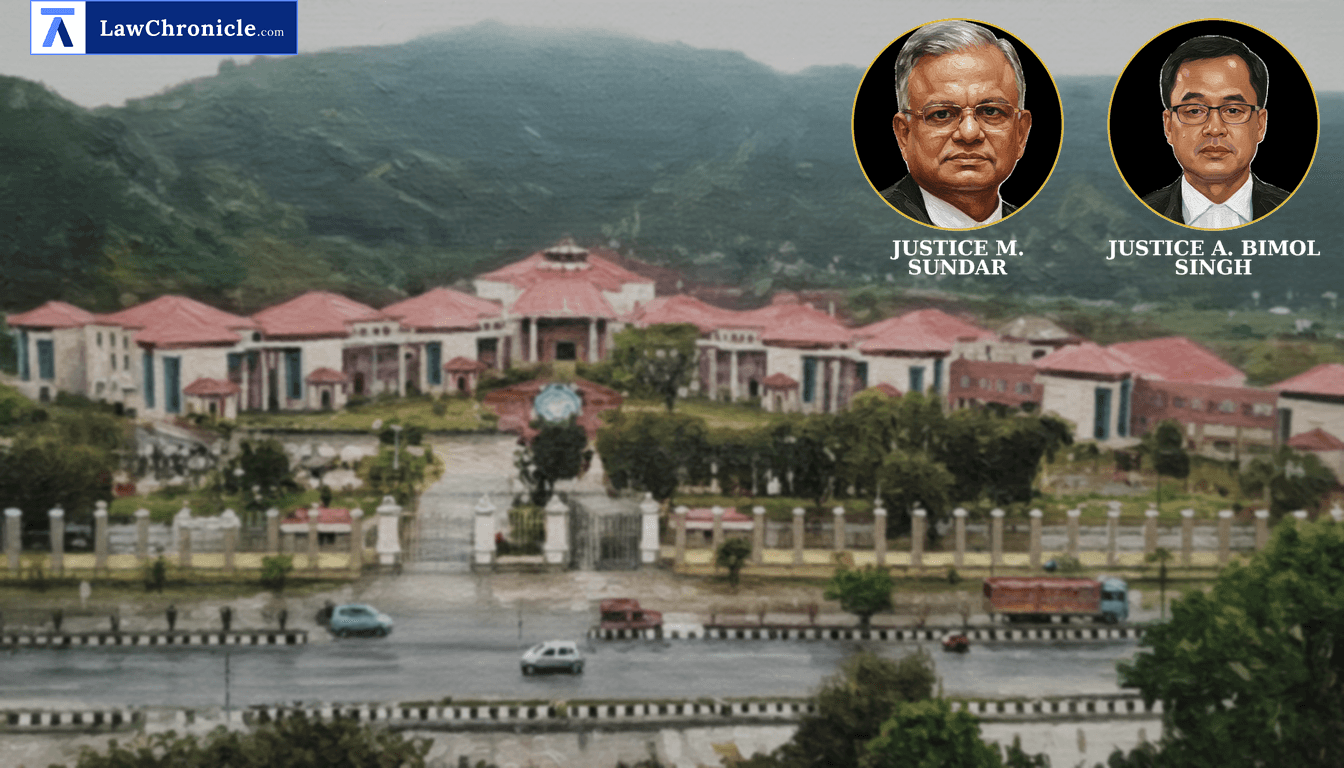
The Manipur High Court has slammed the brakes on judicial interference in public infrastructure projects, ruling that tender processes of immense public significance, particularly those under Centrally Sponsored Schemes, should not be derailed by the private grievances of unsuccessful bidders. This decision underscores the judiciary's commitment to ensuring that critical road construction projects, essential for regional connectivity, are not stalled by litigation that could lead to the lapsing of vital central funds.
A Division Bench comprising Chief Justice Mr. M. Sundar and Justice Ahanthem Bimol Singh delivered this judgment while dismissing an intra-court appeal challenging a Single Bench order that refused to grant interim relief against a multi-crore tender process. The Court emphasized the need for judicial restraint in administrative actions related to economic activities of the State, particularly when infrastructure development is at stake.
Key Takeaways
Public Interest Supersedes Individual Grievances
Infrastructure projects of public importance, especially road construction, must not be lightly interfered with by Courts to avoid administrative burdens and cost escalations.
Limited Scope of Judicial Review in Tenders
Courts should refrain from substituting their own expertise for that of the employer who authored the tender, provided the procedure contemplated is followed.
Strict Adherence to Tender Clauses
In the absence of specific provisions in the tender document (NIT), employers are not obligated to furnish detailed resolution reports or issue Show Cause Notices to bidders during technical evaluation.
Financial Consequences of Delays
Judicial intervention that causes delays in projects funded by Centrally Sponsored Schemes can lead to the lapsing of funds, causing irreparable loss to the State and its citizens.
Court's Rationale on Tender Interpretation
The Court observed that clauses in a Notice Inviting Tender (NIT) are to be construed as clauses in a contract rather than codified rules. Adverting to the legal principles established in Tata Cellular vs. Union of India ( "(1994) 6 SCC 651": 1994 CaseBase(SC) 278), which was reiterated in N.G. Projects Limited Vs. Vinod Kumar Jain and Others and M/S. AL-Can Export Private Limited vs. Prestige H.M. Polycontainers Limited & Others ( "(2024) 9 SCC 94": 2024 CaseBase(SC) 987), the Bench noted that the employer is in the best position to interpret the purpose and purport of the tender clauses. The Court, in its reasoning, observed: "...the tender document is authored by the owner (Employer) and the author of the tender document is in the best position to understand and appreciate the terms... The approach of the Court should be not to find fault with magnifying glass in its hands, rather the Court should examine as to whether the decision-making process is after complying with the procedure contemplated by the tender conditions."
Regarding the appellant's grievance that they were not furnished with the resolution of their complaint before the financial bids were opened, the Court found that Clause 22.6 of the Instruction to Bidder (ITB) only required the complaint to be 'considered for resolution'. Since the financial bids were opened only after such consideration was documented by the employer, the procedural requirement was met. The Court held that even if arbitrariness were alleged, the proper remedy would be to seek damages for wrongful exclusion rather than injuncting the execution of a public contract.
The Court has following directions:
"Ergo, the sequitur is captioned WA fails and the same is dismissed. Consequently, captioned MC thereat also perishes with the main WA and the same is also dismissed. There shall be no order as to costs."
Ratio
In infrastructure projects of public importance, particularly road construction, Courts must exercise extreme restraint and should not grant interim injunctions that impede or delay the progress of such projects. The scope of judicial review is limited to the decision-making process and does not extend to substituting the Court's opinion for that of the technical experts or the employer, even in cases of alleged procedural lapses, where relegating parties to a claim for damages is the preferred judicial approach.
Background
The dispute arose from two Notices Inviting Tender (NsIT) dated 10.07.2026 for road construction under the Pradhan Mantri Gram Sadak Yojana (PMGSY-III) in Manipur, involving 96 packages with a total project cost of approximately Rs. 638 crores. The appellant, M/S Nirbhay Construction, challenged the technical responsiveness of the fourth respondent, alleging double-counting of machinery and personnel and non-disclosure of CBI proceedings. The appellant sought an interim stay on the issuance of work orders, fearing that the opening of financial bids without a formal resolution of their complaint violated the terms of the Specific Relief Act, 1963 and the tender conditions.
The State of Manipur argued that the project was 90% funded by the Central Government and that the funds would lapse if the contracts were not finalized by the cutoff date of 30.09.2026. The High Court, relying on a long line of precedents including Jagdish Mandal vs. State of Orissa ( "(2007) 14 SCC 517": 2006 CaseBase(SC) 535), Michigan Rubber (India) Ltd. Vs. State of Karnataka, Central Coalfields Ltd. vs. SLL-SML (Joint Venture Consortium), Afcons Infrastructures Ltd. vs. Nagpur Metro Rail Corpn. Ltd. ( "(2016) 16 SCC 818": 2016 CaseBase(SC) 338), Galaxy Transport Agencies vs. New J.K. Roadways, Silppi Constructions Contractors vs. Union of India, Uflex Ltd. vs. State of T.N. ( "(2022) 1 SCC 165": 2021 CaseBase(SC) 1618), and National High Speed Rail Corpn. Ltd. vs. Montecarlo Ltd. ( "(2022) 6 SCC 401": 2022 CaseBase(SC) 123), as well as the 2018 amendment to Section 41(ha) of the Specific Relief Act, 1963, refused to interfere. The Court noted that the appellant's complaint had been considered by the employer on 10.09.2026 before the financial bids were opened on 11.09.2026, satisfying the contractual requirements under the Constitution of India, 1950.
Case Details:
Case No.: WA No. 25 of 2026
Neutral Citation: 2026:MNHC:212-DB
Case Title: M/S Nirbhay Construction v. The State of Manipur and others
Appearances:
For the Petitioner(s): Mr. Prashant Bushan, Advocate; Mr. Anjan Prasad Sahu, Advocate
For the Respondent(s): Mr. M. Devananda, Senior Advocate and AAG; Ms. N. Jyotsana, Advocate; Mr. N. Jotendro, Senior Advocate; Mr. Syed Murtaza Ahmed, Advocate; Mr. B.R. Sharma, CGC
Source: 2026 CaseBase(MAN) 89
Similar Articles

 Breaking News


