

Married Daughter Eligible for Compassionate Appointment as Fair Price Shop Dealer: SC
 Copy Link
 Share
Share Save
Save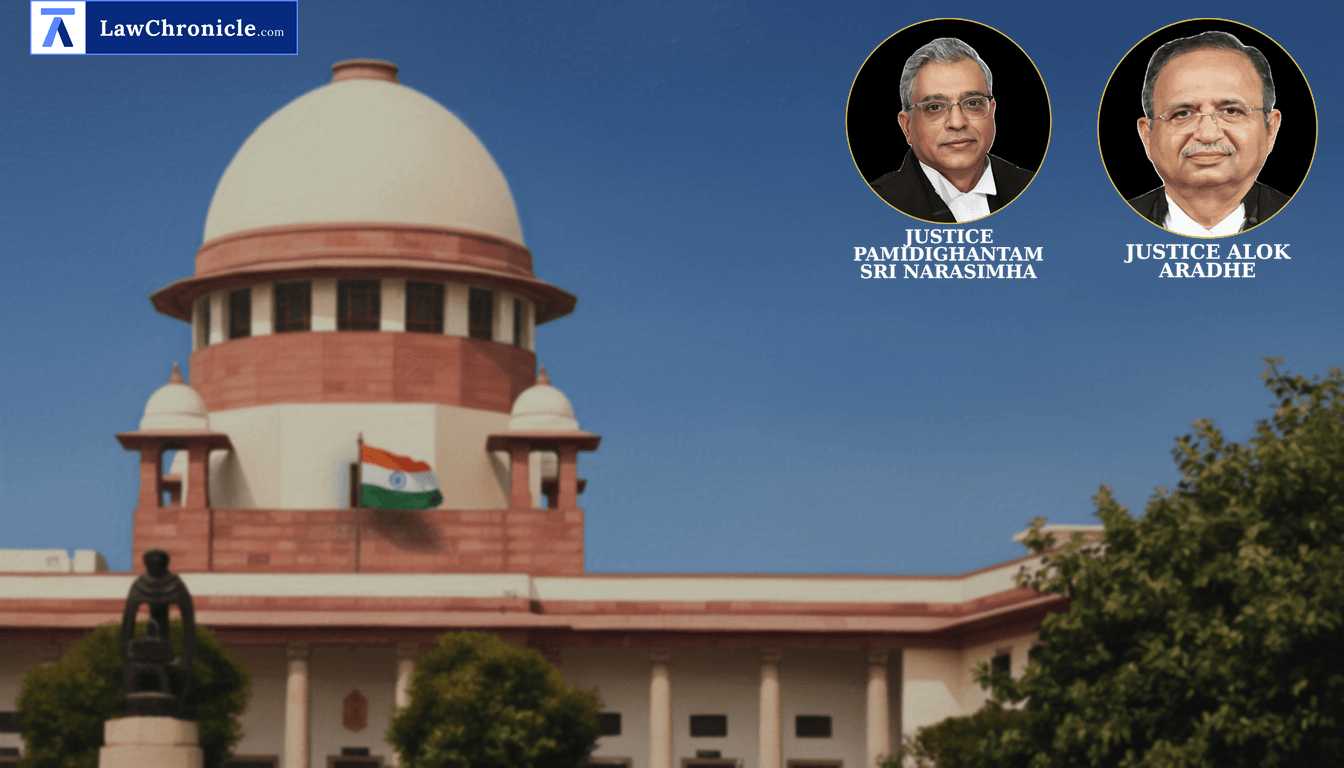
The Supreme Court has affirmed that a daughter's marital status cannot be a ground for denying her appointment on compassionate grounds as a fair price shop dealer, striking down gender-based stereotypes embedded in welfare schemes.
A bench comprising Justice Pamidighantam Sri Narasimha and Justice Alok Aradhe adjudicated on whether the exclusion of married daughters from the definition of 'family' for allotment under the dependent quota was constitutionally sustainable. The Court heard an appeal against a High Court order that had rejected a married daughter's claim to run her deceased mother's fair price shop based on restrictive state guidelines.
Court Strikes Down Gender Stereotypes
The Court observed that excluding married daughters while including married sons creates an impermissible gender-based classification. The bench emphasized that dependency is a factual determination rather than a status-based one. The Court, in its reasoning, observed: "The distinction is founded upon a gender-based stereotype that a daughter, upon marriage, becomes a member of another family and loses all ties with her natal family. Such a presumption is incompatible with the constitutional guarantee of equality and perpetuates historical notions of gender inequality which the Constitution seeks to eradicate."
Purposive Interpretation of 'Family'
Invoking the doctrine of purposive construction, the Court held that the definition of family must include married daughters to serve the objective of providing immediate financial relief to the dependents. The bench noted that a married daughter who continues to reside with or support her parental family shares the same functional characteristics of dependency as an unmarried or widowed daughter.
Background:
The case arose when the mother of the appellant, a fair price shop dealer in District Amethi, passed away in 2024. The appellant, who was the sole earning member supporting four sisters (including one visually impaired), applied for the dealership. Her application was rejected by the SDM and the Deputy Commissioner on the grounds that as a married daughter, she did not fall under the definition of 'family' as per the Government Order dated 05.08.2019 issued under the Uttar Pradesh Essential Commodities (Regulation of Sale and Distribution Control) Order, 2016.
The High Court of Judicature at Allahabad, Lucknow Bench, dismissed her writ petition, feeling bound by the Division Bench decisions in Smt. Kusumlata, Special Appeal No.89 of 2022 and Saida Begum. However, it granted a certificate under Constitution of India acknowledging the substantial question of law.
The Supreme Court analyzed the Essential Commodities Act, 1955 and the 2016 Order, noting that Constitution of India and Constitution of India prohibit discrimination based on sex. The bench relied on the principles of reasonable classification established in Shri Ram Krishna Dalmia & Ors. vs. Shri Justice S.R. Tendolkar & Ors. and Budhan Choudhry vs. State of Bihar & Ors. ( "(1954) 2 SCC 791": 1954 CaseBase(SC) 193), holding that the exclusion lacked a rational nexus with the object of the scheme. The Court further cited Bombay Dyeing & Mfg. Co. Ltd. vs. Bombay Environmental Action Group & Ors., A.P. Dairy Development Corporation Federation vs. B. Narasimha Reddy ( "(2011) 9 SCC 286": 2011 CaseBase(SC) 590), Shayara Bano vs. Union of India & Ors. ( "(2017) 9 SCC 1": 2017 CaseBase(SC) 287), K.S. Puttuswamy & Anr. vs. Union of India & Ors. ( "(2017) 10 SCC 1": 2015 CaseBase(SC) 636), and Nikesh Tarachand Shah vs. Union of India & Anr. ( "(2018) 11 SCC 1": 2017 CaseBase(SC) 125) to underscore that arbitrary state action violates Constitution of India.
Distinguishing the present case from traditional notions, the bench relied on the reasoning in Smt. Vimla Srivastava v. State of U.P. & Anr. and Shailesh Dhairyawan v. Mohan Balkrishan Lulla ( "(2016) 3 SCC 619": 2015 CaseBase(SC) 71), ultimately overruling the contrary views in Smt. Kusumlata, Special Appeal No.89 of 2022 and Saida Begum. The appeal was allowed, and the previous orders rejecting the appellant's claim were quashed.
Case Details:
Case No.: CIVIL APPEAL NO. 7667 OF 2025
NeutralCitation: 2026 INSC 617
Case Title: KULSUM NISHA VERSUS STATE OF U.P. & ORS.
Appearances:
For the Petitioner(s): Mr. Anand Verma, Advocate
For the Respondent(s): Mr. S.R. Singh, Senior Counsel; Ms. Rukhmini Bobde, Amicus Curiae
Source: 2026 CaseBase(SC) 524
 Breaking News