


Matrimonial Stability Leads SC to Quash POCSO Proceedings
 Copy Link
 Share
 Save
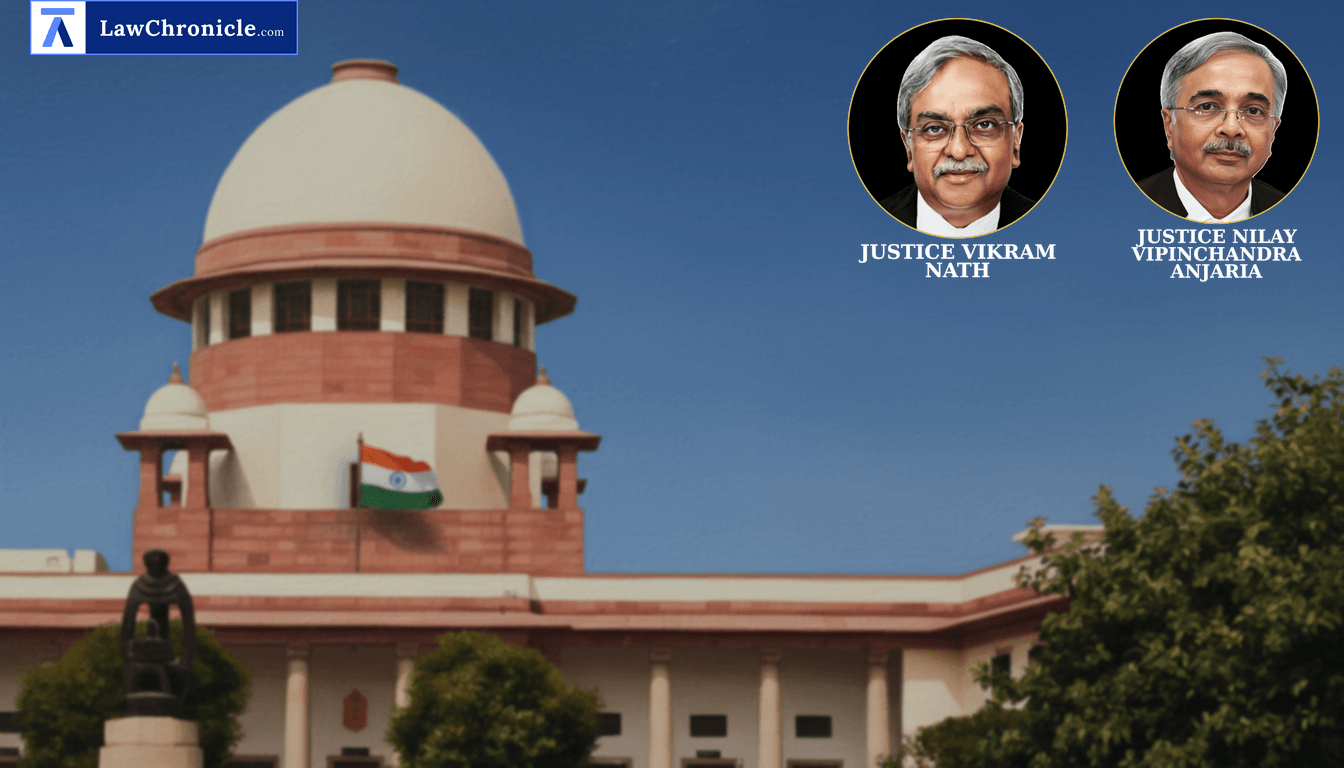
In a significant move to prioritize the welfare of a settled matrimonial life over technical criminal prosecution, the Supreme Court quashed criminal proceedings against a man accused of eloping with a minor girl after the couple demonstrated they were now happily married with a child.
A bench of Justice Vikram Nath and Justice N.V. Anjaria observed that the aim of all legal proceedings is to arrive at substantive justice, noting that in certain matters, legal actions deserve to be halted to yield to the legitimate demands of facts and circumstances. The Court was hearing an appeal against a High Court order that had refused to quash a charge-sheet involving offences under the Indian Penal Code, 1860 and the Protection of Children from Sexual Offences Act, 2012.
The Supremacy of Social Welfare in Legal Outcomes
The Court emphasized that while fleeing with a minor may technically constitute an offence, subsequent developments specifically the marriage and happy domestic life of the parties must weigh heavier in the scales of justice.
The Court, in its reasoning, observed: "It may be true that fleeing with a girl who is not of marriageable age and who is minor is an offence under law, however, the subsequent development of marriage between the two lovers and the fact that they have been merrily living would outweigh the need to take the alleged offence or the criminal proceedings to their logical end. In the fact situation like one obtained in the present one, continuation of criminal proceedings against appellant No.1 would become harassing and stand as an abuse of process of law."
Referring to the precedent in K. Kirubakaran v. State of Tamil Nadu ( "2025 SCC OnLine SC 2307": 2025 CaseBase(SC) 1099), the bench reiterated that the "final cause of law is the welfare of society." It noted that for a couple living together as husband and wife, the pendency of a criminal case operates as a "painful interference" in their happy life.
Directions Issued by the Court
The Court has the following directions:
"The impugned judgment and order dated 19.06.2025 passed by the High Court in Criminal Misc. Application No.566 of 2021 is set aside. The proceedings of Criminal Case No. 10 of 2021 pending before the Court of Additional District & Sessions Judge, Haridwar as well as all proceedings and orders incidental thereto are also quashed. The pending proceedings against appellant No.1 shall stand quashed."
Background:
The dispute originated from an FIR filed on June 1, 2020, by the father of the second appellant, alleging that his daughter (then stated to be 17 years old) had been enticed away by the first appellant. Consequently, the first appellant was charge-sheeted under Sections 363, 368, and 376(2)(d) of the Indian Penal Code, 1860 and Sections 5(8) and 6 of the Protection of Children from Sexual Offences Act, 2012.
The appellants approached the High Court of Uttarakhand under Section 482 of the Code of Criminal Procedure, 1973 seeking to quash the proceedings, arguing they had married as per Muslim rites and were both majors. However, the High Court dismissed the application on June 19, 2025, stating that the victim's age and the appellant's claims required evidence at trial.
In the appeal before the Supreme Court, the couple filed joint affidavits affirming their marriage and the birth of their child. The Court found that since the parties were residing peacefully at their matrimonial home and the 'victim' had expressed her desire to live with her husband in her statement under Section 164 of the Code of Criminal Procedure, 1973, continuing the trial would be an abuse of the process of law.
Case Details:
Case No.: CRIMINAL APPEAL NO. 1480 OF 2026
NeutralCitation: 2026 INSC 331
Case Title: AYYUB MALIK AND ANOTHER VERSUS STATE OF UTTARAKHAND AND ANOTHER
Appearances:
For the Petitioner(s): Mr. P.V. Yogeswaran, Counsel; Mr. Ashish Kumar Upadhyay, Advocate-on-Record
For the Respondent(s): Ms. Saakshi Singh Rawat, Counsel; Mr. Sudarshan Singh Rawat, Advocate-on-Record
Source: 2026 CaseBase(SC) 542
Similar Articles



 Breaking News


