


Mere Adverse Entry In Revenue Records Does Not Trigger Limitation: Karnataka HC
 Copy Link
 Share
 Save
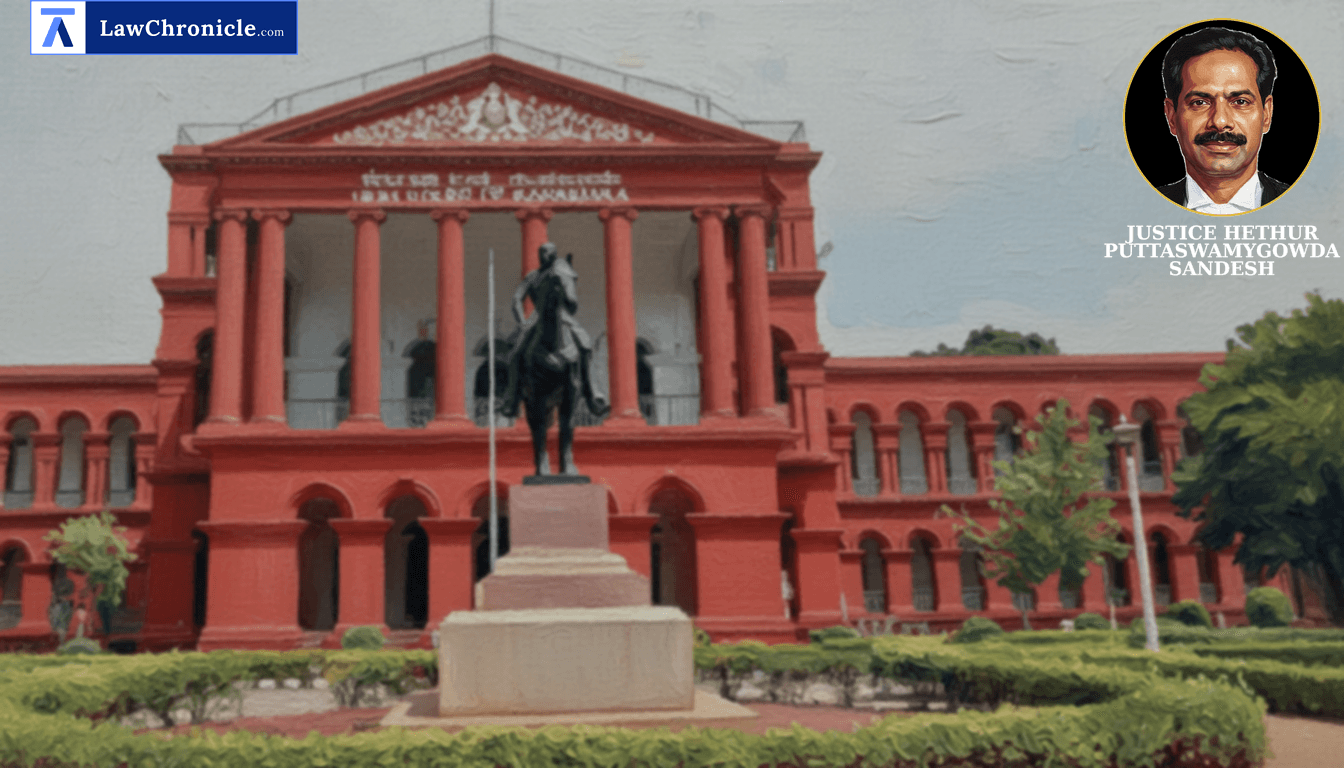
Mere unauthorized or adverse revenue entries do not establish adverse possession or trigger the limitation period for a declaration suit unless an unequivocal threat to the owner's title arises. Dismantling an erroneous appellate decree, the High Court re-established that cause of action under property declaration suits accrues only upon actual infringement of rights rather than passive entry modifications.
A single-judge bench of Justice H.P. Sandesh setting aside a First Appellate Court judgment, restored the Trial Court's decree granting title declaration and permanent injunction in favour of the plaintiff. The Court scrutinized whether a revenue officer's direction to approach a civil court sets the clock ticking for limitation under declaration claims.
Key Takeaways
Accrual of Cause of Action: A mere wrong entry in revenue records does not automatically give rise to a cause of action unless there is an unequivocal threat to rights.
Applicability of Limitation Articles: Suits seeking title declaration are governed by Article 58 of the Limitation Act, requiring action within three years from when the right to sue first accrues, rather than the residuary Article 113.
Proof of Adverse Possession: Uninterrupted long possession or mere revenue entries without hostile animus or overt acts do not establish adverse possession.
Admissions Dispense Title Proof: Judicial admissions of grant and ownership by the contesting party negate the need for strict formal proof of original grant certificates under Section 58 of the Evidence Act.
Court's Reasoning on Limitation and Revenue Entries
The High Court observed that the lower appellate court misdirected itself by treating an order of the Tahasildar as the starting point of limitation under Article 113 of the Limitation Act. Highlighting that there was no dispute regarding title before the revenue authority, the Court emphasized that wrong entries in Column No. 12 of the RTC do not confer title or create an immediate threat to ownership.
Evaluating precedents, the Court placed reliance on DAYA SINGH AND ANOTHER vs. GURDEV SINGH (DEAD) BY LRS. AND OTHERS ( "(2010) 2 SCC 194": 2010 CaseBase(SC) 1291), reiterating that a right to sue accrues only when a clear and unequivocal threat to infringe a right occurs. This principle was further reinforced by decisions in AMAR SINGH AND OTHERS vs. KISHAN DEV (DEAD) THROUGH LRs., SECRETARY TO GOVT. OF INDIA, MINISTRY OF DEFENCE, NEW DELHI AND ANOTHER vs. INDIRA DEVI AND OTHERS ( "AIR 2003 ANDHRA PRADESH 329": 2003 CaseBase(AP) 12), and SRI MARANNA SINCE DEAD REPRESENTED BY HIS LRS. vs. THIPPERANGAPPA SINCE DEAD REPRESENTED BY HIS LRS.. Distinguishing between Article 58 and Article 113 of the Limitation Act, the Court referenced UNION OF INDIA AND OTHERS vs. WEST COAST PAPER MILLS LTD. AND ANOTHER ( "(2004) 2 SCC 747": 2004 CaseBase(SC) 472) and SHAKTI BHOG FOOD INDUSTRIES LIMITED vs. CENTRAL BANK OF INDIA AND ANOTHER ( "(2020) 17 SCC 260": 2020 CaseBase(SC) 1366), as well as MALLAVVA AND ANOTHER vs. KALSAMMANAVARA KALAMMA (SINCE DEAD) BY LEGAL HEIRS AND OTHERS ( "2024 SCC ONLINE SC 3846": 2024 CaseBase(SC) 773), noting that Article 58 applies specifically to declarations where the period runs from when the right to sue first accrues.
Addressing the plea of adverse possession, the Court relied on GOVERNMENT OF KERALA vs. JOSEPH ( "2023 SCC ONLINE SC 961": 2023 CaseBase(SC) 53) and GAYA PRASAD DIKSHIT vs. DR. NIRMAL CHANDER ( "(1984) 2 SCC 286": 1984 CaseBase(SC) 129), observing that continuous possession without hostile assertion or overt acts does not establish adverse title.
The Court, in its reasoning, observed: "The judgments which have been referred by learned counsel appearing for the appellant is also very clear that mere adverse entry in the revenue records will not give rise to cause of action and right to sue accrues when there is a clear and unequivocal threat to infringe a right. But, no such threat to the title of the plaintiff and the defendant No.1 only claims possession... In the case on hand, defendant No.1 not claims any title in respect of the suit schedule property and only claims adverse possession based on an entry, that too, a mischief done by the revenue authorities in showing name of defendant No.1 in column No.12 and no material on what basis, the defendant No.1 was put in possession and mere wrong entry in the revenue records will not take away the case of the plaintiff."
The Court has following directions:
"(i) The regular second appeal is allowed.
(ii) The impugned judgment and decree of the First Appellate Court passed in R.A.No.67/2007 dated 03.07.2010 is set aside.
(iii) The judgment and decree of the Trial Court passed in O.S.No.217/2000 dated 06.08.2007 is restored confirming the declaration and injunction granted in favour of the appellant/plaintiff.
(iv) The application filed under Order XLI Rule 27 read with Section 151 of CPC is dismissed in view of the discussion made above, as the same are not necessary to consider the germane issues involved between the parties."
Ratio
A cause of action to seek a declaration of title under Article 58 of the Limitation Act accrues only when a clear and unequivocal threat to infringe the plaintiff's title takes place. A mere adverse or wrong entry in revenue records, or an administrative direction by revenue authorities to approach a civil court regarding revenue entries, does not constitute a challenge to title so as to trigger the period of limitation.
Background
The plaintiff filed a civil suit in 2000 seeking declaration of absolute ownership and permanent injunction regarding 4 acres 11 guntas of land in Sy.No. 143 (old Sy.No. 92/3), alleging that the land was granted to him in 1951. While column No. 9 of the RTC reflected the plaintiff's name, defendant No. 1's name appeared in column No. 12. In 1993, the Tahasildar directed the parties to approach the Civil Court for revenue entry corrections. When the defendants attempted to interfere with possession in August 2000, the plaintiff instituted the suit.
Defendant No. 1 claimed adverse possession and asserted that the suit was barred by limitation under Article 113 of the Limitation Act. The Trial Court decreed the suit in favour of the plaintiff, noting admissions by defendant No. 1 during cross-examination confirming the grant in the plaintiff's favour. However, the First Appellate Court reversed the trial judgment, holding the suit time-barred and questioning the non-production of the grant certificate.
Allowing the second appeal under Section 100 of the CPC, the High Court held that the appellate court erred in ignoring judicial admissions under Section 58 of the Evidence Act and wrongly calculated limitation from the 1993 revenue order.
Case Details:
Case No.: Regular Second Appeal No. 2077 of 2010
Case Title: Sri. Horakerappa v. Sri. Thimmappa (Dead by LRs) & Ors.
Appearances:
For the Petitioner(s): Sri. Ravi Shankar S., Advocate
For the Respondent(s): Sri. R.B. Deshpande, Advocate for R1(a to h)
Source: 2026 CaseBase(KAR) 7913
Similar Articles



 Breaking News


