Mere Recovery of Money Without Proof Of Demand Cannot Substantiate Bribe Charge: SC
 Copy Link
 Share
Share Save
Save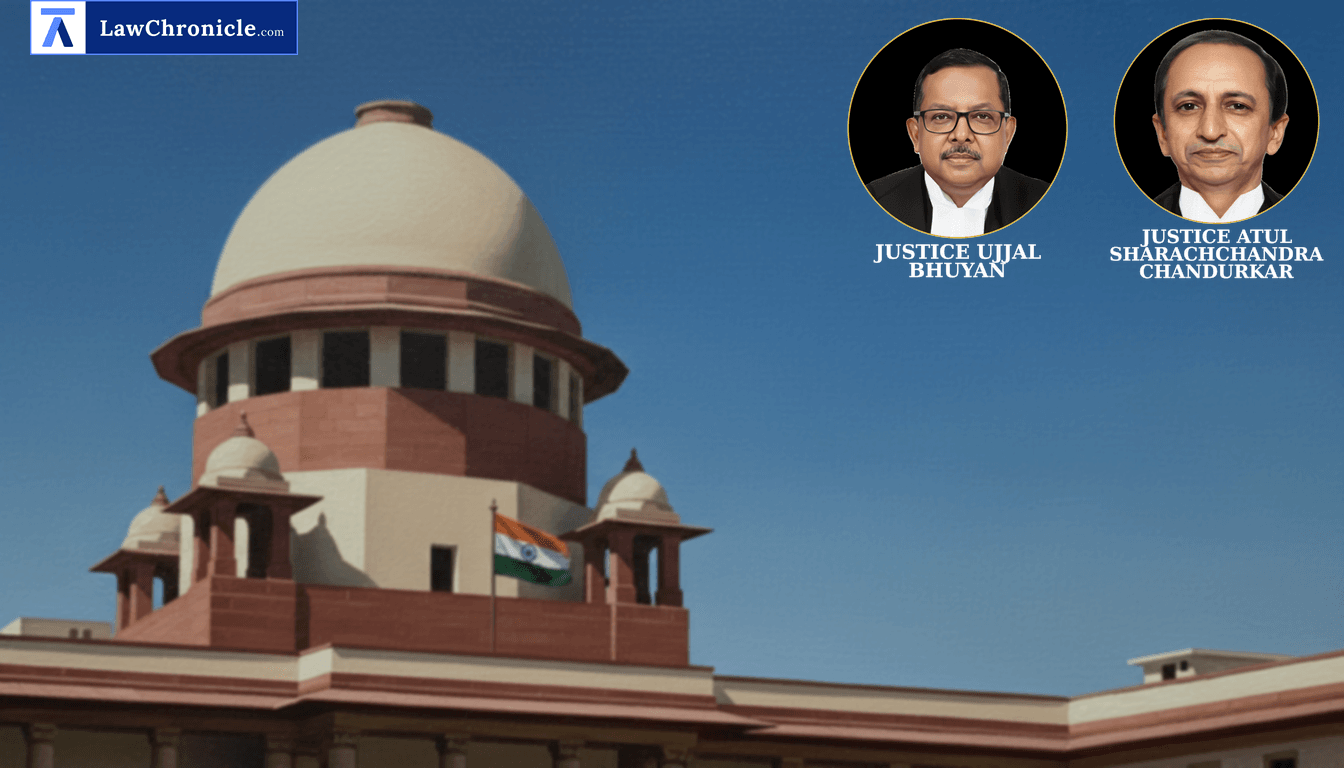
Demolishing a decades-old corruption prosecution, the Supreme Court ruled that mere recovery of currency notes cannot sustain a conviction under anti-corruption law if the initial demand for a bribe is not proved beyond a reasonable doubt. The judgment reinforces that statutory presumptions against public servants cannot be triggered in the absence of foundational proof regarding an explicit illegal demand.
A Division Bench comprising Justice Ujjal Bhuyan and Justice Atul S. Chandurkar set aside the conviction of a Talati-cum-Mantri and a Peon under Sections 7, 12, and 13(1)(d) of the Prevention of Corruption Act, 1988. The Court scrutinized the prosecution's evidence regarding an alleged trap operation and found material contradictions that undermined the core allegations of illegal demand.
Key Takeaways
- Proof of Demand Is Paramount: Statutory presumption under Section 20 of the Prevention of Corruption Act, 1988 cannot be invoked merely upon the recovery of tainted money if the primary demand remains unproven.
- Sanction Authority Compliance: Sanction to prosecute a public servant under Section 19(1)(c) of the Prevention of Corruption Act, 1988 must strictly emanate from the authority competent to remove them from service.
- Impact on Trap Cases: Prosecuting agencies cannot rely solely on the recovery of marked currency notes without establishing an explicit, unambiguous demand for illegal gratification.
Evaluating the evidentiary framework of the prosecution, the Court acquitted both accused officials, observing that the evidence on record failed to establish guilt beyond reasonable doubt.
The Court, in its reasoning, observed: "If the initial demand itself is not proved, mere recovery of the amount of ₹20/- from A2 would not resurrect the case of the prosecution to enable the Court to hold that the charge was proved."
Ratio
Under Section 20 of the Prevention of Corruption Act, 1988, the statutory presumption of illegal gratification does not automatically arise upon the mere recovery of money. The prosecution must first establish the foundational fact of a clear demand beyond reasonable doubt before any legal presumption can be drawn against an accused public servant.
Background
The case originated in February 1996 when a complainant applied for an Income Certificate at the Mamlatdar office, which was forwarded to the Bechri Grampanchayat. It was alleged that the Talati-cum-Mantri demanded ₹120 (₹100 for himself and ₹20 for the Peon) to issue the certificate. Following a complaint lodged with the Anti-Corruption Bureau, a trap was arranged. During the trap, the complainant handed ₹20 to the Peon, after which a raid was conducted. Charges were framed under Sections 7, 12, and 13(1)(d) of the Prevention of Corruption Act, 1988 alongside Section 120B of the Indian Penal Code, 1860.
The trial court convicted both individuals under the Prevention of Corruption Act, 1988 while acquitting them of criminal conspiracy under the Indian Penal Code, 1860. The High Court of Gujarat subsequently affirmed the conviction, prompting the present appeal before the Apex Court.
During arguments, the appellants highlighted material discrepancies in the complainant's statements across different proceedings, including an unproven initial demand and an invalid prosecution sanction granted by a Deputy District Development Officer instead of the competent District Development Officer under the Gujarat Panchayats Act, 1961. Citing precedents such as Gopalbhai Mohanbhai Nagoda vs. State of Gujarat, Shamji Karshan vs. The State of Gujarat, Mohd. Iqbal Ahmad vs. State of Andhra Pradesh ( "1979 INSC 11": 1979 CaseBase(SC) 302), Pramatha Nath Taluqdar vs. Saroj Ranjan Sarkar ( "1961 INSC 357": 1961 CaseBase(SC) 284), Shri Ram & Another vs. The State of Uttar Pradesh ( "1974 INSC 230": 1974 CaseBase(SC) 192), and State of Lokayuktha Police, Davanagere vs. C.B. Nagaraj ( "2025 INSC 736": 2025 CaseBase(SC) 591), the defense argued that statutory presumptions could not be invoked without proving the initial demand.
Accepting these contentions, the Supreme Court held that the prosecution failed to establish the foundational demand and noted that the sanction order was defective. Consequently, the Supreme Court allowed the appeals, quashed the High Court and trial court judgments, and fully acquitted both appellants.
Case Details:
Case No.: Criminal Appeal No. 1177 of 2015
Neutral Citation: 2026 INSC 890
Case Title: Rafikmiya Ahmedmiya Malek v. State of Gujarat
Appearances:
For the Petitioner(s): Mr. Divyesh Pratap Singh, Advocate
For the Respondent(s): Mr. Prashant Bhagwati, Advocate
Source: 2026 CaseBase(SC) 805
 Breaking News