Missing Oath Attestation In Election Petition Copy Not Fatal: SC
 Copy Link
 Share
Share Save
Save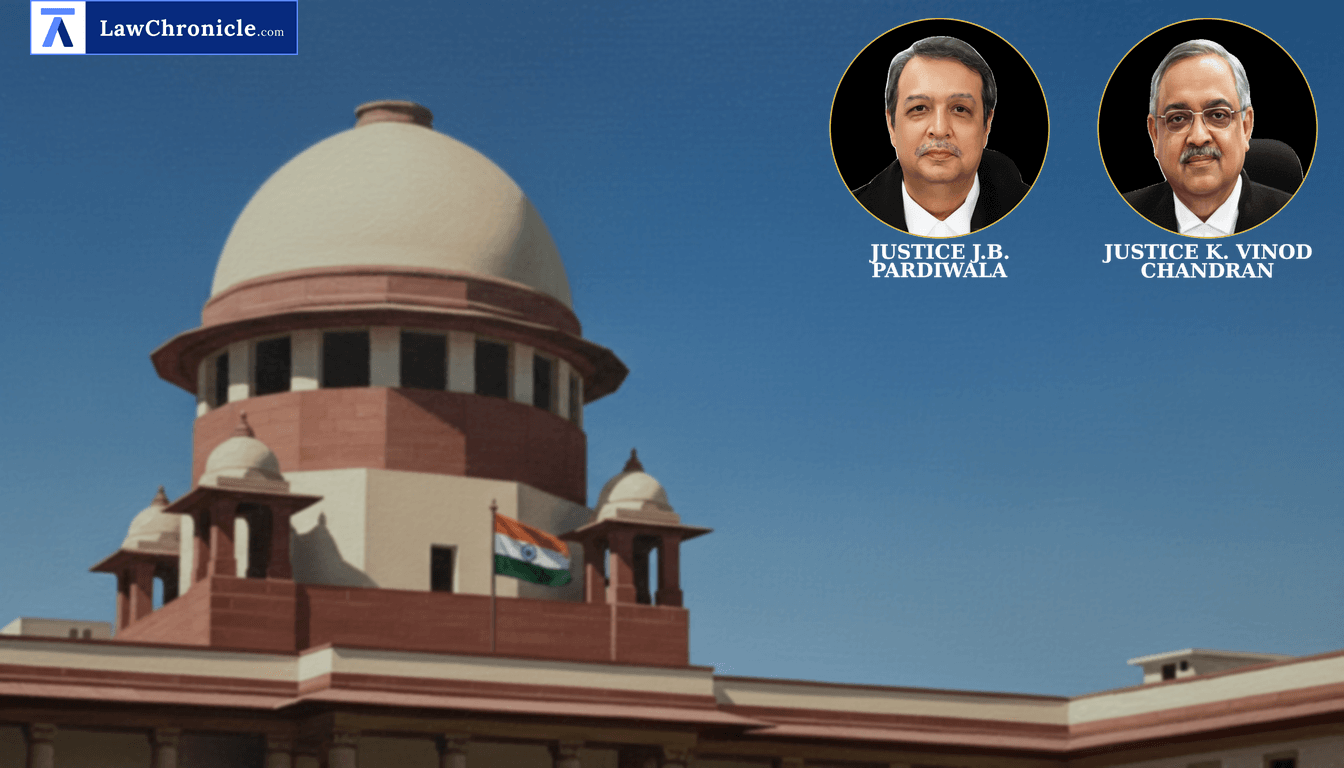
In a crucial clarification on election law jurisprudence, the Supreme Court ruled that an omission of notary or oath commissioner attestation in the served copy of a Form-25 affidavit does not entail the automatic dismissal of an election petition. Reaffirming binding Constitution Bench precedent, the court established that procedural defects in verification copies do not invalidate the entire proceedings if the original filed before the court contains the requisite affirmation on oath.
Setting aside an order of the High Court that had rejected an election petition challenging the Lok Sabha election results from No. 7 Karimganj Parliamentary Constituency in Assam, a bench of Justice J.B. Pardiwala and Justice K. Vinod Chandran restored the petition for fresh consideration on merits.
Key Takeaways
- Defects In Copy Not Fatal: Omission of notary attestation marks in the served copy of a Form-25 affidavit is not a fatal defect mandating summary dismissal under Section 86 of Representation of People Act, 1951.
- Precedent Primacy Affirmed: The Court highlighted that the Constitution Bench judgment in Murarka Radhey Shyam Ram Kumar v. Roop Singh Rathore and Others continues to hold the field, superseding contradictory rulings by smaller benches.
- Severability Of Unattested Corrupt Practice Charges: If the original court file lacks proper affirmation, allegations of corrupt practices are liable to be struck off, but the election petition must still proceed on other independent grounds.
- Attestation Terminology Equivalence: Using rubber stamps like 'certified to be true copy' alongside 'attested to be true copy' satisfies the attestation mandate of Section 81(3) of Representation of People Act, 1951.
Court Observations and Directions
The Supreme Court observed that Section 81(3) of Representation of People Act, 1951 only requires the petitioner to sign every copy to take responsibility that it is a true copy, without prescribing a rigid, specific form of attestation. Addressing the conflict between past rulings, the Court noted that smaller three-judge benches had misunderstood the Constitution Bench position in T.M. Jacob v. C. Poulose and Others, whereas the landmark decision in Murarka Radhey Shyam Ram Kumar v. Roop Singh Rathore and Others explicitly remains binding law.
The Court, in its reasoning, observed: "The verification of the corrupt practices, having been made in the original, by a Commissioner of Affidavits, as prescribed, if at all, the copy did not contain that endorsement, it does not necessarily mislead the Returned Candidate but only entails a verification by the Court as to whether the same is available in the affidavit filed before Court. The absence of affirmation is not fatal since it neither amounts to a misrepresentation nor does it mislead the Returned Candidate."
The Court has following directions:
"Suffice it to request the High Court to verify and if due attestation of the affirmation on oath, is available, proceed with the matter on merits and if not available, not to permit the allegation of corrupt practises to be urged and proceed with the consideration on the merits of the other grounds, if any are pleaded. We, hence, find absolutely no reason to sustain the order of the High Court and reverse the same. We restore the Election Petition to the files of the High Court for consideration as required herein above."
Ratio
A defect in the verification or oath attestation in the served copy of a Form-25 affidavit accompanying an election petition under Representation of People Act, 1951 does not attract summary dismissal of the petition under Section 86. Where the original affidavit filed in court contains a valid affirmation, variance in the served copy does not mislead the respondent; if the original itself lacks valid affirmation, only allegations of corrupt practice are struck off, leaving other pleaded grounds intact for trial on merits.
Background
The appellant filed an election petition challenging the 2024 Lok Sabha election of the successful candidate from No. 7 Karimganj Parliamentary Constituency, Assam. The High Court rejected the petition under Section 86 of Representation of People Act, 1951 on preliminary objections. The respondent contended that varying rubber stamps were used for attestation ('attested to be true copy' for pages 1–84 and 'certified to be true copy' for pages 85–185), violating Section 81, and that the copy of the affidavit in Form-25 under Rule 94A of Conduct of Elections Rules, 1961 lacked indication of notarization.
Reversing the decision, the Supreme Court relied on F.A. Sapa v. Singora to hold that a petitioner's signature certifying a page as a true copy complies with Section 81(3). On the Form-25 attestation issue, the appellant relied on T.M. Jacob v. C. Poulose and Others and Dr Shipra (Smt) and Others v. Shanti Lal Khoiwal and Others, while the respondent cited Dr Shipra (Smt) and Others v. Shanti Lal Khoiwal and Others. Distinguishing Dr Shipra (Smt) and Others v. Shanti Lal Khoiwal and Others, the Apex Court observed that T.M. Jacob v. C. Poulose and Others had clarified its limited application. Reassessing the legal hierarchy under National Insurance Co. Ltd. v. Pranay Sethi and Others ( "(2017) 16 SCC 680": 2017 CaseBase(SC) 551), the Court ruled that the Constitution Bench judgment in Murarka Radhey Shyam Ram Kumar v. Roop Singh Rathore and Others governs the issue, holding that minor variances in affidavit copies do not mislead returned candidates or warrant threshold dismissal.
Case Details:
Case No.: Civil Appeal No. 7474 of 2025
Neutral Citation: 2026 INSC 915
Case Title: Hafiz Rashid Ahmed Choudhury v. Kripanath Mallah & Ors.
Appearances:
For the Petitioner(s): Mr. Harin Pravinkant Raval, Learned Senior Counsel
For the Respondent(s): Mr. Wajeeh Shafiq, Learned AoR
Source: 2026 CaseBase(SC) 823
 Breaking News