


Motor Accident Proof Standard Is Preponderance of Probabilities, Not Criminal Rigor: Supreme Court
 Copy Link
 Share
 Save
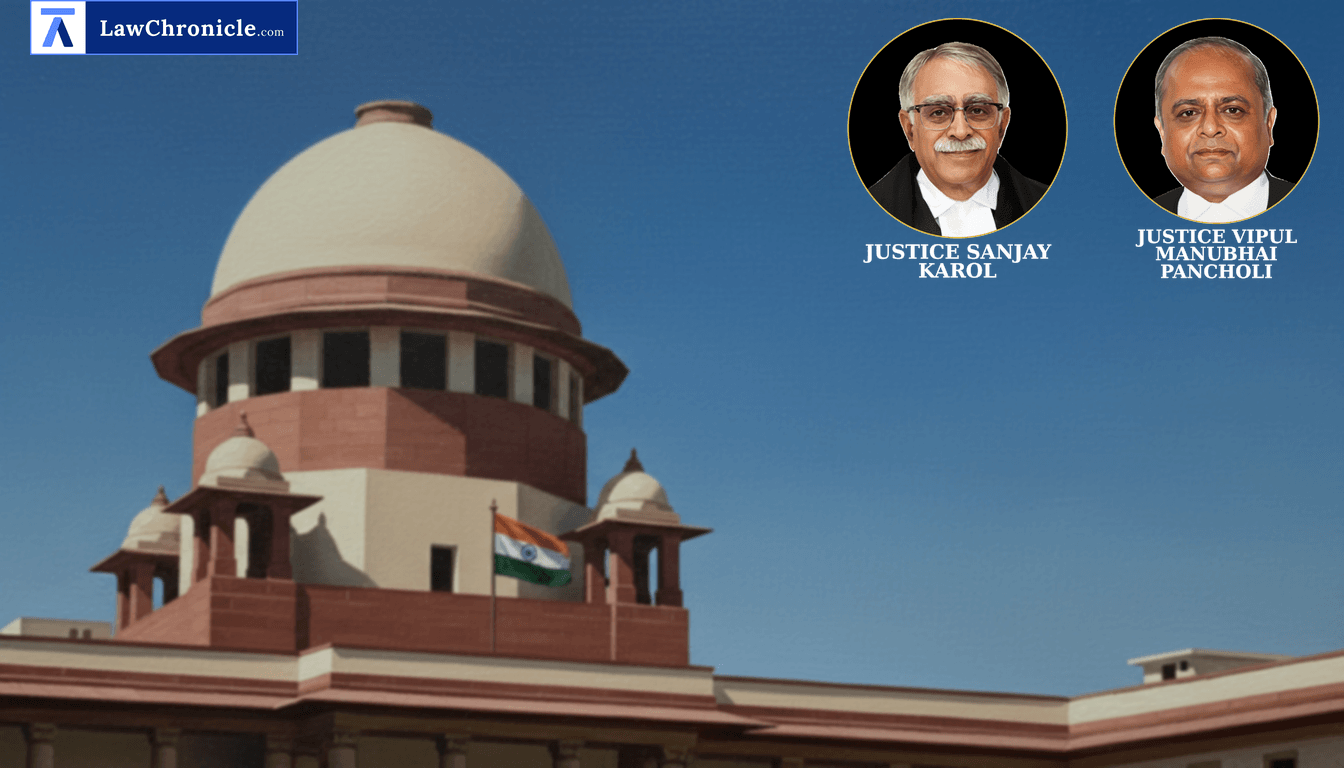
By emphasizing the 'preponderance of probabilities' over criminal standards of proof, the Supreme Court has dismantled the defense of insurers who rely on delayed, self-procured photographs to escape liability in motor accident claims. This landmark ruling reinforces the status of the Motor Vehicles Act, 1988 as social welfare legislation, ensuring that the testimony of injured eyewitnesses outweighs circumstantial evidence manufactured long after the collision.
A bench of Justice Sanjay Karol and Justice Vipul M. Pancholi set aside the concurrent findings of the Allahabad High Court and the Motor Accident Claims Tribunal (MACT), which had dismissed claim petitions following a fatal 2002 collision between a Maruti Car and a stationary tanker. The Court clarified that Tribunals must not import the stringency of criminal law into civil compensation proceedings.
Standard of Proof and Eyewitness Credibility
The Court observed that the lower courts erred by placing decisive reliance on photographs taken by the tanker owner ten hours after the accident while discarding the testimony of a surviving injured eyewitness. The bench reiterated that the standard of proof in motor accident cases is strictly the preponderance of probabilities.
The Court, in its reasoning, observed: "The Tribunal is not a criminal Court and must not import the stringency of the criminal standard while evaluating civil liability arising out of motor accidents. The evidence-on-record must, therefore, be appreciated in a pragmatic manner keeping in view the object and purpose of the Motor Vehicles Act, 1988."
Inadmissibility of Delayed Photographic Evidence
Addressing the evidentiary value of Exhibits 3 and 4 photographs produced by the tanker owner the Supreme Court noted that they were not taken by the police as part of an official investigation but were privately developed by an interested party. The Court held that such photographs, taken after a considerable lapse of time, cannot accurately represent the position of vehicles at the time of impact.
Adverse Inference and Negligent Parking
The bench further criticized the non-production of the tanker's conductor as a witness and the lack of warning signals on the stationary heavy vehicle. The Court applied the principle of 'res ipsa loquitur', noting that parking a heavy vehicle on a public road at night without hazard indicators constitutes negligence in itself. It also noted that the filing of a charge-sheet against the tanker driver under Sections 279, 338, and 304A of the Indian Penal Code corroborated the claimants' version.
The Court has following directions:
"The entire awarded amount shall be deposited by the respondent-Insurance Company within a period of eight weeks. The claimants shall be entitled to interest at the rate of 6% per annum from the date of filing of the claim petitions until realization. The amount of Rs.50,000/- as awarded by the Tribunal, if already paid under Section 140 of the Motor Vehicles Act, 1988, shall be adjusted against the final compensation payable. The amount be directly remitted into the bank account of the claimants."
Key Takeaways:
Preponderance of Probabilities Over Criminal Standards
Motor accident claims must be decided on the balance of probabilities rather than proof beyond reasonable doubt, preventing Tribunals from using overly technical evidentiary bars.
Injured Eyewitness Status
Testimony from an injured witness carries higher evidentiary value and cannot be discarded in favor of circumstantial evidence produced by interested parties without strong justification.
Employer Liability for Safe Parking
Parking heavy vehicles on main roads at night without reflective signs or hazard lights creates a foreseeable risk, shifting the burden of proof to the vehicle owner under the doctrine of res ipsa loquitur.
Non-Production of Material Witnesses
Failure to produce key witnesses like a vehicle conductor allows the court to draw an adverse inference against the respondents for withholding the best available evidence.
Ratio Decidendi:
In motor accident claim proceedings, the standard of proof required is that of preponderance of probabilities. Evidence must be evaluated pragmatically in light of the beneficial nature of the Motor Vehicles Act, 1988. When a heavy vehicle is left standing on a roadway at night without adequate warning signs and a collision occurs, the principle of res ipsa loquitur shifts the burden to the respondents to prove they took all reasonable precautions. Furthermore, private photographic evidence created after a significant delay cannot override the credible testimony of an injured eyewitness.
Background:
The dispute originated from a severe collision on January 30, 2002, involving a Maruti Car and a tanker on the Allahabad-Kanpur Road, resulting in three deaths and one survivor. The legal heirs filed claims under Section 166 of the Motor Vehicles Act, 1988. The Tribunal and High Court initially dismissed the claims, accepting the defense that the Maruti Car hit a stationary tanker. However, the Supreme Court analyzed the evidence anew, applying principles from Sithara N.S. & Ors. vs. Sai Ram General Insurance Company Limited and Prabhavathi & Ors. vs. The Managing Director, Bangalore Metropolitan, Transport Corporation ( "(2025) SCC OnLine SC 455": 2025 CaseBase(SC) 309) for determining negligence standards, and Sarla Verma v. Delhi Transport Corporation ( "(2009) 6 SCC 121": 2009 CaseBase(SC) 380) and National Insurance Co. Ltd. v. Pranay Sethi ( "(2017) 16 SCC 680": 2017 CaseBase(SC) 551) for calculating the quantum of compensation. The Court ultimately allowed the appeals, awarding total compensation amounts ranging from approximately Rs. 35 lakhs to Rs. 65 lakhs including interest to the different appellants.
Case Details:
Case No.: CIVIL APPEAL NO(s). OF 2026 (Arising out of the SLP (C) No(s) 10565/2025)
Case Title: MANJU SINGH v. AVINASH SINGH & ORS.
Source: 2026 CaseBase(SC) 647
Similar Articles
 Breaking News


