


SC: Narcotics Search of Hand-Carried Items Not Governed by Section 50 of NDPS Act
 Copy Link
 Share
 Save
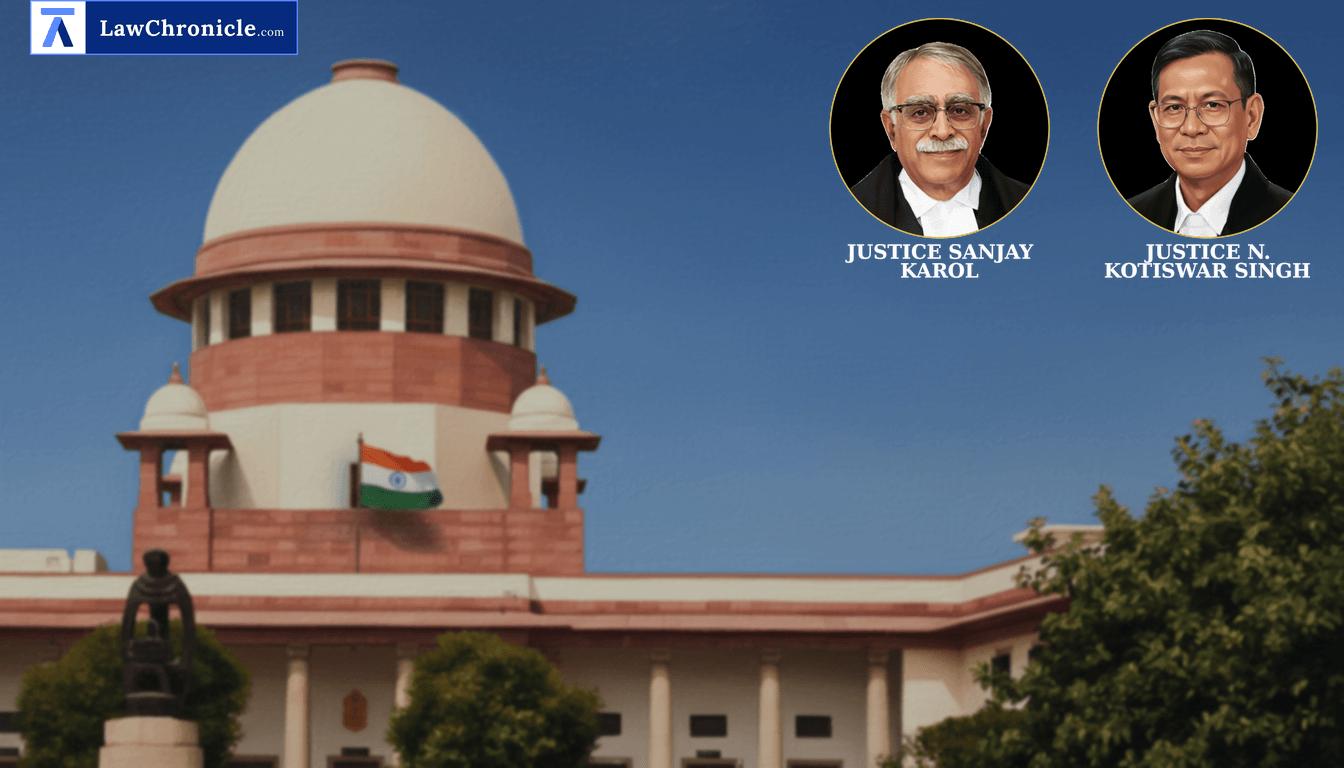
The Supreme Court has clarified the boundaries of personal search under narcotics law, ruling that the mandatory procedural safeguards for body searches do not extend to external articles like water bottles or bags. This distinction ensures that while the right to a Gazetted Officer's presence remains sacrosanct for bodily searches, it cannot be invoked as a technical loophole to invalidate recoveries from hand-carried containers.
In a judgment delivered by a bench of Justice Sanjay Karol and Justice Nongmeikapam Kotiswar Singh, the Court heard an appeal challenging a 14-year rigorous imprisonment sentence for the possession of 100 grams of smack. The appellant contended that the search violated the statutory procedures established under the Narcotic Drugs and Psychotropic Substances Act, 1985.
Search of Containers vs. Personal Search
The Court observed that the protection under Section 50 of the Narcotic Drugs and Psychotropic Substances Act, 1985 is strictly confined to cases where recovery is sought from the personal search (body search) of the accused. Distinguishing between a person and the objects they carry, the Court noted that searching a bag, suitcase, or container does not trigger the same procedural mandate.
The Court, in its reasoning, observed: "The protection under Section 50 is confined to cases where the recovery is sought to be effected through the personal search of the accused. It has no application where the search is of an article, such as a bag, container, suitcase or any other object, which the accused may be carrying."
This rationale aligns with the principles established in State of H.P. v. Pawan Kumar ( "(2005) 4 SCC 350": 2004 CaseBase(SC) 890) and Ranjan Kumar Chadha v. State of H.P. ( "2023 SCC OnLine SC 1262": 2023 CaseBase(SC) 87). The Bench further noted that even though Section 50 was not technically applicable to the search of a water bottle, the police had nonetheless informed the appellant of his rights as a matter of abundant caution, as evidenced by the testimonies and the 'Report for Grant of Consent'.
Procedural Irregularities and Section 52A
Magisterial Presence in Sampling
Addressing the contention regarding Section 52A of the Narcotic Drugs and Psychotropic Substances Act, 1985, the appellant argued that the failure to draw samples in the presence of a Magistrate should lead to acquittal. The Court rejected this, stating that while Section 52A is a crucial procedure for the disposal of seized substances, a lapse in its immediate compliance is a procedural irregularity that does not automatically vitiate a trial if other primary evidence, such as the panchnama and seizure memo, is reliable.
Referring to Narcotics Control Bureau v. Kashif ( "(2024) 11 SCC 372": 2024 CaseBase(SC) 891), the Court reiterated that: "Any lapse or delay in compliance with Section 52-A by itself would neither vitiate the trial nor would entitle the accused to be released on bail. The court will have to consider other circumstances and the other primary evidence collected during the course of investigation."
Hostile Independent Witnesses
On the issue of independent witnesses turning hostile, the Court relied on Rizwan Khan v. State of Chhattisgarh ( "(2020) 9 SCC 627": 2020 CaseBase(SC) 1289) to affirm that the testimony of official police witnesses can form the basis of a conviction if it is found to be trustworthy and reliable. The Court found the testimonies of the police officials in this case to be consistent and credible despite the lack of corroboration from private witnesses.
Quantum of Sentence and the 2001 Amendment
While the appellant sought the benefit of the quantity-based sentencing introduced by the Narcotic Drugs and Psychotropic Substances (Amendment) Act 2001, the Court clarified that this benefit is not retrospective for cases where the trial had already concluded prior to October 2, 2001. Relying on Basheer v. State of Kerala ( "(2004) 3 SCC 609": 2004 CaseBase(SC) 1397), the Court noted that since the appellant was convicted in 1997, the unamended Section 21 applied. However, the Court exercised its discretion to reduce the sentence to the statutory minimum.
The Court has the following directions:
"The conviction of the appellant under Sections 8 and 21 of the NDPS Act is affirmed. The impugned judgments of the Trial Court and the High Court are modified only to the extent of the sentence awarded to the appellant, which is reduced from 14 years to 10 years of rigorous imprisonment. The punishment of a fine of Rs.1 Lakh is maintained. If the fine has not already been deposited, the appellant shall deposit the same within a period of three months, failing which he shall undergo rigorous imprisonment for a further period of one year."
Key Takeaways
Distinction in Search Mandates: Confirms that Section 50 safeguards apply only to the physical person and not to articles like bags or bottles being carried by the accused.
Status of Official Witnesses: Reaffirms that a conviction can stand solely on the testimony of police officials if their evidence is reliable, even if independent witnesses turn hostile.
Section 52A is Procedural: Establishes that non-compliance with magisterial sampling under Section 52A is a procedural irregularity and not a fatal flaw, provided the chain of custody and primary evidence are intact.
Non-Retrospectivity of NDPS Amendments: Clarifies that the 2001 quantity-based sentencing benefits do not apply to cases where the trial concluded before the amendment came into force.
Ratio
The procedural safeguard under Section 50 of the NDPS Act, 1985, which grants the accused the right to be searched before a Gazetted Officer or Magistrate, applies exclusively to the search of the person of the accused and does not extend to the search of any article or container carried by the accused. Furthermore, procedural lapses under Section 52A regarding the drawing of samples do not vitiate the trial if the search, seizure, and identity of the contraband are established through other reliable primary evidence.
Background:
The case originated in 1996 when the appellant was apprehended at Shamgarh Railway Station with a water bottle containing 100 grams of smack. The Trial Court convicted him in 1997 under Sections 8 and 21 of the Narcotic Drugs and Psychotropic Substances Act, 1985, sentencing him to 14 years of rigorous imprisonment. The High Court of Madhya Pradesh affirmed this conviction in 2011. The appellant challenged the verdict in the Supreme Court on grounds of non-compliance with mandatory search procedures and sampling protocols. The Supreme Court, while affirming the conviction, modified the sentence.
Case Details:
Case No.: Criminal Appeal No(s). …………… of 2026 (Arising out of SLP(Crl.) No(s).5946-5947 of 2026)
NeutralCitation: 2026 INSC 729
Case Title: Mehboob Shah v. State of Madhya Pradesh
Appearances:
For the Petitioner(s): Mr. Sushil Kumar Jain, Senior Counsel
For the Respondent(s): Mr. Pashupathi Nath Razdan, Advocate on Record
Source: 2026 CaseBase(SC) 679
Similar Articles



 Breaking News


