National Press Day | Tracing Constituent Assembly Debates on Freedom of Press
 Copy Link
 Share
 Save
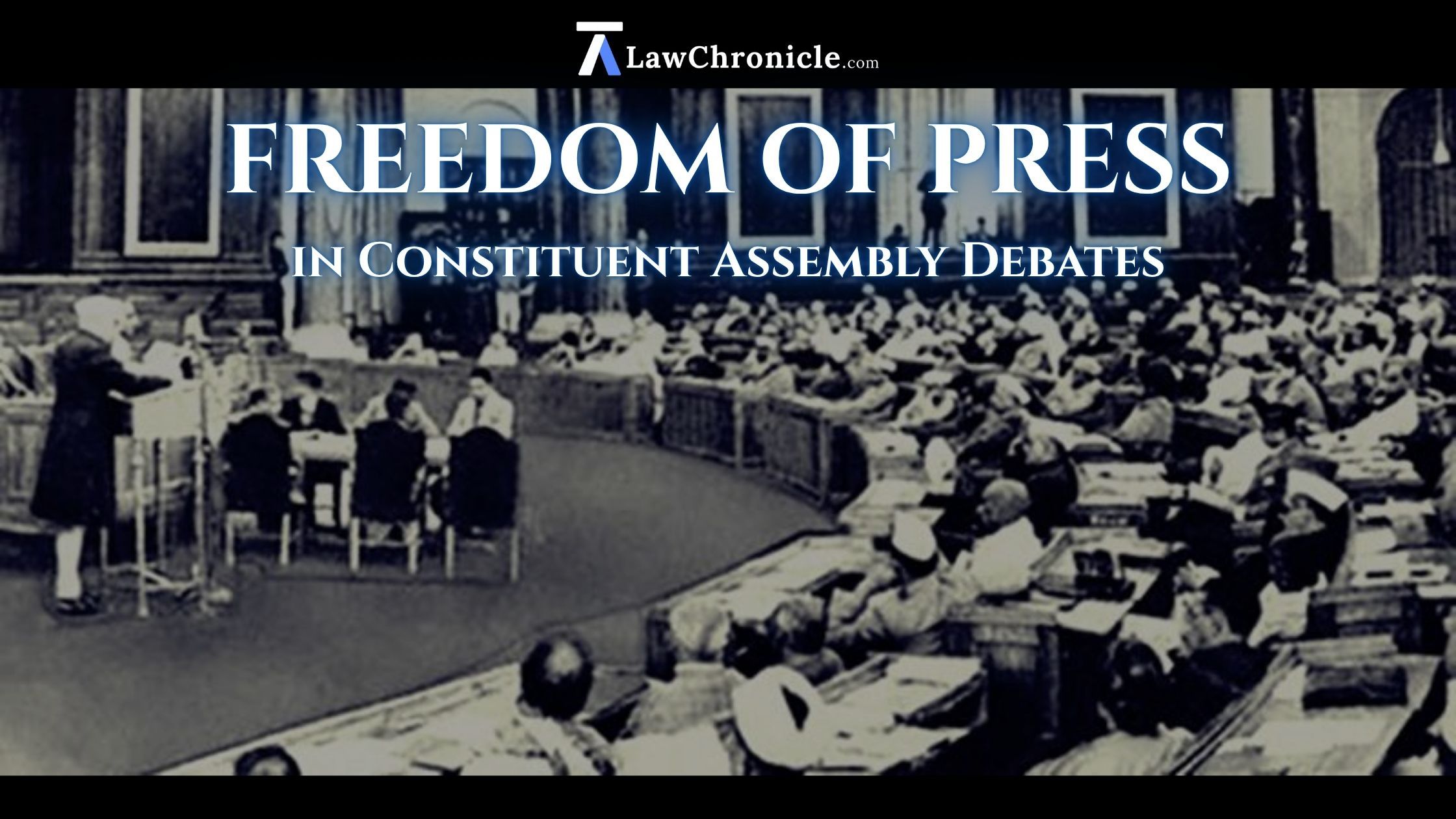
Every year on 16 November, India marks National Press Day, the date on which the Press Council of India began functioning in 1966. It is a day to reflect on the role of the press in a democracy. It is also an occasion to revisit a curious fact about the Constitution of India: the words "freedom of the press" appear nowhere in Part III. How, then, is press freedom a fundamental right? The answer lies in the Constituent Assembly debates of 1 and 2 December 1948, and in a line of Supreme Court decisions that began within months of the Constitution coming into force.
Freedom of Press in Constituent Assembly Debates
Draft Article 13, which became today's Article 19, was taken up in the Assembly on 1 December 1948. Its clause (1)(a) guaranteed citizens the right to freedom of speech and expression. It said nothing specific about the press, and several members were unwilling to let that pass.
Damodar Swarup Seth moved an amendment to list "freedom of the press" as a separate freedom. He called the draft "clumsily drafted" and described the omission as significant. He conceded that press freedom might be argued to be implicit in speech and expression, but maintained that this was an age of a growing and powerful press, and that the freedom deserved separate and explicit mention.
Prof. K. T. Shah moved a similar amendment to add "press and publication" to clause (1)(a). He confessed to being amazed at the omission and pointed out that press freedom had been the subject of some of the bitterest constitutional struggles in liberal democracies. In his view, leaving it out meant relying on the "charity" of administrators to read it in by convention or implication. He also warned that the press is easily accused of licence and that its liberty therefore needs the protection of an express guarantee.
The debate was not confined to the missing words. Members including Mahboob Ali Baig and Hukam Singh argued that the exceptions in clauses (2) to (6) would take back what clause (1) gave. Baig listed the Press Acts among the repressive laws that would survive, and Hukam Singh warned that the freedom of the press and other freedoms were being left to the legislature. A central point of controversy was the draft's reference to "sedition". K. M. Munshi moved to drop that word, calling it one of doubtful and varying import. He proposed instead a restriction aimed at matters that undermine the security of the State or tend to overthrow it. Criticism of the government, he argued, is the essence of democracy. Thakur Das Bhargava separately urged that restrictions be made "reasonable", and Dr. B. R. Ambedkar accepted that change.
On 2 December 1948, Shibban Lal Saxena noted that "sedition" had been removed from the clause, and asked Dr. Ambedkar to bring an amendment that would bring freedom of the press into clause (1)(a). Dr. Ambedkar declined. In his reply, he said the press has no special rights beyond those of an individual citizen: an editor or manager is a citizen exercising the right of expression, so no special mention of the press was necessary.
Freedom of the Press in Constitution
The outcome is the text we have today. Article 19(1)(a) guarantees all citizens "the right to freedom of speech and expression", and freedom of the press is not expressly included. The framers did not deny it. Their view was that it was already contained in the citizen's right to speak and express.
This is why the Supreme Court has repeatedly observed that although Article 19(1)(a) does not mention the press, it is the settled view of the Court that the freedom of speech and expression includes the freedom of the press and of circulation. The press, in other words, derives its constitutional protection from the citizen's right, and enjoys that protection subject to the same limits. Those limits are found in Article 19(2), which allows the State to impose reasonable restrictions in the interests of the sovereignty and integrity of India, the security of the State, friendly relations with foreign States, public order, decency or morality, or in relation to contempt of court, defamation or incitement to an offence. This clause, as it now reads, was substituted by the Constitution (First Amendment) Act, 1951.
The debate of 1948 explains why the courts had to do the work. What Seth and Shah wanted written into the text, the judiciary has read into it.
Freedom of Press is a Fundamental Right
The Supreme Court's approach to press freedom has been built, case by case, on Article 19(1)(a). Four decisions mark the main steps.
Romesh Thappar v. State of Madras, 1950 CaseBase(SC) 71
The petitioner was the printer, publisher and editor of Cross Roads, an English weekly published from Bombay. The Madras Government, relying on Section 9(1-A) of the Madras Maintenance of Public Order Act, 1949, banned the entry and circulation of the journal in the State. A six-judge Bench held on 26 May 1950 that freedom of speech and expression includes freedom of propagation of ideas, and that this freedom is ensured by freedom of circulation. Without circulation, the Court observed, publication would be of little value.
The Court held that a law restricting speech could be saved by Article 19(2) only if it was directed solely against the undermining of the security of the State or its overthrow. Section 9(1-A) reached further, to public safety and public order generally, and was struck down as wholly void because it could not be severed. Notably, the Court linked its reasoning to the Constituent Assembly's decision to drop "sedition" from draft Article 13(2). That deletion, it held, shows that criticism of the government is not a ground for curtailing the freedom of speech and of the press, unless it undermines the security of the State or tends to overthrow it. Fazl Ali J. dissented.
Brij Bhushan v. State of Delhi, 1950 CaseBase(SC) 54
Decided the same day, this case concerned the Delhi weekly Organiser. The Chief Commissioner, acting under Section 7(1)(c) of the East Punjab Public Safety Act, 1949 as extended to Delhi, required the printer, publisher and editor to submit for scrutiny, before publication, all communal matter and news and views about Pakistan, other than material from official sources or approved news agencies.
The Court held that pre-censorship of a journal is a restriction on the liberty of the press, which is an essential part of the right to freedom of speech and expression under Article 19(1)(a). Following Romesh Thappar, it held that the provision was not saved by Article 19(2) and quashed the order. The majority drew on Blackstone's view that the liberty of the press lies in the absence of previous restraint. Fazl Ali J. dissented here as well, reasoning that public disorder undermines the security of the State.
Bennett Coleman & Co. v. Union of India, 1972 CaseBase(SC) 320
Decided on 30 October 1972, this case challenged the Newsprint Policy for 1972-73. Among other things, the policy capped newspapers at 10 pages, prevented common ownership units from starting new papers or editions, and barred them from moving newsprint quota between their publications. The Government argued that it was merely rationing a scarce import.
The majority held that the real test is the effect of a measure on the right, not the object or form of the measure. Because the restrictions directly affected circulation and growth, they were a newspaper control disguised as a newsprint control. The Court reiterated that freedom of the press and of circulation falls within Article 19(1)(a), that it embodies the people's right to read, and that a law singling out the press for prohibitive burdens falls outside Article 19(2). It struck down the page limit and related remarks, and the bar on new editions or newspapers. It also rejected borrowing the American idea of "regulation" of speech, since the First Amendment contains no exceptions like Article 19(2). Mathew J. dissented.
Indian Express Newspapers (Bombay) Pvt. Ltd. v. Union of India, 1984 CaseBase(SC) 224
In this case, decided on 6 December 1984 and reported as AIR 1986 SC 515, newspaper publishers challenged customs duty on imported newsprint (a combined 15 per cent from 1 March 1981, later converted to a flat per-tonne levy), arguing that it raised newspaper prices and cut circulation. The Court said the press is the heart of social and political intercourse. It held that freedom of the press means freedom from interference by authority that would affect the content and circulation of newspapers, and that, apart from Article 19(2), there can be no restriction in the name of public interest.
The judgment did not grant newspapers immunity from taxation. It held that the newspaper industry must bear its fair fiscal share, but that a tax which stifles freedom of expression becomes unconstitutional, and that taxes touching newsprint call for closer scrutiny, since it may suffice to show a distinct and noticeable burden attributable to the tax. The Court found the Government's justification inadequate, including a Minister's remark that newspapers contained "piffles", which it called an impermissible ground. It directed the Government to reconsider the levy within six months, and fixed an interim rate of Rs. 550 per tonne. The Supreme Court also rejected the challenge to classifying newspapers into small, medium and big for purposes of the duty.
The Road from 1948
The thread running from the Constituent Assembly to these judgments is consistent. The framers chose not to name the press, trusting that the citizen's right to free speech and expression would carry it. The Supreme Court has since confirmed that it does, and has refused to let that freedom be curtailed through indirect means such as bans on circulation, pre-censorship, newsprint rationing or taxation. On National Press Day, the Constituent Assembly debates are a reminder that the guarantee exists because members like Seth and Shah pressed for it, and because the courts have, for more than seven decades, held that it was always part of Article 19(1)(a).
 Breaking News