No Cross-Contract Set-Off Without Natural Justice, Rules Supreme Court
 Copy Link
 Share
 Save
The Supreme Court has quashed state-level set-off orders that sought to recover alleged dues from entirely separate running contracts without providing a prior hearing. The Bench emphasized that arbitrary cross-contractual set-off by state organs without procedural fairness and clear contract authorization are illegal and unconstitutional.
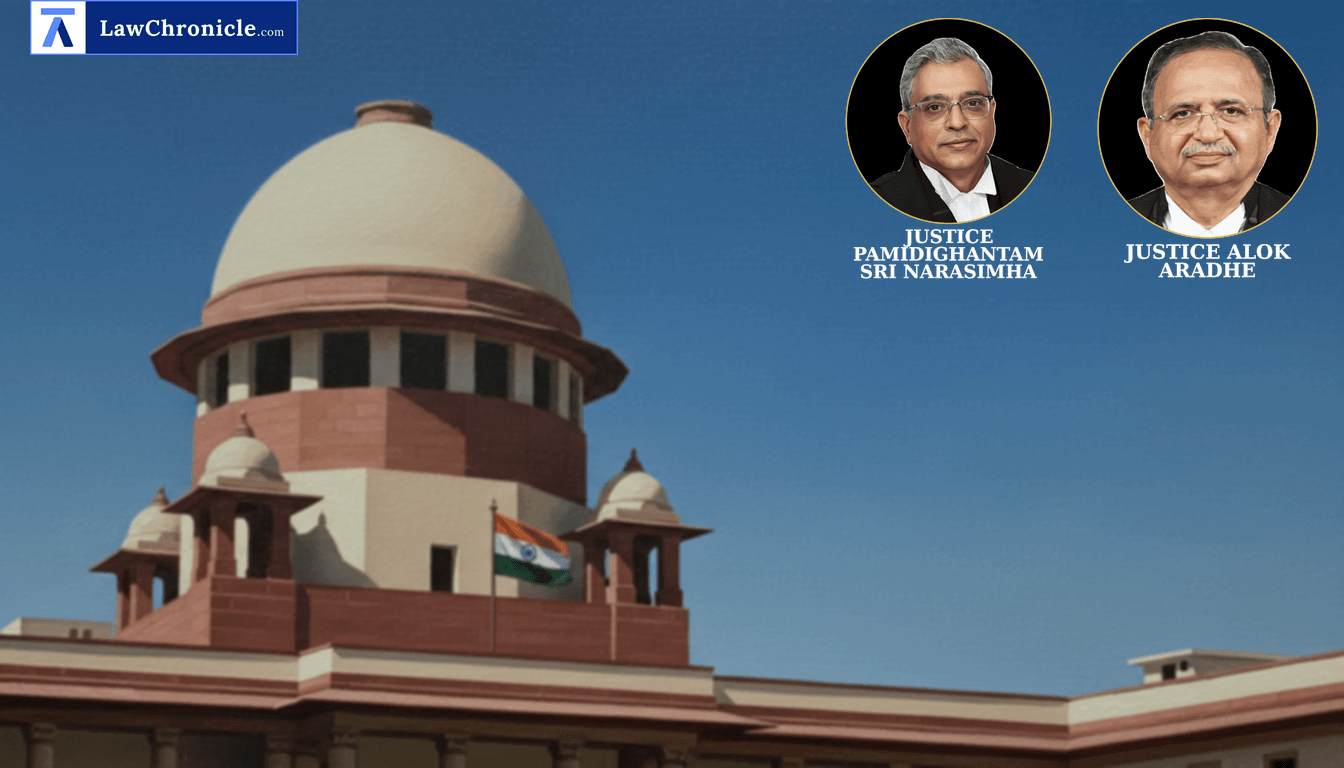
A bench comprising Justice Pamidighantam Sri Narasimha and Justice Alok Aradhe set aside three orders of the Chhattisgarh High Court that had dismissed writ petitions challenging cross-contract recoveries initiated by the State.
Key Takeaways
Check on Executive Arbitrariness: The State cannot arbitrarily adjust unadjudicated claims from distinct ongoing contracts.
Mandatory Natural Justice: Audit-based financial recoveries require prior notice and hearing to the affected contractor.
Scope of Pre-Contract Integrity Pacts: Cross-contract recovery provisions require prior explicit findings of breach under prescribed mechanisms.
Unadjudicated Claims Aren't Debts: Alleged overpayments remain disputed claims for damages rather than ascertained debts until legally established.
Addressing the validity of the state action, the Supreme Court evaluated whether contractual provisions authorized the summary cross-contract deduction. The Court held that none of the clauses relied upon by the State authorized the withholding of amounts under separate subsisting contracts without proper procedure.
In analyzing the nature of unadjudicated claims, the Apex Court relied on precedent to emphasize that disputed liabilities cannot be unilaterally converted into debts. The Supreme Court observed that "Until the alleged overpayment is established in accordance with law, it remains, a disputed and unadjudicated claim for damages and not a debt presently due; and a party to a contract cannot, merely because it also holds amounts otherwise payable under it, treat such a claim as though it were an ascertained debt and appropriate those amounts in satisfaction of it. Therefore, the recovery effected by the recovery order was not only in contravention of the conditions prescribed in the clause but also in flagrant violation of principles of natural justice."
Ratio
State authorities cannot treat an unadjudicated, disputed claim arising out of one contract as an ascertained debt to unilaterally set off or recover amounts due under separate and independent contracts, without specific contractual authorization and strict adherence to natural justice principles.
Background
The appellant firm was awarded three road works under the Pradhan Mantri Gram Sadak Yojana by the Chhattisgarh Rural Road Development Agency. After executing a portion of the work, running bills were raised. Concurrently, based on an investigation report into separate earlier contracts awarded in 2023, state authorities alleged an overpayment of over Rs. 2 crores. Following initial revenue recovery proceedings under Section 146 of the Chhattisgarh Land Revenue Code, 1959 being quashed by the High Court for lack of natural justice, an Executive Engineer issued a recovery order deducting Rs. 84,17,003/- from the running bills of the subsequent distinct works.
Simultaneously, an FIR was registered against a partner of the firm under Sections 420, 467, 468, 471, 409, and 120-B of the Indian Penal Code, 1860. The appellant filed writ petitions under Article 226 of the Constitution of India assailing the recovery order. The High Court dismissed the petitions holding that disputed factual questions were involved.
On appeal, the Supreme Court relied on the principles articulated in ABL International Ltd. & Anr. v. Export Credit Guarantee Corporation of India Ltd. & Ors. ( "(2004) 3 SCC 553": 2003 CaseBase(SC) 82) to rule that the High Court erred in declining jurisdiction, since the question turned strictly on contractual power and natural justice rather than disputed work measurements. Further rulings including Caretel Infotech Ltd. v. Hindustan Petroleum Corporation Limited (HPCL) & Ors. ( "(2019) 14 SCC 81": 2019 CaseBase(SC) 2277), Bharti Airtel Ltd. & Anr. v. Vijaykumar V. Iyer & Ors., State of Gujarat & Anr. v. Amber Builders ( "(2020) 2 SCC 540": 2020 CaseBase(SC) 1616), H.M. Kamaluddin Ansari and Co. v. Union of India & Ors., Nabha Power Limited (NPL) v. Punjab State Power Corporation Limited (PSPCL) & Anr. ( "(2018) 11 SCC 508": 2017 CaseBase(SC) 1114), and Union of India & Ors. v. N. Murugesan & Ors. were analyzed regarding contractual set-offs and cross-contractual recoveries. The Supreme Court allowed the appeals, quashed the recovery order, and directed the refund of Rs. 84,17,003/- with 6% interest.
Case Details:
Case No.: Civil Appeal No. of 2026 (@ S.L.P. (C) No. 10464 of 2026)
Neutral Citation: 2026 INSC 1072
Case Title: M/S Awadhesh Singh Gautam v. State of Chhattisgarh & Ors.
Appearances:
For the Petitioner(s): Mr. Gaurav Agrawal, Senior Advocate
For the Respondent(s): Mr. Bishwajit Dubey, Additional Advocate General
Source: 2026 CaseBase(SC) 8192
 Breaking News