No PIL in Service Matters except for Quo Warranto: Madras HC
 Copy Link
 Share
 Save
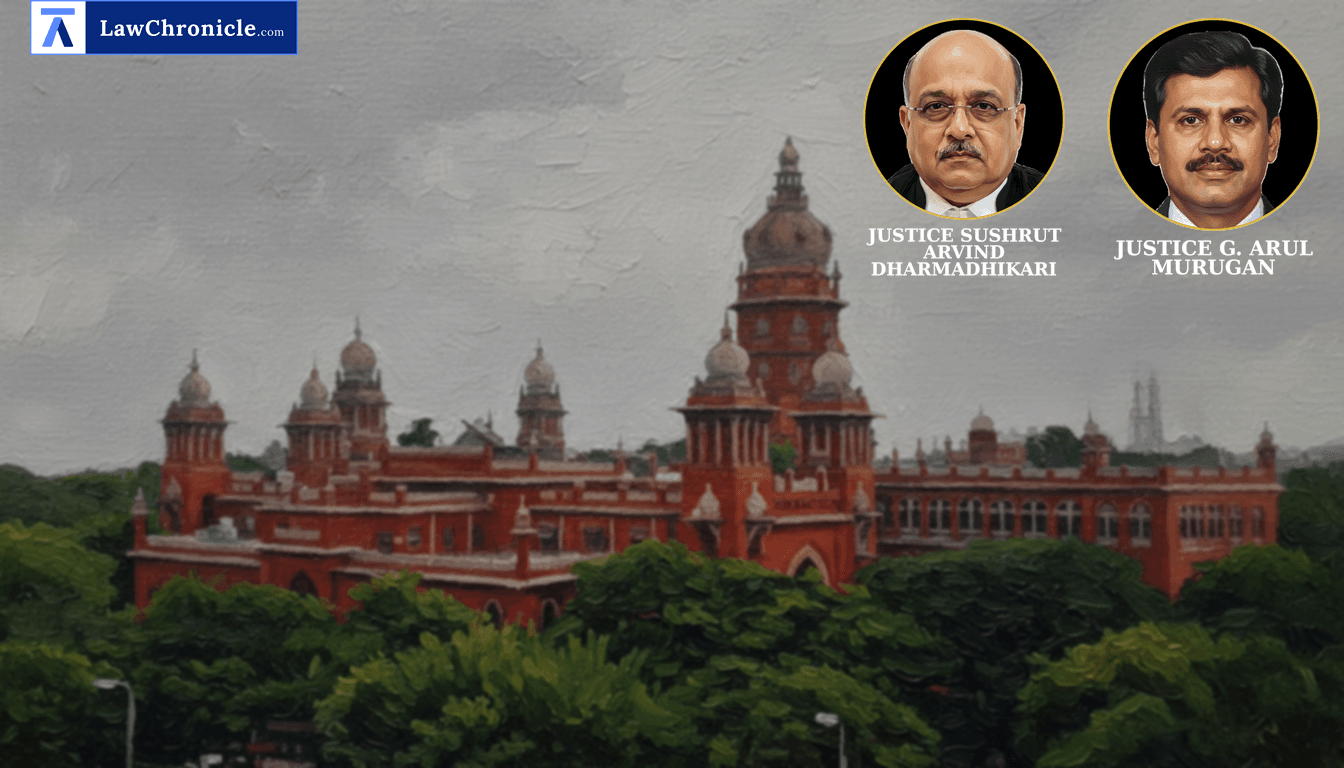
Public Interest Litigation (PIL) cannot be used as a tool to challenge the appointment or notification of government servants by strangers to the service, as the Madras High Court dismissed a plea seeking the removal of over 350 Legal Metrology Officers for alleged lack of qualifications.
A bench comprising the Hon'ble Chief Justice Sushrut Arvind Dharmadhikari and Justice G. Arul Murugan heard the writ petition filed as a public interest litigation by a registered consumer welfare association. The petitioner sought a writ of mandamus directing the authorities to discharge officers notified from the Labour Department and other departments, claiming they lacked the requisite science background as mandated under the statutory rules.
Key Takeaways
No PIL for Service Matters
Public interest litigation is generally barred in service matters to ensure the speedy disposal of employment disputes without interference from third-party strangers.
Mandatory Impleadment of Affected Parties
Any petition seeking the removal of specific officers from their posts is legally defective if the affected individuals are not made parties to the proceedings, violating the principle of natural justice.
Strict Scope for Quo Warranto
Challenges to public appointments by third parties are only permissible through a writ of quo warranto, and even then, the court must be satisfied the appointment strictly violates statutory rules.
PIL Jurisdiction Bars Strangers in Service Disputes
The Madras High Court addressed the maintainability of the petition, emphasizing that the subject matter was essentially a service dispute regarding who may hold the post of Legal Metrology Officer. Relying on settled law, the Bench noted that the petitioner was a consumer association and thus a "stranger to the service," lacking any personal stake in the posts. The Madras High Court observed that entertaining such petitions by strangers would defeat the objective of speedy disposal of service matters.
In its reasoning, the Madras High Court observed that "...except for a writ of quo warranto, public interest litigation is not maintainable in service matters. For a writ of quo warranto, the Court must be satisfied that the appointment is contrary to the statutory rules. Suitability of a candidate for appointment is for the appointing authority and not for the court, unless the appointment is contrary to the statutory provisions or rules."
Procedural Lapses and Natural Justice
The Bench further highlighted a significant procedural flaw: the petitioner failed to implead any of the 308 notified officers or the 50 officers sent for training. The Madras High Court remarked that no one should be condemned unheard, and a petition seeking to take away the rights of individuals not present before the court is fundamentally defective. The Bench accordingly dismissed the PIL.
Ratio
Except for a writ of quo warranto, public interest litigation is not maintainable in service matters. A stranger to the service cannot challenge the appointment or notification of government servants through a writ of mandamus, and the court will not inquire into the suitability of candidates unless a clear violation of statutory rules is demonstrated while ensuring all affected parties are impleaded.
Background
The dispute originated from a petition filed by the Consumer Welfare and Environmental Protection Association under Constitution of India. The petitioner contended that consumers were being cheated due to inaccurate weighing and short delivery, attributing this to the fact that enforcing officers lacked a science background. They cited Rule 28 of the Legal Metrology (General) Rules, 2011, which prescribes specific qualifications like a Degree in Science or a Diploma in Engineering.
Internal communications and RTI replies indicated that requests for relaxation of these qualifications under Rule 28(4) of the Legal Metrology (General) Rules, 2011 had been refused by the central authorities. Despite this, the State had notified officers from the Labour Department. The Court, citing Duryodhan Sahu (Dr.) v. Jitendra Kumar Mishra and Hari Bansh Lal v. Sahodar Prasad Mahto ( "(2010) 9 SCC 655": 2010 CaseBase(SC) 1549), held that since the petitioner was not a competing candidate or an aggrieved employee, the PIL was not maintainable. The Bench also referenced Ashok Kumar Pandey v. State of W.B. to warn against frivolous petitions wasting judicial time. Consequently, the petition was dismissed.
Case Details:
Case No.: W.P.No.37886 of 2026
Case Title: The Consumer Welfare and Environmental Protection Association v. State of Tamil Nadu & Ors.
Appearances:
For the Petitioner(s): Mr.S.Sathia Chandran
For the Respondent(s): Mr.M.Roshan Atiq, Additional Govt Pleader for R1, R2, R5 and R6
Source: 2026 CaseBase(MAD) 24692
 Breaking News