

No Relief Under Article 226 When a Statutory Remedy Exists: SC
 Copy Link
 Share
Share Save
Save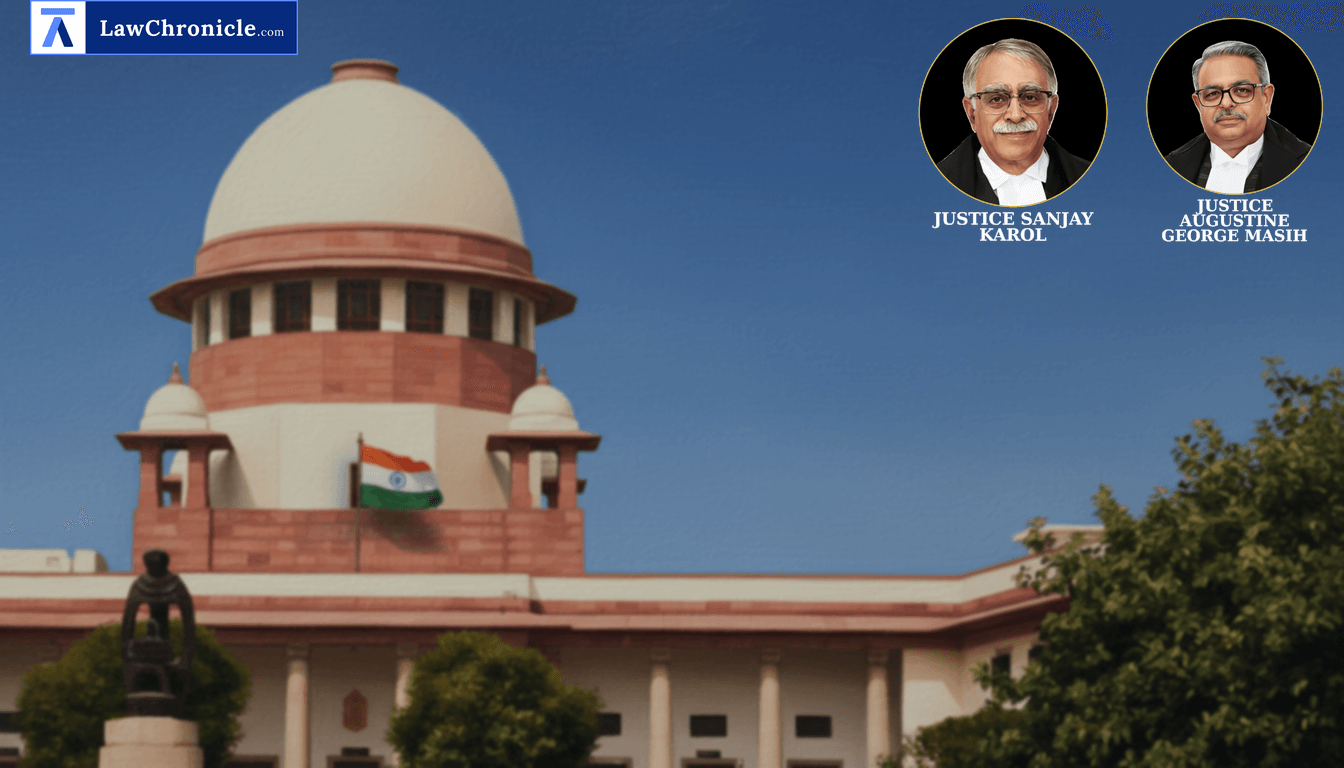
The Supreme Court of India ruled that the extraordinary jurisdiction under Article 226 of the Constitution should not have been invoked when other equally effective legal remedies were already available under the relevant statute.
A bench of Justice Sanjay Karol and Justice Augustine George Masih heard appeals against an interim order of the High Court which had directed the police to record the statement of the director of a company and to initiate criminal proceedings. The challenge arose from a writ under Article 226 of the Constitution of India, 1950 seeking registration of an FIR in respect of alleged forgery, impersonation and fabricated survey proceedings relating to a leisure resort project, and contested whether the High Court could direct the police to register an FIR without the complainant first availing statutory remedies.
The Court allowed the appeals and set aside the High Court's interim direction and quashed FIR No.0194/2025. The Court held that extraordinary constitutional jurisdiction under Article 226 of the Constitution of India, 1950 was not to be invoked where alternative and equally efficacious statutory remedies existed, and observed that writ jurisdiction was discretionary and subject to self-imposed restrictions.
The Court, in its reasoning, observed: "Keeping in view the above exposition of law, we find that the extraordinary jurisdiction under Article 226 of the Constitution of India ought not to have been invoked when alternative equally efficacious statutory remedies were available." The judgment also emphasized that "Article 226 is not a panacea for all grievances," and directed that parties were at liberty to pursue remedies under the statutory scheme.
Background
The dispute arose from the purchase and development of a property into a resort and the creation of inter se rights by lease and alleged sub-lease arrangements. The complainant company had purchased the land and developed a project comprising villas and a composite unit. A lease and a later alleged fraudulent registered lease in respect of Unit No.23 and a subsequent sub-lease dated 14.10.2022 were alleged to have been used to assert control over the project. During a Corporate Insolvency Resolution Process, a statutory moratorium under Section 14 of the Insolvency and Bankruptcy Code 2016 was stated to be in force. The complaint alleged that an application for measurement was submitted on 02.04.2025 using forged documents and that a woman impersonated the director during a site survey on 19.04.2025.
The complainant first approached the Land Records Authority by complaints dated 13.06.2025 and 09.07.2025 and the Authority conducted a hearing but advised the complainant to seek redressal from the competent authority, recording that "it would be appropriate for you to seek redressal from the competent authority,if necessary, regarding the said property dispute." A reference was also sent to the police and the police returned the matter to the Land Records Department for inquiry. The complainant then invoked the writ jurisdiction of the High Court seeking a direction to the Senior Police Inspector to register offences under Sections 318, 336, 319 and allied provisions of the Bharatiya Nagarik Suraksha Sanhita, 2023. Without issuing notice, the High Court ordered the director to attend the police station for recording of her statement and that necessary action be taken; FIR No.0194/2025 was subsequently registered.
On appeal, the Supreme Court examined the settled principle that writ jurisdiction under Article 226 was discretionary and ordinarily should not be invoked where an efficacious statutory remedy existed. The Court relied on the principles summarized in Radha Krishan Industries v. State of H.P. ( "(2021) 6 SCC 771": 2021 CaseBase(SC) 1575) to underscore that when a right is created by statute which prescribes a remedy, that remedy must ordinarily be exhausted before seeking constitutional relief; it referred to Rikhab Chand Jain v. Union of India ( "2025 SCC OnLine 2510": 2025 CaseBase(SC) 1325) for the proposition that resort to alternative statutory machinery should not be bypassed by invoking writ jurisdiction; it relied on Sakiri Vasu v. State of U.P. ( "(2008) 2 SCC 409": 2007 CaseBase(SC) 968) to note the established route for grievances about non-registration or investigation of FIRs through the police hierarchy and the Magistrate, and it noted that Sudhir Bhaskarrao Tambe v. Hemant Yashwant Dhage had followed the approach that High Courts should not be the forum of first instance for such complaints.
The Court analyzed the statutory sequence under the Bharatiya Nagarik Suraksha Sanhita, 2023 which contemplates registration of information before the officer-in-charge and, in case of refusal, remedies before the Superintendent of Police and then the Magistrate. Finding that the complainant had not exhausted the statutory remedies under the Bharatiya Nagarik Suraksha Sanhita, 2023 and that no exceptional circumstances were shown, the Court concluded that the writ petition was premature. The impugned interim order was set aside, FIR No.0194/2025 was quashed and liberty was reserved to the parties to pursue alternative remedies in accordance with law. The Court clarified that its decision did not express any opinion on the merits of the underlying allegations.
Case Details:
NeutralCitation: 2026 INSC 442
Case Title: SUJAL VISHWAS ATTAVAR & ANR. vs. THE STATE OF MAHARASHTRA & ORS.
 Breaking News