


No Risk Assumed Under Insurance Policy Without Advance Premium: SC
 Copy Link
 Share
 Save
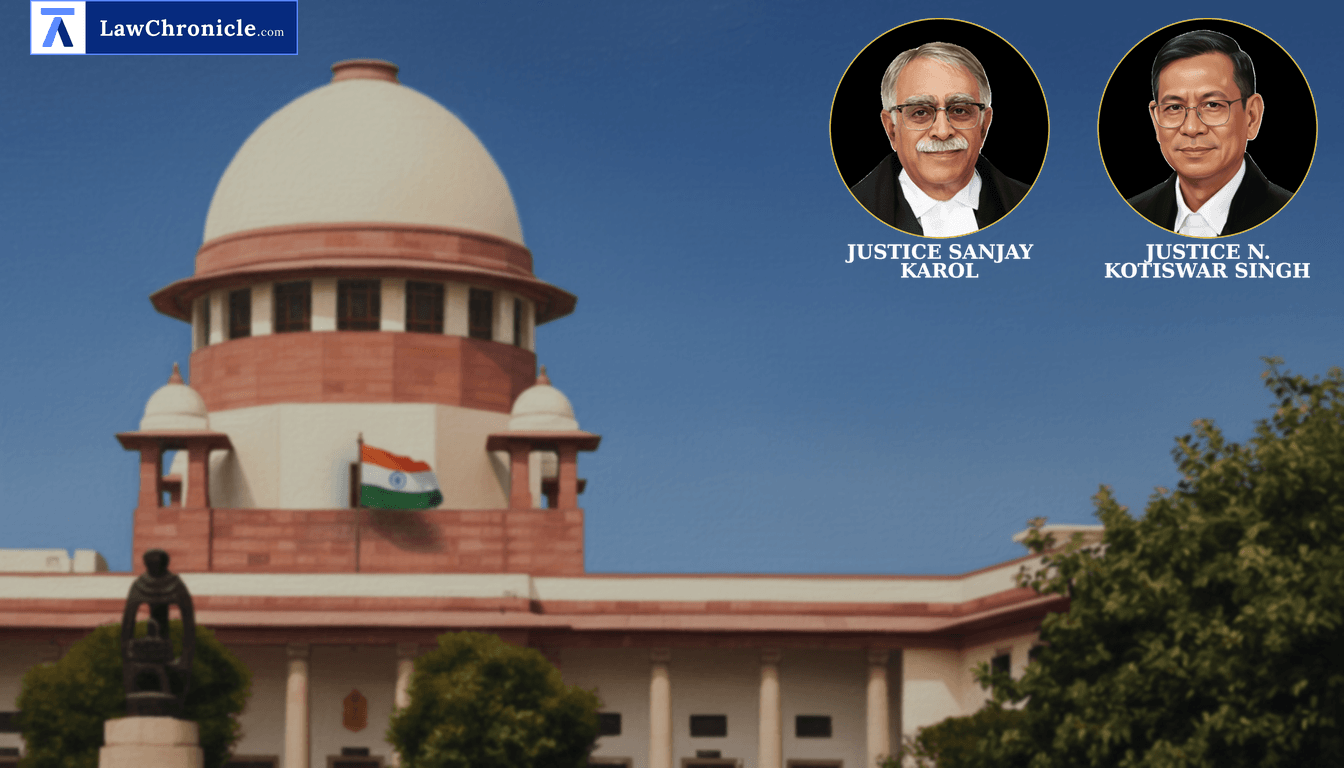
The Supreme Court has mandated strict compliance with advance premium payments under insurance laws, ruling that internal managerial assurances or post-facto premium acceptance cannot override mandatory statutory bars against assuming retrospective risk.
A bench of Justice Sanjay Karol and Justice Nongmeikapam Kotiswar Singh allowed the appeals filed by the insurer, setting aside the order of the National Consumer Disputes Redressal Commission (NCDRC) that had allowed a major fire loss claim.
Key Takeaways
- Statutory Precedence Over Internal Assurances: Managerial assurances or emails cannot waive or dilute the mandatory statutory requirement of advance premium payment under Section 64VB of the Insurance Act, 1938.
- No Retrospective Regularisation: Payment of additional premium post-incident operates prospectively from the date of payment and cannot retrospectively cover losses incurred when the turnover limit was already surpassed.
- Limits on Agent's Authority: An agent or manager lacks implied or ostensible authority under the Indian Contract Act, 1872 to enlarge insurance risk or alter contractual terms in violation of statutory provisions and principal directives.
The Supreme Court observed that the turnover of the insured was central to the operation of the Marine Cargo Annual Turnover Policy, and the insured was legally bound to extend coverage prior to the incident by paying the requisite premium.
The Court, in its reasoning, observed: "In that view of the matter, no occasion arose for the Divisional Manager of the appellants to assure the respondent of extension of coverage... But since this payment directly links to turnover and would in effect make the appellant liable for an incident that took place at a time when the coverage based on the turnover had already been surpassed, it has to be hit by Section 64VB, which provides no possibility for post facto regularisation."
Concurring with the primary judgment, Justice Nongmeikapam Kotiswar Singh highlighted the scope of agency and authority, stating: "An agent cannot acquire, by implication, authority to do that which the principal has not authorised, or to undertake a liability which the governing statute does not permit the principal to assume in that manner... Therefore, the principle qui facit per alium facit per se applies to acts within the agent's authority, however, it does not enable an agent to confer upon the Principal a liability which the agent was neither authorised nor legally competent to assume on its behalf."
Ratio
Section 64VB of the Insurance Act, 1938 creates an absolute statutory embargo prohibiting an insurer from assuming risk prior to the actual receipt or guaranteed advance payment of premium. Retrospective regularisation of risk through subsequent premium acceptance is legally impermissible, and no agent or officer possesses implied or ostensible authority under the Indian Contract Act, 1872 to bind an insurer in contravention of statutory mandates.
Background
The dispute arose after the respondent insured company obtained a Marine Cargo Annual Turnover Policy for an expected annual turnover of Rs 1200 Crores for the year 2010. During the policy period, the turnover surpassed the initial sum insured by July 2010. On November 7, 2010, a massive fire broke out at a freight station, causing heavy losses to cotton bales stored by the respondent. Although the insurer's surveyor initially assessed the damages, the claim was eventually repudiated vide letter dated July 27, 2012, citing Section 64VB of the Insurance Act, 1938 and non-payment of advance premium for the turnover exceeding Rs 1200 Crores.
The respondent approached the NCDRC, relying on an email dated May 17, 2010, issued by the insurer's Divisional Manager, which had assured that transits would remain covered till the policy's end date even if turnover crossed the insured amount. The NCDRC allowed the complaint and directed the insurer to pay the assessed amount. Aggrieved, the insurer appealed before the Supreme Court.
Analyzing the statutory provisions, the Supreme Court relied on precedents such as Deokar Exports (P) Ltd. v. New India Assurance Co. Ltd. ( "(2008) 14 SCC 598": 2008 CaseBase(SC) 1315) to affirm the strict prohibition under Section 64VB. The Court examined principles of implied and ostensible authority of agents as established in Harshad J. Shah v. LIC of India, State of Orissa v. United India Insurance Co. Ltd., and State Bank of India v. Shyama Devi ( "(1978) 3 SCC 399": 1978 CaseBase(SC) 231), observing that managerial communications cannot override internal directives or statutory mandates. Addressing the argument regarding estoppel and acceptance of additional premium post-incident, the Court cited Shyam Telelink Ltd. v. Union of India, Electronics Corpn. of India Ltd. v. Secy., Revenue Deptt., Govt. of A.P., and State of W.B. v. Gitashree Dutta to hold that estoppel cannot apply against a statutory command.
Justice Kotiswar Singh further discussed agency principles under Sections 182, 186, 187, 188, 226, 227, 237, and 196 of the Indian Contract Act, 1872, referencing Delhi Electric Supply Undertaking v. Basanti Devi & Anr. ( "(1999) 8 SCC 229": 1999 CaseBase(SC) 1150) and Dilawari Exporters v. Alitalia Cargo & Ors. ( "(2010) 5 SCC 754": 2010 CaseBase(SC) 936), to hold that managerial administration does not equate to rewriting policy risks or waiving statutory compliance. Consequently, the Supreme Court allowed both appeals and set aside the NCDRC's ruling.
Case Details:
Case No.: CIVIL APPEAL NOS. 7687-7688 OF 2025
Neutral Citation: 2026 INSC 876
Case Title: THE NEW INDIA ASSURANCE COMPANY LIMITED & ORS. v. M/S LOUIS DREYFUS COMMODITIES INDIA PVT. LTD.
Appearances:
For the Petitioner(s): Mr. Salil Paul, learned counsel
For the Respondent(s): Mr. Joy Basu, learned senior counsel
Source: 2026 CaseBase(SC) 796
Similar Articles



 Breaking News


