


No Vested Right to Promotion Under Superseded Executive Instructions: SC
 Copy Link
 Share
Share Save
Save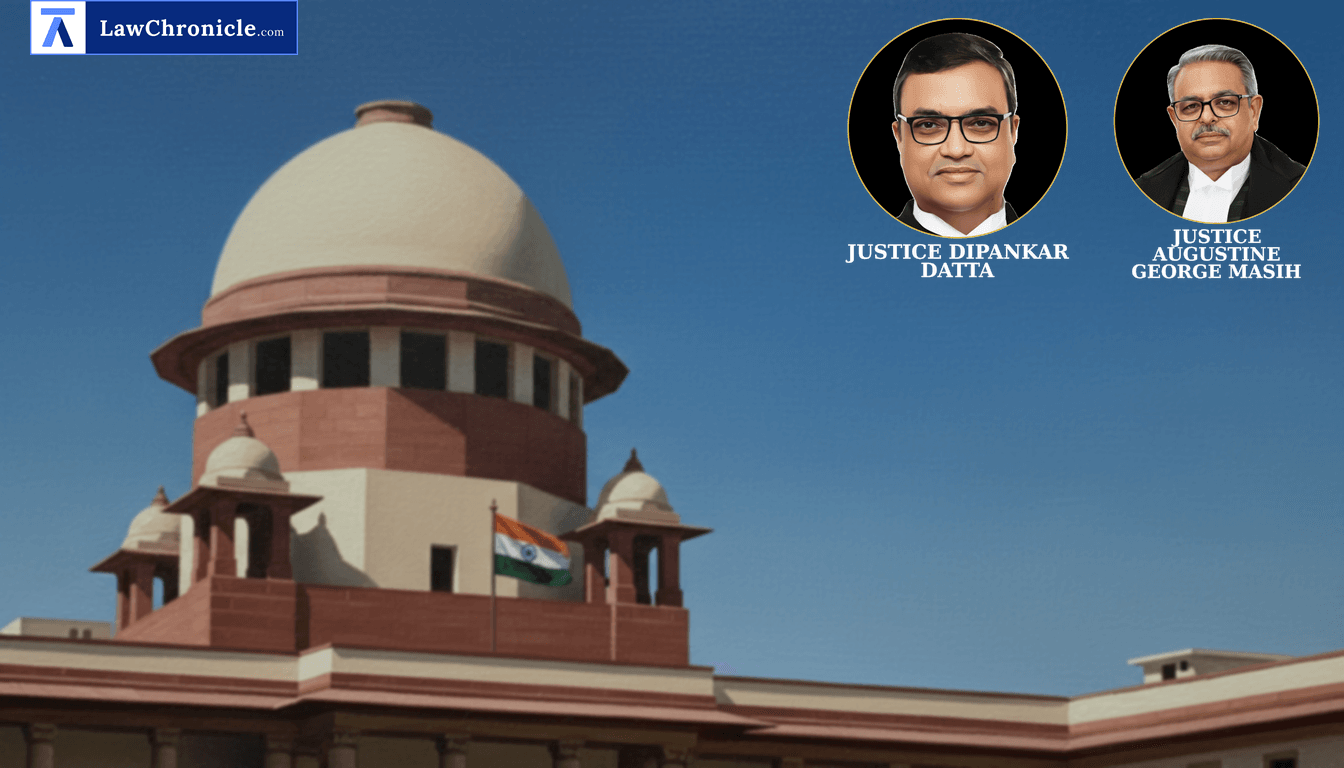
The Supreme Court of India, in State of Odisha & Ors. v. Sreepati Ranjan Dash, clarified that employees do not have a vested right to be considered for promotion under outdated executive instructions once formal recruitment rules are enacted, particularly in the context of cadre restructuring.
A bench comprising Justice Dipankar Datta and Justice Augustine George Masih set aside a judgment of the Orissa High Court which had directed the State to consider candidates for the post of Assistant Regional Transport Officer (ARTO) under 1981 executive instructions. The Apex Court emphasized that the power of the government to restructure a cadre and change the method of selection is a matter of policy that remains within its competence.
The Primacy of Formal Recruitment Rules over Executive Instructions
The Court noted that the Odisha Transport Service (Method of Recruitment and Conditions of Service) Rules, 2021 were framed under the Constitution of India, 1950 to regulate the Odisha Transport Service. These rules superseded the previous Executive Instructions. The Court held that when a conflict arises between executive instructions and rules made under the proviso to Article 309, the latter must prevail. This principle was supported by the precedent in Union of India v. Somasundaram Viswanath ( "(1989) 1 SCC 175": 1988 CaseBase(SC) 587).
The 'Raj Kumar' Precedent and Overruling of 'Rangaiah'
The Court highlighted that the legal landscape regarding promotion and vacancies changed significantly with the decision in State of H.P. v. Raj Kumar ( "(2023) 3 SCC 773": 2022 CaseBase(SC) 360), which explicitly overruled the long-standing principle in Y.V. Rangaiah v. J. Sreenivasa Rao. The Court, in its reasoning, observed: "The statement in Y.V. Rangaiah that, 'the vacancies which occurred prior to the amended Rules would be governed by the old Rules and not by the amended Rules', does not reflect the correct proposition of law governing services under the Union and the States under Part XIV of the Constitution. It is hereby overruled."
Court's Rationale on Selection Posts and Policy Decisions
The Bench further distinguished between 'promotional' and 'selection' posts, noting that for selection posts, merit and the method of recruitment are policy decisions of the State. Referring to Sant Ram Sharma v. State of Rajasthan ( "AIR 1967 SC 1910": 1967 CaseBase(SC) 169), the Court reiterated that ranking in a gradation list does not confer an automatic right to promotion to selection posts. Furthermore, relying on Haryana SEB v. Gulshan Lal ( "(2009) 12 SCC 231": 2009 CaseBase(SC) 21), the Court affirmed that an employee's limited right is only for consideration, not a guarantee of promotion.
Background:
The dispute originated when two respondents, serving as Assistant Section Officers, sought promotion to the post of ARTO based on Executive Instructions issued in 1981. While their names were recommended by the Transport Commissioner, the Government of Odisha rejected the proposal to convene a Departmental Promotion Committee (DPC), citing the restructuring of the Odisha Transport Service and the impending Odisha Transport Service (Method of Recruitment and Conditions of Service) Rules, 2021. The High Court of Orissa had previously ruled in favor of the employees, holding that because the vacancies arose before the 2021 Rules, they should be filled under the old instructions. The State challenged this, arguing that the 2021 Rules necessitated a combined competitive examination through the Odisha Public Service Commission. The Supreme Court ultimately agreed with the State, concluding that the High Court had "missed the woods for the trees" by failing to apply the updated legal principles established in State of H.P. v. Raj Kumar ( "(2023) 3 SCC 773": 2022 CaseBase(SC) 360).
Case Details:
Case No.: CIVIL APPEAL NO.13121 OF 2025
NeutralCitation: 2026 INSC 505
Case Title: STATE OF ODISHA & ORS. VERSUS SREEPATI RANJAN DASH
Source: 2026 CaseBase(SC) 438
 Breaking News