Non-Arraignment of Employees No Ground To Quash Corporate Prosecution: SC
 Copy Link
 Share
Share Save
Save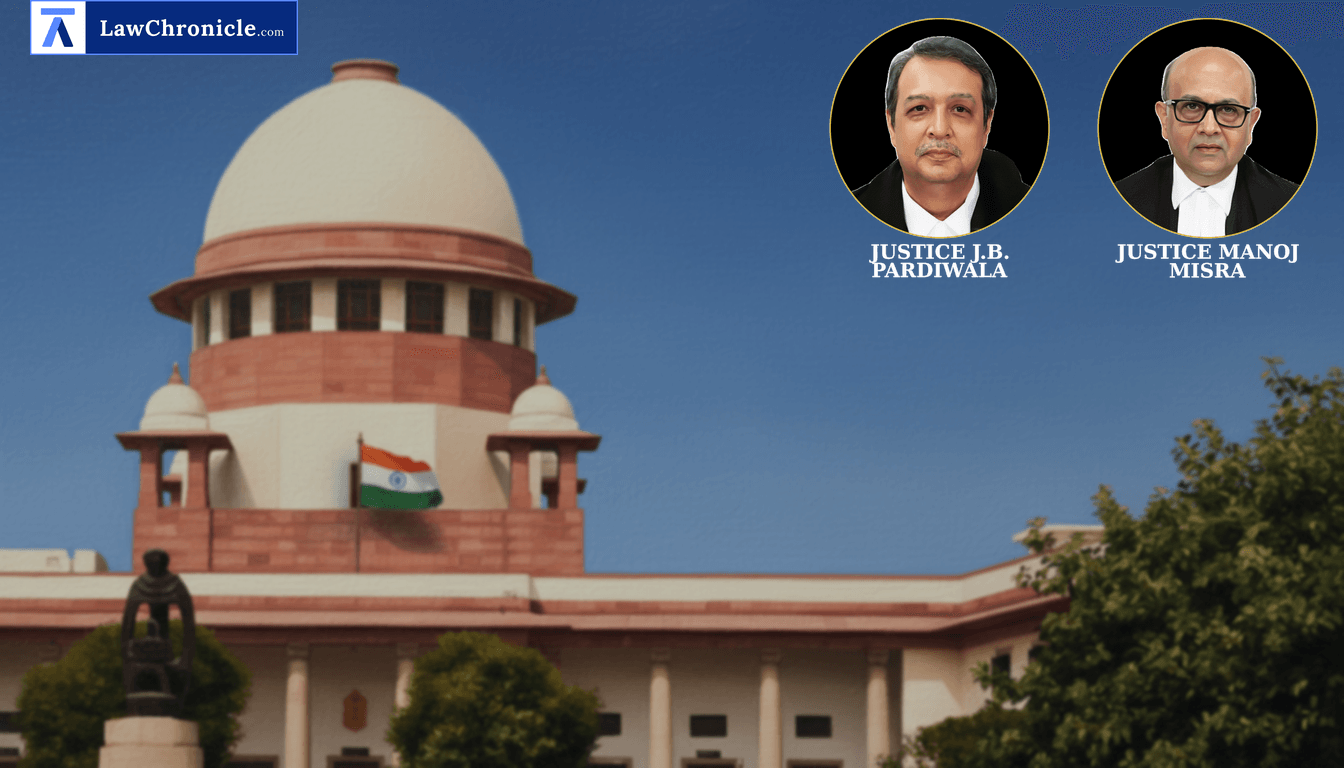
Setting a landmark precedent in corporate criminal jurisprudence, the Supreme Court has ruled that a company can be prosecuted for offences requiring mens rea even if no natural person or employee has been individually identified or arraigned alongside it as an accused.
A Bench of Justice J.B. Pardiwala and Justice Manoj Misra dismissed an appeal challenging a High Court order that refused to quash criminal proceedings against a pharmaceutical company accused of bribery and conspiracy.
Key Takeaways
Corporations Face Direct Trial: Non-identification or non-arraignment of human alter egos cannot stifle criminal proceedings against a corporate entity at the threshold stage.
Three-Stage Attribution Test: Courts must sequentially analyze constitutional documents, delegated authority, and statutory purpose to impute guilty mind to a company.
Trial Court Fact-Finding Required: Establishing corporate mens rea through human agency is a matter for trial rather than a ground for quashing under Section 482 CrPC.
No Blanket Immunity: Corporate entities remain liable for grave offences involving mandatory imprisonment and fine.
Three-Tier Framework on Corporate Mens Rea
The Bench thoroughly examined international and Indian jurisprudence, including landmark rulings like Tesco Supermarkets Ltd. v. Nattrass, Meridian Global Funds Management Asia Ltd v. Securities Commission, Standard Chartered Bank v. Directorate of Enforcement ( "(2005) 4 SCC 530": 2005 CaseBase(SC) 266), Iridium India Telecom Ltd. v. Motorola Inc. ( "(2011) 1 SCC 74": 2010 CaseBase(SC) 340), and Aneeta Hada v. Godfather Travels and Tours Pvt. Ltd.. Formulating a comprehensive three-stage attribution framework under Indian law to determine corporate mens rea, the Court observed:
"The inquiry into attribution is not concerned with corporate metaphysics, i.e., with locating some abstract 'directing mind and will' or 'brain' of the corporation. Consequently, the inquiry, at every stage, does not ask who may generally be said to run, control, or embody the corporation. It asks only whose act, in relation to the particular transaction or matter in question, is to be treated as the corporation's own."
The Court outlined the sequential inquiry stages as follows:
- Examination of constitutional documents (memorandum and articles of association) or implied rules of company law.
- Verification of express or implied delegation of authority accompanied by discretion and independence.
- Evaluation of statutory purpose whether narrow or broad to determine if a special rule of attribution must be fashioned based on facts and circumstances.
Ratio
Criminal proceedings against a corporate entity for offences involving mens rea cannot be quashed under Section 482 of the Code of Criminal Procedure, 1973 solely because no natural person or employee of the company has been identified or arraigned alongside it as an accused, provided the allegations prima facie disclose that natural persons acted on behalf of the corporation with the requisite mental state.
Background
The Appellant, a pharmaceutical public limited company, supplied medical products to Bhabha Atomic Research Centre (“BARC”). The Central Bureau of Investigation filed a chargesheet alleging that a public servant at BARC conspired with the Appellant to procure medicines at inflated rates, causing wrongful loss to BARC and illegal gratification to the officer. Offences were registered under Section 120B read with Section 420 of the Indian Penal Code and Sections 11, 12, 13(2) read with 13(1)(b) and 13(1)(d) of the Prevention of Corruption Act,1988.
No individual officer or employee of the Appellant was arrayed as an accused. The Appellant approached the High Court of Karnataka under Section 482 of the Code of Criminal Procedure, 1973 seeking to quash the proceedings, contending that a company cannot have mens rea or enter into a conspiracy independent of natural persons who acted on its behalf. The High Court dismissed the petition, relying on Iridium India Telecom Ltd. v. Motorola Inc. ( "(2011) 1 SCC 74": 2010 CaseBase(SC) 340). Affirming the High Court's dismissal, the Supreme Court held that non-arraignment of natural persons is not fatal at the threshold stage under Section 482 CrPC.
Case Details:
Case No.: Criminal Appeal No. 4250 of 2026
Neutral Citation: 2026 INSC 957
Case Title: Sanofi India Ltd. v. Central Bureau of Investigation
Appearances:
For the Petitioner(s): Mr. Siddharth Luthra, Senior Advocate
For the Respondent(s): CBI Advocates
Source: 2026 CaseBase(SC) 5095
 Breaking News