


Non-Conduct Of Oral Inquiry Vitiates Disciplinary Proceedings: Allahabad HC
 Copy Link
 Share
 Save
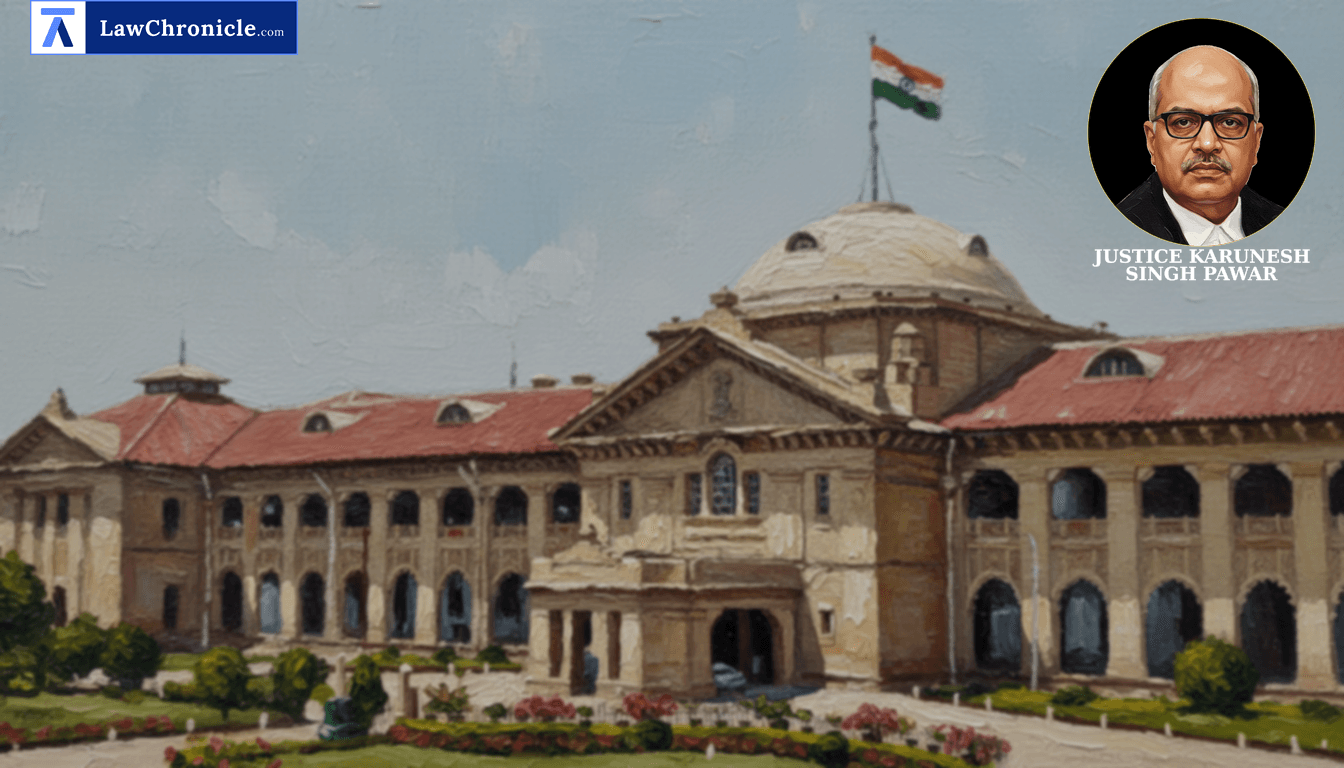
The Allahabad High Court has held that disciplinary proceedings resulting in major penalties are legally unsustainable if they are conducted without a regular oral inquiry or the fixing of a date, time, and place for evidence. The court emphasized that documentary evidence must be proven through admissible oral evidence and cannot be the sole basis for a finding of guilt in the absence of witness testimonies.
In a matter heard by Hon’ble Justice Karunesh Singh Pawar, the Court examined the validity of a punishment order passed against a government servant where the inquiry officer relied solely on documents without conducting an oral hearing. The bench quashed the punishment, noting that the entire process was in complete disregard of the principles of natural justice and the mandatory procedure prescribed under the Uttar Pradesh Government Servant (Discipline and Appeal) Rules, 1999.
Fundamental Procedural Infirmities Vitiate Inquiry
The Court observed that no oral evidence was led by the department to prove the documents relied upon in the charge-sheet. It noted that the Inquiry Officer failed to fix a specific date, time, or place for the inquiry, thereby depriving the petitioner of the opportunity to cross-examine witnesses. The Court, in its reasoning, observed: "...where no oral evidence is led by the department to prove the documents relied upon in support of the charge-sheet, such documentary evidence cannot be taken into consideration by the Inquiry Officer for recording a finding of guilt against the charged employee. In the present case, it is an admitted position that no oral inquiry was conducted. No date, time or place for holding the inquiry was ever fixed. Consequently, the entire disciplinary proceedings stand vitiated, having been conducted in complete disregard of the principles of natural justice as well as the mandatory procedure prescribed under the Rules, 1999."
Failure to Consider Petitioner's Defence and Board of Revenue Report
Beyond procedural lapses, the Court found that the disciplinary authority passed a "non-speaking" and "cryptic" order. The authority had merely reproduced the charge-sheet and the inquiry report without independent analysis. Furthermore, a crucial report from the Board of Revenue, which favored the petitioner by stating he exercised due vigilance, was completely ignored. The Court held that a quasi-judicial authority is legally obligated to assign reasons while accepting or rejecting a delinquent employee's defense.
Prejudicial Effects of Inordinate Delay
The Court also took a stern view of the four-year administrative delay in concluding the proceedings. Referring to the precedents in State of Madhya Pradesh v. Bani Singh ( "1990 Supp (1) SCC 738": 1990 CaseBase(SC) 255) and P.V. Mahadevan v. Managing Director, Tamil Nadu Housing Board ( "(2005) 6 SCC 636": 2005 CaseBase(SC) 145), the bench remarked that such prolonged delays cause serious prejudice to employees who remain under a "cloud of uncertainty."
The Court has the following directions:
"(i) The impugned punishment order dated 10.09.2025, as contained in Annexure-1 to the writ petition, is hereby quashed.
(ii) The consequential order dated 09.12.2025, as contained in Annexure-2 to the writ petition, is also hereby quashed.
(iii) A writ in the nature of mandamus is issued commanding the respondents to restore all consequential service benefits to the petitioner, including restoration of the withheld annual increment, refixation of pay, release of consequential monetary benefits and all attendant service benefits, as if the impugned orders had never been passed.
(iv) The aforesaid exercise shall be completed by the competent authority within a period of three months from the date of production of a certified copy of this order before the authority concerned."
Background:
The dispute arose after the District Magistrate, Lucknow, recommended disciplinary action against the petitioner, a former Sub-Divisional Magistrate, for alleged irregularities in housing site allotments. Proceedings were initiated under Rule 7 of the Uttar Pradesh Government Servant (Discipline and Appeal) Rules, 1999. While Charge No. 1 was found proved by the Inquiry Officer based on the petitioner's alleged lack of scrutiny of recommendations made by subordinates, the petitioner argued that no oral inquiry was ever held. The Court relied on the principles established in State of U.P. v. Saroj Kumar Sinha ( "(2010) 2 SCC 772": 2010 CaseBase(SC) 535) and Satyendra Singh v. State of Uttar Pradesh and Another ( "2024 SCC OnLine SC 3325": 2024 CaseBase(SC) 768) to conclude that the absence of oral evidence rendered the inquiry non est in law. Consequently, the petition was allowed, and all benefits were ordered to be restored.
Case Details:
Case No.: WRIT - A No. - 2342 of 2026
Case Title: Santosh Kumar Singh Versus State Of U.P. Thru. Addl. Chief Secy./Prin. Secy. Appointment And Personnel Deptt. Lko And 2 Others
Appearances:
For the Petitioner(s): Rajesh Kumar, Raj Kumar Singh, Ravi Singh
For the Respondent(s): Sudhir Kumar Singh, Standing Counsel (C.S.C.)
Source: 2026 CaseBase(ALL) 220
 Breaking News


