Non-Tabling of Rules in Assembly Not Fatal Unless Penalty Provided: SC
 Copy Link
 Share
Share Save
Save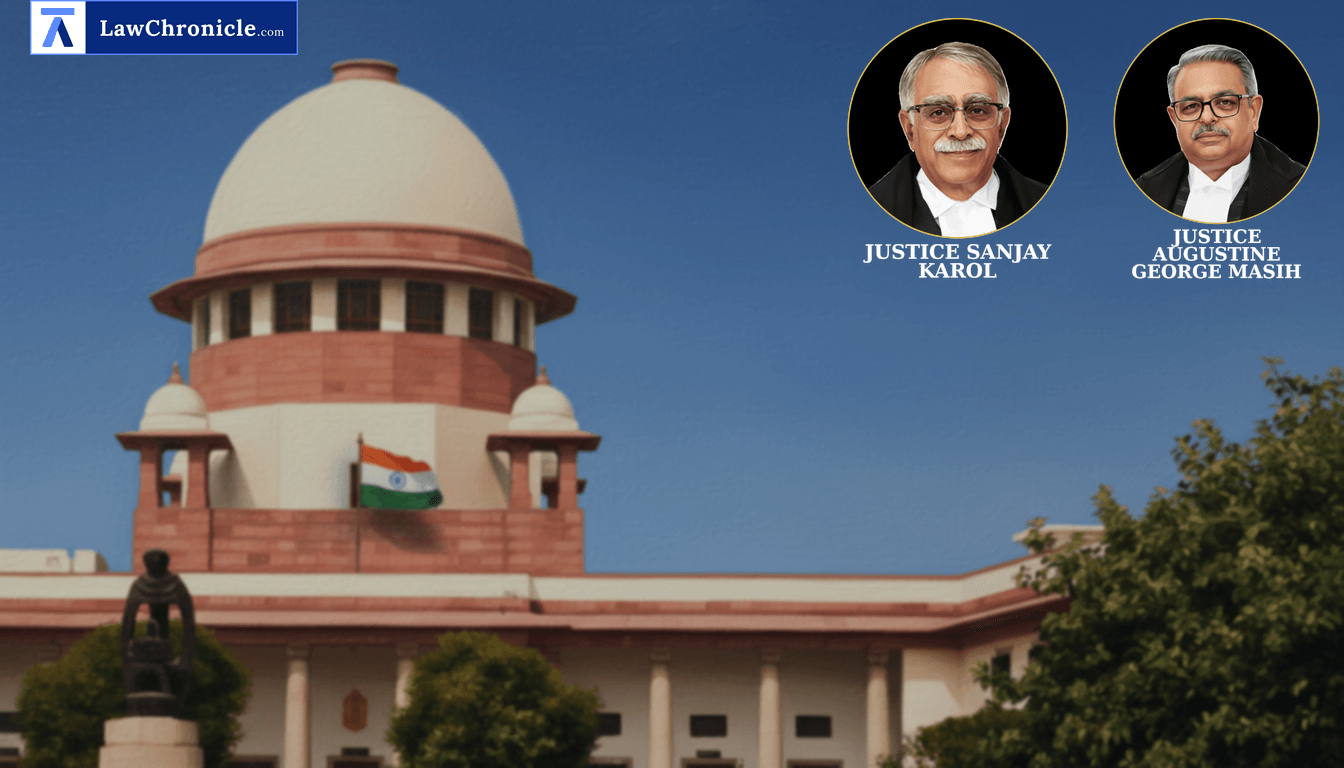
Statutory rules framed by executive authorities do not become void merely because they were not laid before the State Legislative Assembly, provided the underlying statute specifies no penal consequences for non-compliance. In a major clarification on subordinate legislation, the Supreme Court ruled that mandatory-sounding statutory requirements like legislative tabling can be directory in nature depending on statutory intent and real-world consequences.
A Division Bench comprising Justice Sanjay Karol and Justice Augustine George Masih was hearing an appeal challenging a decision of the Chhattisgarh High Court which had quashed an employee's promotion granted thirteen years prior on the grounds that service rule amendments were executive in nature and had not been validly enacted or laid before the legislature.
Scope of Registrar's Authority and Rule-Making Powers
The Supreme Court held that the Registrar holds full power to frame and amend service conditions under Section 55(1) of the Chhattisgarh Cooperative Societies Act, 1960. Applying Section 21 of the General Clauses Act, 1897, the Bench underscored that authority to frame rules inherently carries the power to add to, amend, vary, or rescind them. Rejection of an administrative action merely due to misdescription or improper nomenclature of power was held untenable, relying on Kiran Devi v. Bihar State Sunni Wakf Board ( "(2021) 15 SCC 15": 2021 CaseBase(SC) 517), Municipal Corpn. of Ahmedabad v. Ben Hiraben Manilal, and Hukumchand Mills Ltd. v. State of M.P..
Addressing the mandate under Section 95(3) of the Chhattisgarh Cooperative Societies Act, 1960 requiring rules to be laid before the Legislative Assembly, the Court evaluated whether the statutory word 'shall' rendered the procedure mandatory or directory. Relying on Constitution Bench decisions in State of U.P. v. Manbodhan Lal Srivastava, State of U.P. v. Babu Ram Upadhya, and Bhikraj Jaipuria v. Union of India, the Court reiterated that the use of 'shall' does not automatically make a provision mandatory if no invalidating consequences or penalties are prescribed for non-compliance.
Analyzing the degree of legislative control over delegated legislation, the Supreme Court cited Atlas Cycle Industries Ltd. v. State of Haryana ( "(1979) 2 SCC 196": 1978 CaseBase(SC) 349) and K.T. Plantation (P) Ltd. v. State of Karnataka to affirm that simple laying provisions without affirmative or negative resolution requirements are purely directory. The Court also drew support from State of M.P. v. Hukum Chand Mills Karamchari ( "(1996) 7 SCC 81": 1995 CaseBase(SC) 415), which interpreted an identical provision under the M.P. Cooperative Societies Act.
The Court, in its reasoning, observed: "In order to determine whether ‘shall’ as used in Section 95(3) of the 1960 Act is obligatory or otherwise, the fact that there is no consequence of non-compliance of the laying procedure, acquires importance. This meets one half of the requirements to be considered in order to conclude that a provision is directory. The other half is whether there will be ‘serious general inconvenience and prejudice’ to the public or to the Government... in the absence of consequence, the laying procedure given in Section 95(3) is clearly directory. Non-compliance thereof cannot defeat the exercise of power by the Registrar."
Furthermore, the Court noted that settled appointments and promotions should not be disturbed after a prolonged lapse of time. Reversing the findings of the High Court which relied on Punjab Water Supply & Sewerage Board v. Ranjodh Singh and Union of India v. Ashok Kumar Aggarwal ( "(2013) 16 SCC 147": 2013 CaseBase(SC) 134) to hold that executive instructions cannot override statutory rules, the Bench granted full relief to the employee.
The Court issued the following directions:
"The necessary consequence of the conclusion recorded by us is that the appellant shall (a) be placed on the said position and status from which he was removed; (b) his seniority shall be protected; (c) entitled to all benefits of promotion that may have fallen due as per law; and (d) he shall also be entitled to 50% back wages payable within two months from the date of this judgment, failing which an interest @6% per annum shall be paid."
Key Takeaways
- Directory Nature of Laying Clauses: Tabling requirements for delegated legislation under subordinate statutes are directory unless express nullification or statutory consequences are attached to non-laying.
- Inherent Power to Amend: Statutory authorities empowered to frame regulations possess inherent power under Section 21 of the General Clauses Act, 1897 to modify, rescind, or delete those rules.
- Protection of Long-Standing Promotions: Employees should not suffer from judicial delay or administrative errors disrupting promotions acted upon and enjoyed over long periods.
Ratio
Statutory laying provisions governing subordinate legislation are directory in the absence of explicit penal consequences or mandatory legislative resolution requirements; validly exercised rule-making powers cannot be invalidated merely due to procedural non-tabling or formal defects in notification nomenclature.
Background:
The dispute originated from promotional lists prepared for Class-I officers at the District Central Cooperative Bank Ltd, Raipur, governed by the Chhattisgarh District Cooperative Central Bank Employee Service (Employment, Terms and their Working Conditions) Rules, 1982 framed pursuant to Section 55 of the Chhattisgarh Cooperative Societies Act, 1960. Qualification norms were tied to the Chhattisgarh Co-operative Society Rules, 1962. Initially, Rule 5(3)(a) barred employees appointed to special technical posts from being absorbed or promoted into non-technical administrative posts like Additional Manager.
On July 4, 2005, the Registrar issued an order deleting Rule 5(3)(a, b, c). Later, on August 13, 2010, the Additional Registrar issued a communication clarifying that technical employees were eligible for promotion. Pursuant to Departmental Promotion Committee recommendations, the appellant was promoted as Additional Manager on December 30, 2010. Respondent No. 5 challenged this promotion before the High Court, contending that technical officers could not be promoted to administrative posts and that an executive circular could not amend statutory service rules.
The learned Single Judge and subsequently the Division Bench of the High Court set aside the appellant's promotion after 13 years, holding that Niyam 1982 had statutory force and could not be altered by executive correspondence without formal statutory amendments laid under Section 95(3). Reversing this decision, the Supreme Court allowed the appeal, restored the appellant's promotion with protected seniority, and granted 50% back wages.
Case Details:
Case No.: Civil Appeal No. 769 of 2026 (Arising out of SLP (C.) No. 8726 of 2024)
NeutralCitation: 2026 INSC 769
Case Title: S. P. Chandrakar v. State of Chhattisgarh & Ors.
Source: 2026 CaseBase(SC) 707
 Breaking News