


Non-Wearing of Helmet Does Not Ipso Facto Prove Contributory Negligence: Gujarat HC
 Copy Link
 Share
 Save
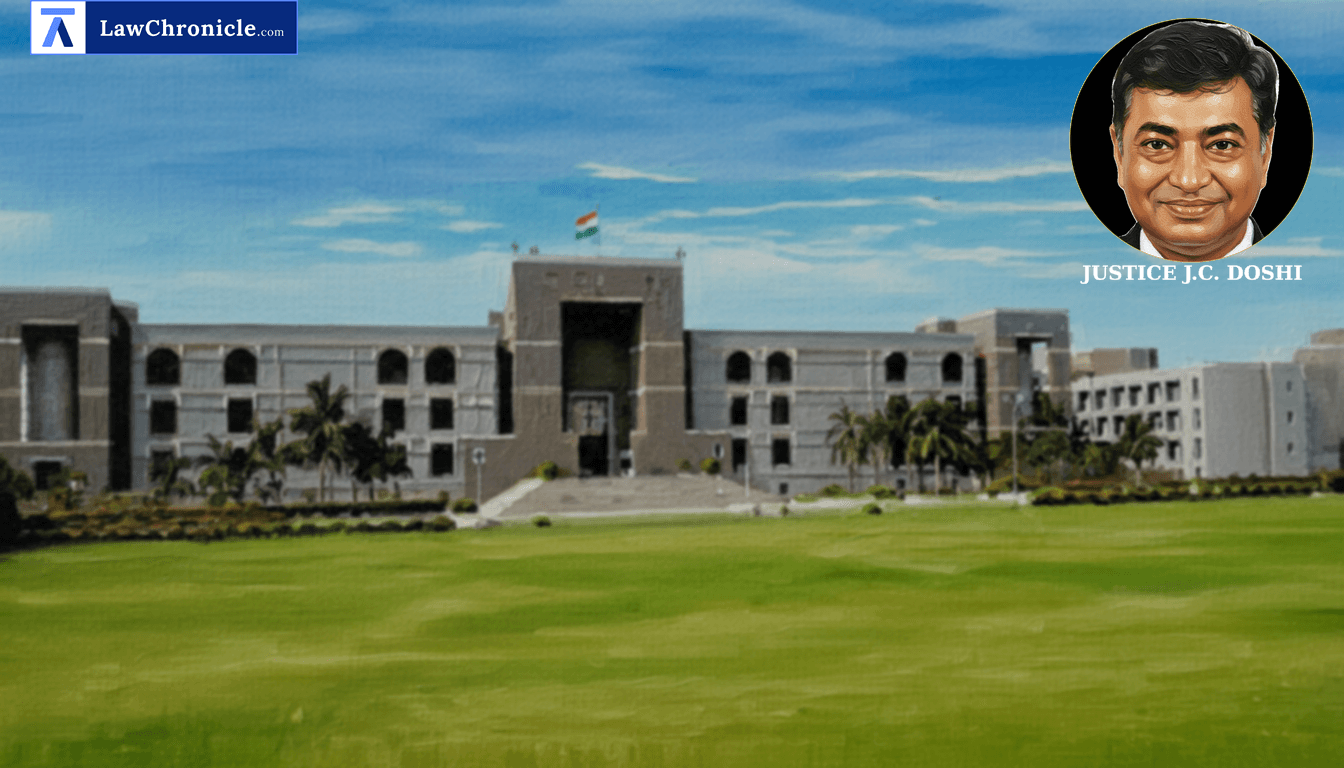
The High Court of Gujarat has solidified the principle that statutory violations like riding without a helmet do not automatically translate to contributory negligence unless a direct causal link to the accident is established. This ruling reinforces the mandate for insurance companies and state transport corporations to provide just compensation, prioritizing the beneficial nature of social welfare legislation over technical breaches of traffic rules.
A single-judge bench of Justice J. C. Doshi heard the cross-appeals filed by the Gujarat State Road Transport Corporation (GSRTC) and the claimants. The case involved a fatal road accident where a GSRTC bus dashed into a motorcycle from behind, leading to the death of the rider. The Court was tasked with determining the issues of negligence and the adequacy of the compensation awarded by the Motor Accident Claims Tribunal (MACT).
Key Takeaways
Negligence Standard for Larger Vehicles
Drivers of larger vehicles like state transport buses are held to a higher standard of care and caution compared to smaller vehicles on the road.
Helmet Violation and Liability
Failure to wear a helmet is a safety violation to minimize injury but does not constitute a causative factor for the accident itself unless proven otherwise.
Evidentiary Value of Police Records
Police investigation records, including FIRs and Charge-Sheets, serve as reliable prima facie evidence of rash and negligent driving in civil compensation claims.
Mandate for Just Compensation
Courts must adopt a holistic and pragmatic view to ensure compensation is realistic, liberal, and restorative, rather than mere arithmetical calculation.
Court's Rationale on Negligence and Statutory Violations
The Court dismissed the GSRTC's contention that the deceased was contributorily negligent for not wearing a helmet. Relying on judicial precedents, the Court noted that a safety measure's absence does not excuse the tortfeasor's primary negligence in causing the collision. The Court further emphasized that the driver of a 'big vehicle' like an S.T. bus must exercise greater caution.
The Court, in its reasoning, observed: "It is a well-settled principle that mere violation of statutory provisions, such as non-wearing of a helmet, does not ipso facto confer a right upon the tortfeasor to plead contributory negligence, unless it is established that such violation had a direct nexus with the occurrence of the accident. It is also pertinent to note that the object of wearing a helmet is primarily a safety measure intended to minimize or prevent the severity of head injuries. It does not, in any manner, prevent the happening of the accident."
Regarding the evidentiary value of criminal records, the Court applied the principles from ICICI Lombard General Insurance Co. Ltd. v. Rajani Sahoo & Ors. ( "(2025) 2 SCC 599": 2025 CaseBase(SC) 105) and Reena Versus Managing Director, Karnataka State Road Transport Corporation ( "2026 INSC 889": 2026 CaseBase(SC) 801), noting that a Charge-Sheet creates a prima facie case of negligence that is not displaced by criminal acquittals.
The Court has the following directions:
"16.1 First Appeal No.3267 of 2005 filed by the GSRTC fails and stands dismissed.
16.2 First Appeal No.3120 of 2025 is partly allowed.
16.3 The GSRTC is directed to deposit the enhanced amount of compensation with interest as stated herein above within a period of six weeks from the date of receipt of this order. Rest of the direction(s) of the Tribunal remain same.
16.4 The Tribunal shall disburse the entire awarded amount lying in the FDR and/or with the Tribunal, with accrued interest thereon, if any, to the claimants, by account payee cheque / NEFT / RTGS, after proper verification and after following due procedure.
16.5 While making the payment, the Tribunal shall deduct the courts fees, if not paid, in accordance with rules/law."
Ratio
In claims under the motor vehicles act, 1988, the absence of a helmet or a valid driving license does not automatically attract the doctrine of contributory negligence; the burden lies on the tortfeasor to prove a causal connection between the statutory violation and the occurrence of the accident. Furthermore, a Charge-Sheet serves as sufficient prima facie evidence to establish civil liability for negligence.
Background
The dispute arose from an accident on July 13, 2021, where Mohanbhai Hirabhi Marvadi succumbed to injuries after his motorcycle was hit from behind by a GSRTC bus. The Tribunal initially granted Rs. 14,25,000/- in compensation. The GSRTC appealed for a reduction, alleging the deceased was negligent due to the lack of a helmet and license. Conversely, the claimants sought enhancement, arguing the income assessment was too low.
The Court reviewed National Insurance Company Ltd. Vs. Pranay Shethi ( "(2017) 16 SCC 680": 2017 CaseBase(SC) 551) and United India Insurance Co. Ltd., versus Satinder Kaur @ Satwinder Kaur ( "(2021) 11 SCC 780": 2020 CaseBase(SC) 22) for the calculation of non-pecuniary damages and consortium. It found the Tribunal's income assessment deficient and increased the compensation to Rs. 17,76,660/-, directing the GSRTC to pay the additional amount with 7.5% interest. The Court relied on Managing Director, Tamil Nadu State Transport Corporation vs. Mariyammal to reiterate that non-wearing of a helmet cannot be construed as a causative factor for the accident itself.
Case Details:
Case No.: R/FIRST APPEAL NO. 3267 of 2025 With R/FIRST APPEAL NO. 3120 of 2025
Neutral Citation: 2026:GUJHC:58614
Case Title: Gujarat State Road Transport Corporation Versus Minor Rohit Mohanbhai Marvadi & Ors.
Appearances:
For the Petitioner(s): Mr Hs Munshaw, Mr Vibhuti Nanavati, Masumi V Nanavaty, Nishit A Bhalodi
For the Respondent(s): NOTICE SERVED for the Defendant(s) No. 1, 2, 5
Source: 2026 CaseBase(GUJ) 23041
Similar Articles
 Breaking News


