On This Day: Indian Flag Adopted by the Constituent Assembly
 Copy Link
 Share
Share Save
Save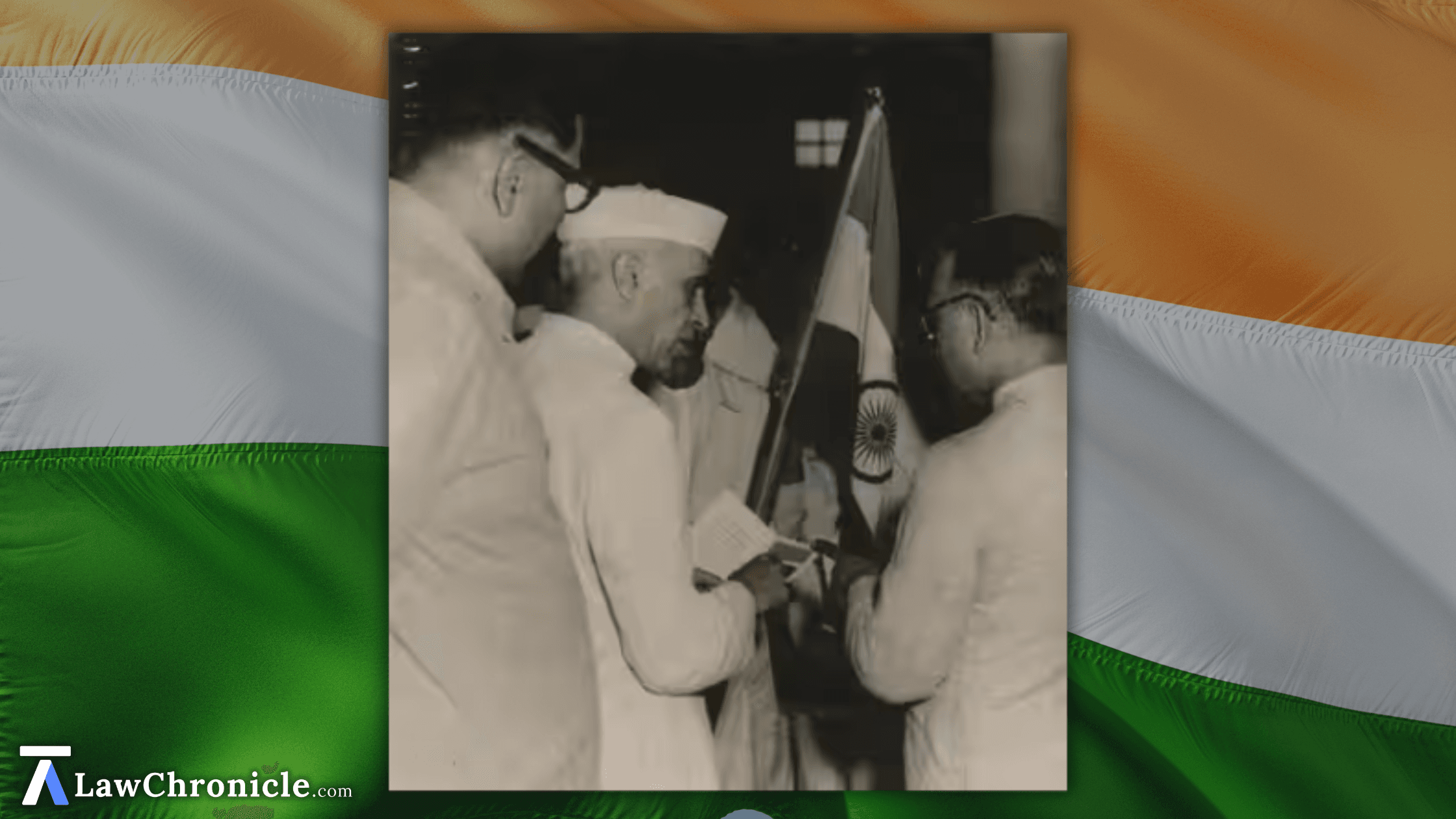
Every year on 22nd July, India marks the day the tricolour was formally given constitutional sanction. This is about Indian flag adoption day, when the Constituent Assembly took up a Resolution moved by Jawaharlal Nehru and gave the nation its National Flag of India. The Resolution was brief and technical in its wording, but the debate that followed it was anything but ordinary. Members from across communities and provinces rose to speak, and by the end of the sitting, the House had unanimously resolved that the Indian flag adopted on 22nd July would be the flag of a free India.
This article draws directly from the Constituent Assembly Debates of 22nd July, to record, in the words of the members themselves, how the flag came into being.
The Resolution: How the Indian Flag Was Adopted by Constituent Assembly
The proceedings opened with Jawaharlal Nehru moving the Resolution in the following terms:
"Resolved that the National Flag of India shall be horizontal tricolour of deep Saffron (Kesari), white and dark green in equal proportion. In the centre of the white band, there shall be a Wheel in navy blue to represent the Charkha. The design of the Wheel shall be that of the Wheel (Chakra) which appears on the abacuse of the Sarnath Lion Capital of Asoka. The diameter of the Wheel shall approximate to the width of the white band. The ratio of the width to the length of the Flag shall ordinarily be 2:3."
This is the precise text under which the Indian flag adopted by Constituent Assembly took its final constitutional form: A horizontal tricolour of saffron, white and dark green, with the navy blue Ashoka Chakra placed at the centre of the white band, in a width-to-length ratio of 2:3.
Nehru himself noted that the words of the Resolution carried "no glow or warmth" on their own, even though what lay behind them was, in his words, "the concentrated history of a short span in a nation's existence." He told the Constituent Assembly that the flag had, in a sense, already been adopted, "not by a formal resolution, but by popular acclaim and usage, adopted much more by the sacrifice that surrounded it in the past few decades." According to Jawaharlal Nehru, the Constituent Assembly was "only ratifying that popular adoption."
Nehru on the National Flag of India: A Flag Without Communal Significance
A significant part of Jawaharlal Nehru's address was devoted to clarifying that the National Flag of India carried no communal meaning. He told members that some had "misunderstood its significance" and thought of the colours "in communal terms," believing that some part of it represented one community or another. He was direct in rejecting this idea with the words: "when this Flag was devised there was no communal significance attached to it." Instead, the design was meant to be beautiful and to represent, in his words, "the spirit of the nation, the tradition of the nation, that mixed spirit and tradition which has grown up through thousands of years in India."
He also addressed what the flag meant for India's place in the world, hoping it would not be "a Flag of Empire, a Flag of Imperialism, a Flag of domination over anybody," but rather "a Flag of freedom not only for ourselves, but a symbol of freedom to all people who may see it", a flag he hoped would be carried far, "not only where Indians dwell as our ambassadors and ministers but across the far seas where it may be carried by Indian ships."
Indian Flag Colours Meaning: What Members Said in the Debate
Several members addressed the meaning of Indian Flag Colours directly during the debate, and their explanations form the most detailed record of how the tricolour's saffron, white and green were understood during of adoption.
Seth Govind Das on Saffron, White and Green
Seth Govind Das told the House that "there is no touch of communalism in the three colours of the flag." He recalled that when the flag's colours had once been red, white and green, "there was a trace of communalism," but that changing them to saffron, white and green was meant to make clear "that the three colours had no communal significance." He specifically rejected the idea that saffron represented Hindus alone, pointing out that even in the Mahabharata "there was no question of colour", since Arjuna's chariot flag bore the symbol of Hanuman, and Karna's flag bore the symbol of an elephant.
Syed Muhammad Saadulla on the Three Bands
Syed Muhammad Saadulla offered a layered explanation of the Indian Flag Colours Meaning, drawing on both nature and faith. He described saffron as representing "the scorched condition caused by the torrid heat of the Indian Sun," and noted that saffron was "the colour of all those people who live the spiritual life not only among Hindus but also among Muslims." White, he said, should remind everyone "that we must be pure not only in word but also in deed." Green, he explained, was "the emblem of the upsurge of India's freedom," recalling the flag raised by Bahadur Shah in 1857, and also carried meaning for Muslims as "the colour of the Flag of the Muslims from the time of the great Prophet of Arabia thirteen centuries ago." On the change from the Charkha to the Dharma Chakra of Asoka, he called it "a heaven-born inspiration of the authorities."
S. Radhakrishnan on the Ashoka Chakra
S. Radhakrishnan focused on the wheel at the centre of the flag, describing it as representing "the wheel of the Law, the wheel Dharma." He told the Assembly that truth could only be attained "by the pursuit of the path of Dharma, by the practice of virtue," and that the wheel's message was one of constant motion: "Be ever alert, be ever on the move, go forward, work for a free, flexible, compassionate, decent, democratic, society in which Christians, Sikhs, Moslems, Hindus, Buddhists will all find a safe shelter."
Voices Across Communities on the Indian Flag Adopted by Constituent Assembly
The debate drew responses from members representing different communities and provinces, each situating the flag within India's collective struggle rather than any single group's identity.
- Chaudhri Khaliquzzaman said that "none, who calls himself a citizen of India, can have occasion to disagree" with Nehru's speech, adding that "every Muslim, Hindu and Christian will feel proud in hoisting this flag throughout the length and breadth of India."
- Govind Malaviya recalled that under this flag, "the Congress and the khilafat, the Hindus and the Muslims together infused the fire of enthusiasm in the people of this country," and that "every community in India has shed its blood and has sacrificed its all."
- S. Nagappa reminded the House that "the higher the Flag flies, the greater is the honour of the Nation."
- Laxminarayan Sahu connected the flag's symbolism to the Jagannath temple tradition, describing it as, in his words, "not only National, but in a way International because the wheel represents the wheel of eternity."
- Jerome D'Souza hoped the flag would stand as "a reminder of our love of peace," and that in moments of internal strife, "the sight of this Flag" would "help to soften the harsh and discordant voices."
- Sarojini Naidu recalled once addressing a peace celebration in New York where she had not seen the flag of a free India among the flags of other nations. On July 22, she told the Assembly, "we attain our own Flag, the Flag of Free India," adding that under this flag "there is no prince and there is no peasant, there is no rich and there is no poor."
Kamath's Withdrawn Amendment on the Swastika
Before the Resolution through which Indian Flag was adopted Constituent Assembly was put to the House, H. V. Kamath had proposed that the Swastika be inscribed inside the Chakra, arguing that together they would "fittingly symbolise our ancient culture." After examining the design, however, he found it "somewhat hard to fit the Swastika into this Chakra," noting it "would make it rather clumsy and cumbersome." He withdrew the amendment, leaving the Resolution as originally moved by Nehru.
The Assembly's Assent Marked Indian Flag Adoption Day
At the close of the debate, the President called on members to record their assent in a manner befitting the occasion, asking them "to express their assent to the Resolution which has been placed before them and show their respect to the Flag by getting up and standing in their places for half a minute." With that, the Resolution was adopted, and the National Flag of India - the horizontal tricolour of saffron, white and dark green, with the navy blue Ashoka Chakra at its centre, received the sanction of the Constituent Assembly.
This is why July 22 is remembered as Indian flag adoption day: the day on which, through a single Resolution and the words of members who had lived through the freedom struggle, the flag that had already been carried, defended and mourned over for decades was formally given the status of the nation's own.
Also Read About Preamble of Indian Constitution
 Breaking News