


Partition Not a Pre-Requisite: SC Affirms Absolute Title as Right of Widow in Ancestral Property
 Copy Link
 Share
 Save
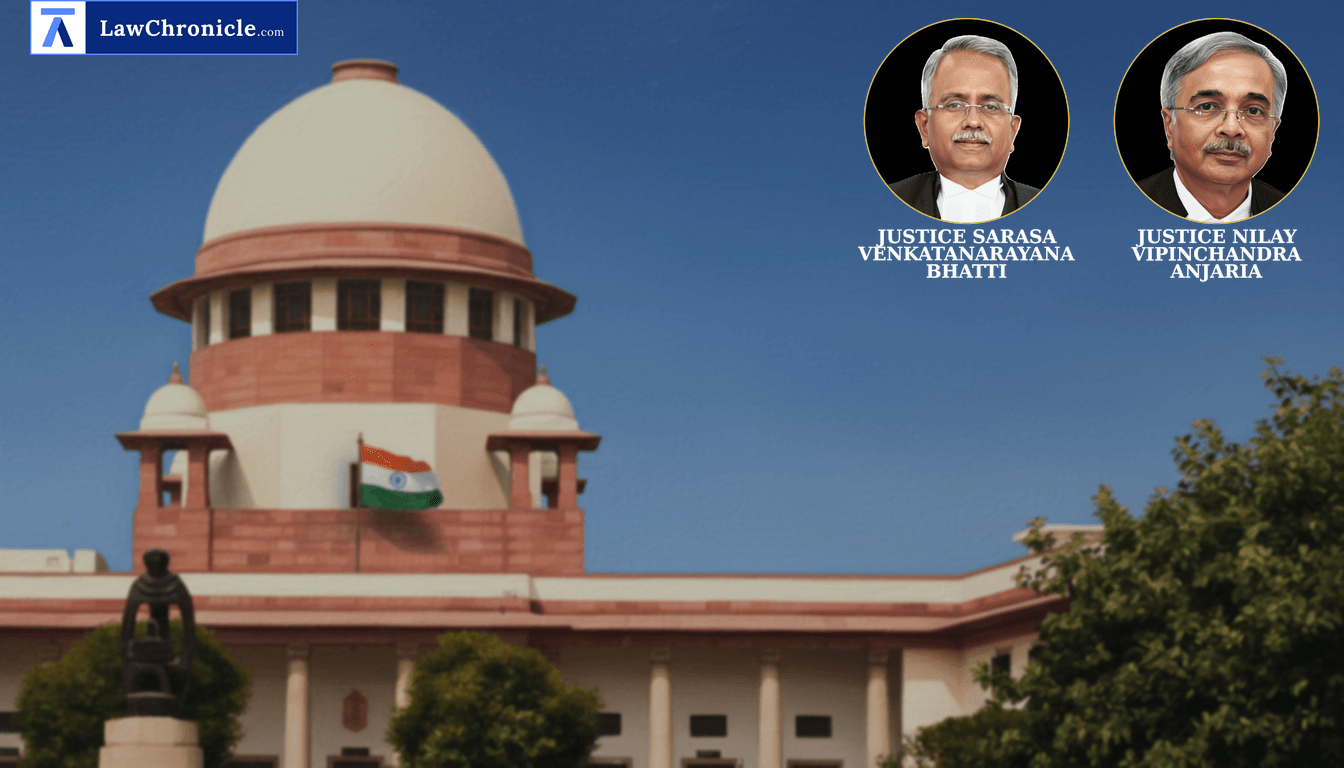
The Supreme Court affirmed that the expansion of a widow's limited estate into absolute title takes effect by operation of law regardless of whether a formal division of shares took place. The Apex Court emphasized that partition of undivided family property is not a prerequisite for a Hindu widow's limited interest under statutory law to blossom into full and absolute ownership.
A Division Bench comprising Justice S.V.N. Bhatti and Justice N.V. Anjaria dismissed a civil appeal challenging the judgment of the High Court of Karnataka, Circuit Bench at Dharwad. The appeal arose out of a suit for declaration and injunction filed by the legal heir of a deceased male coparcener seeking exclusive ownership over ancestral house properties to the exclusion of his father's second wife and her legal representatives.
Key Takeaways
Automatic Expansion of Rights: A Hindu widow's limited share under statutory provisions expands automatically into absolute title under Section 14(1) of the Hindu Succession Act, 1956 without requiring a formal partition.
Pre-existing Maintenance Rights Recognized: The statutory rights granted to a Hindu widow merely recognize and enforce her pre-existing Shastric right to maintenance.
Inapplicability of Section 14(2) Restraints: Any restriction on alienation or limited estate is wiped out under Section 14(1) unless a completely new, independent title is created for the first time.
Validity of Subsequent Alienations: Once a Hindu widow becomes the absolute owner of property, she possesses full legal capacity to dispose of it through wills or sales, creating valid title in transferees.
Right of Widow in Ancestral Property
The Supreme Court affirmed that the interplay between Section 3(2) of the Hindu Women's Rights to Property Act, 1937 and Section 14(1) of the Hindu Succession Act, 1956 removes any restriction on a widow's right. The Bench emphasized that partition is not a condition precedent for a Hindu widow to enjoy absolute ownership over husband's ancestral property.
The Apex Court highlighted that "The partition between the Plaintiff and second wife, as is well settled, is not a sine qua non for continuing to enjoy the right as an independent or absolute owner of the property left behind by the prepositus. Even assuming, without deciding the said argument, that a partition has not occurred in the undivided property, the shares in the coparcenary are subject to fluctuation but not to denial of a right."
Addressing the judicial precedents cited by the parties, the Bench reiterated the legal framework laid down in Potti Lakshmi Perumallu v. Potti Krishnavenamma ( "1964 SCC OnLine SC 35": 1964 CaseBase(SC) 232), V. Tulasamma & Others v. Sesha Reddy ( "(1977) 3 SCC 99": 1977 CaseBase(SC) 255), and Raghubar Singh & Ors. v. Gulab Singh & Ors. ( "(1998) 6 SCC 314": 1998 CaseBase(SC) 254). It noted that Section 14(1) and its Explanation must be given the widest amplitude to advance the socio-economic objectives of the legislation and emancipate women from limited estates.
Ratio
A Hindu widow who acquires an interest in her husband's estate by operation of Section 3(2) of the Hindu Women's Rights to Property Act, 1937 acquires absolute ownership of the property under Section 14(1) of the Hindu Succession Act, 1956 upon its commencement. Formal partition or separation of shares is not a condition precedent for the transformation of a widow's limited estate into absolute title, and any subsequent transfer or testamentary disposition executed by her remains valid in law.
Background
The dispute pertained to house properties situated in Terdal Village, Jamkhandi Taluka, Karnataka. The original owner died intestate in 1949, leaving behind a son (the plaintiff) from his first wife, and his second wife along with two daughters. Following his death, the plaintiff claimed exclusive title as the sole male coparcener under traditional Mitakshara law. However, after second wife passed away in 1986, her daughter obtained mutation of the properties based on a registered Will executed by second wife in 1984. During the pendency of the suit, part of the property was transferred to a third party through a registered sale deed.
The Trial Court partly decreed the suit, holding that since husband died before 1956, his son inherited the estate as the sole surviving male coparcener, while second wife had only a limited interest under Sections 3(1) and 3(3) of the Hindu Women's Rights to Property Act, 1937. It held that because second wife never sought partition during her lifetime, her limited interest did not ripen into absolute title under Section 14(1) of the Hindu Succession Act, 1956. The First Appellate Court upheld these findings.
However, in a second appeal filed under Section 100 of the Code of Civil Procedure, 1908, the Karnataka High Court set aside the judgments of the lower courts. The High Court held that by virtue of Section 3(2) of the Hindu Women's Rights to Property Act, 1937 read with Section 14(1) of the Hindu Succession Act, 1956, Second wife had become the absolute owner, validating the Will and subsequent sale. Upholding the High Court's view, the Supreme Court held that the High Court properly exercised its jurisdiction under Section 100 of the Code of Civil Procedure, 1908 and dismissed the civil appeal.
Case Details:
Case No.: Civil Appeal No. 660 of 2019
Neutral Citation: 2026 INSC 1033
Case Title: Ganapati (Dead) By His LRs v. Prabhakar & Others
Appearances:
For the Petitioner(s): Mr. Anil Katarki, Advocate
For the Respondent(s): Mr. Shanthkumar V. Mahale, Senior Advocate
Source: 2026 CaseBase(SC) 7189
Similar Articles
 Breaking News


