Partners of a firm are jointly and severally liable for dishonoured cheque; notice to partners deemed notice to firm, Supreme Court restores complaint
 Copy Link
 Share
Share Save
Save
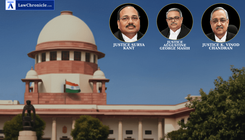
A bench of Justices B.V. Nagarathna and Satish Chandra Sharma heard an appeal against the Madras High Court’s order quashing a complaint under Section 138 of the Negotiable Instruments Act and examined whether a partnership firm must be separately served notice or impleaded before partners could be prosecuted for a dishonoured cheque.
The Court allowed the criminal appeal, held that the High Court erred in quashing the complaint and directed restoration of the prosecution. It clarified that a partnership firm was a “compendious name” for its partners and that partners were personally, jointly and severally liable for debts of the firm; consequently, notice to partners could be treated as notice to the firm and absence of specific impleadment of the firm did not vitiate the complaint. The Court observed that the statutory scheme treated a “company” to include a firm by a deeming fiction but that liability in the case of a firm was not merely vicarious. The Court, in its reasoning, observed: “To reiterate, when the partnership firm is only a compendious name for the partners of the firm, any offence committed under Section 138 read with Section 141 of the Act would make the partners of the firm jointly and severally liable with the firm. If, on the other hand, the Parliament intended that the partners of the firm be construed as separate entities for the purpose of penalty, then it would have provided so by expressly stating that the firm, as well as the partners, would be liable separately for the offence under Section 138 of the Act.” The Court further noted that “the notice issued to the partners of the firm in the instant case shall be construed to be a notice issued to the partnership firm also viz., ‘Mouriya Coirs’.”
Background The appellant had advanced Rs.21 lakh to a partnership (Mouriya Coirs). One partner issued a cheque in the firm’s name which was dishonoured on presentation. The complainant issued statutory notice to the two partners but did not address the notice to the partnership firm nor implead the firm as an accused in the complaint filed under Section 138. The respondents moved the Madras High Court under Section 482 CrPC which quashed the complaint on the ground that the cheque was issued in the firm’s name and the statutory requirements of Section 141 read with Section 138 (as interpreted to require notice/impleadment of the firm) were not complied with.
Before the Supreme Court, counsel for the appellant stressed that a partnership was not a separate juristic person like a company and partners had joint and several liability; hence partners could be prosecuted even if the firm was not separately impleaded. Senior counsel for the respondents relied on Section 141’s Explanation, submitting that a firm was included within the definition of “company” and, by reason of that deeming provision, the firm should be made an accused for vicarious liability to attach.
The Court analysed precedent including Aneeta Hada and Dilip Hariramani, distinguished company jurisprudence, and reviewed the Partnership Act, 1932, and authorities such as Dulichand and G. Ramesh. It held that while Section 141 used an inclusive definition for “company”, the nature of partnership law meant a firm was a compendious expression for its partners and did not possess separate juristic personality like a company. The Court concluded the defect (non-impleading of the firm and absence of notice to the firm) was not fatal where partners were served and arraigned; it granted permission to the complainant to implead the firm and restored the complaint. The Supreme Court set aside the High Court order, restored STC No.1106/2022 to the file of the Judicial Magistrate No. II, Pollachi and directed the trial court to proceed in accordance with law.
Case Details: Case No.: 2025 INSC 831 (Criminal Appeal arising out of SLP (Criminal) No.5706 of 2024) Case Title: Dhanasingh Prabhu v. Chandrasekar & Another Appearances: For the Petitioner(s): [Name(s) not indicated in the judgment] For the Respondent(s): Sri S. Nagamuthu, Senior Counsel
The appeal was allowed and the complaint was restored on July 14, 2025; the trial court was directed to dispose of the complaint in accordance with law.
 Breaking News