Political Status and Public Identity Do Not Substitute Strict Proof of Citizenship: Gauhati HC
 Copy Link
 Share
 Save
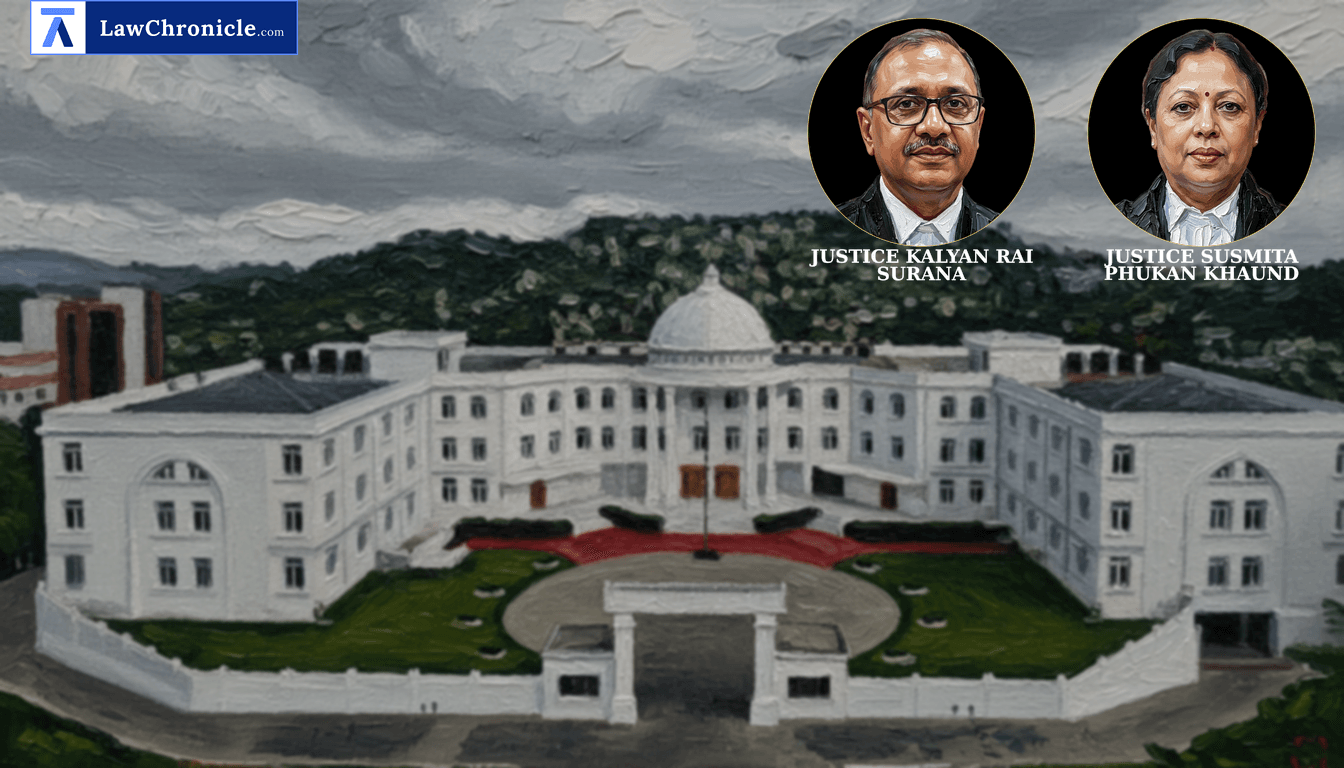
The Gauhati High Court has reinforced the stringent evidentiary standards required under the Foreigners Act, 1946, ruling that a family member’s status as a public representative or election candidate cannot bridge the legal gap in proving lineage for citizenship. The Court dismissed a plea by a woman declared a foreigner, emphasizing that self-generated documents like PAN cards and EPICs are insufficient to discharge the burden of proof without corroborating records and author testimonies.
A division bench comprising Justice Kalyan Rai Surana and Justice Susmita Phukan Khaund adjudicated the writ petition challenging an opinion of the Foreigners Tribunal. The bench scrutinized the petitioner's claim of being an Indian citizen by birth, particularly her reliance on the political credentials of her projected father, a former Guwahati Municipal Corporation Councillor.
Key Takeaways
Public Standing No Proof of Linkage
High-profile public roles or electoral candidacies of a parent do not automatically establish the citizenship or biological linkage of their children in the absence of primary evidence.
Inadequacy of Self-Applied Documents
PAN cards and Elector Photo Identity Cards (EPIC) are issued on self-application without formal inquiry and do not constitute conclusive proof of citizenship under the law.
Burden of Proof Remains Absolute
Under Section 9 of the Foreigners Act, 1946, the onus is entirely on the proceedee to establish citizenship through admissible, proved documents rather than through claims of professional legal incompetence or administrative oversight.
Mandatory Author Testimony
Certificates issued by local authorities or representatives are inadmissible unless the author is examined as a witness to prove the document's contents and authenticity.
Inadmissibility of Secondary Evidence and PAN Cards
The Gauhati High Court, in its reasoning, observed that "The PAN Card and EPIC exhibited by the petitioner... is not a proof of citizenship. These are documents that are issued on self-application without any formal enquiry by the Income Tax Department and Election Commission of India. Therefore, unless, the records supplementing the PAN Card and EPIC are proved, the said exhibited documents cannot be accepted as a proof of citizenship of India."
The bench further clarified that a mere copy of an application for NRC updation, which had not been finalized, is not admissible. It noted that the petitioner failed to prove a continuous residence or a clear linkage between the projected grandparents and herself, noting gaps in the voter lists across several decades.
Ratio
A person's status as an elected official or a political candidate is irrelevant to the determination of citizenship under the Foreigners Act, 1946. To discharge the burden of proof under Section 9, a proceedee must establish a clear, documented linkage to ancestors who were Indian citizens prior to the cut-off date, supported by admissible evidence and the testimony of document authors.
Background
The petitioner, Kulchan Begum, was referred to the Foreigners Tribunal initially under the Illegal Migrants (Determination by Tribunals) Act, 1983, which was later struck down in Sarbananda Sonowal v. Union of India ( "(2005) 5 SCC 665": 2005 CaseBase(SC) 66). The case was subsequently registered under the Foreigners Act, 1946. The petitioner claimed her father was a public figure in Guwahati, having contested Lok Sabha and Assembly elections and served as a GMC Councillor. She presented voter lists from 1966, 1970, and 1997, along with certificates from local representatives, to establish her lineage.
However, the Tribunal found the evidence inadequate, noting that the voter lists did not clearly link her to the persons named therein, and the age gaps between the projected family members were suspicious. The petitioner also raised a plea that she was a victim of "wrong advice" by her previous counsel, a claim the Gauhati High Court rejected as a manufactured afterthought. Citing precedents like Nasiruddin v. Union of India and Md. Babul Islam v. Union of India & Ors. ( "W.P.(C) 3547/ 2016, decided on 09.05.2018": 2015 CaseBase(GAU) 418), the Bench upheld the Tribunal's decision that she failed to discharge her burden under Section 9 of the Foreigners Act, 1946.
Case Details:
Case No.: WP(C)/2459/2020
Neutral Citation: 2026:GAU-AS:16235
Case Title: KULCHAN BEGUM v. THE UNION OF INDIA AND 6 ORS.
Appearances:
For the Petitioner(s): Mr. S. Zaman, Advocate.
For the Respondent(s): Mr. G. Pegu, CGC; Mr. G. Sarma, SC, FT & Border; Mr. P. Sarmah, Addl. Sr. GA; Mr. A.I. Ali, SC, ECI.
Source: 2026 CaseBase(GAU) 1606
 Breaking News