Prior Bid Value Reduction cannot justify Cancellation of E-Auction: Supreme Court
 Copy Link
 Share
 Save
The Supreme Court has ruled that a State instrumentality cannot discard a valid, above-reserve competitive bid merely because the highest bidder had previously offered a higher amount under a surrendered contract.
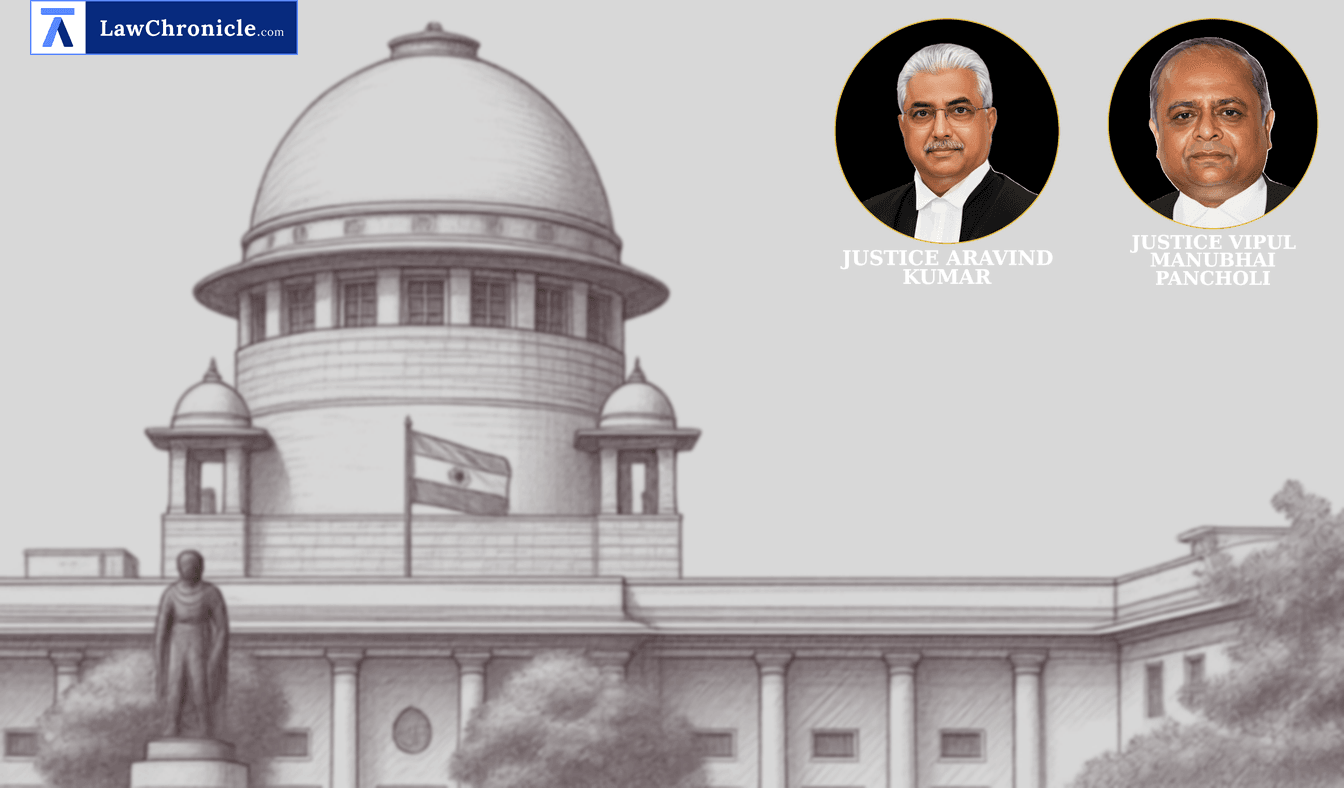
A Division Bench comprising Justice Aravind Kumar and Justice Vipul M. Pancholi allowed the appeals challenging the decision of the Madhya Pradesh State Mining Corporation Limited to cancel the e-auction processes for the Shahdol and Katni sand mining groups. The Apex Court set aside the Madhya Pradesh High Court's common judgment that had affirmed the cancellation, holding that public interest and revenue considerations must be backed by rational material rather than speculative comparisons.
Key Takeaways
Historical Bids Are Not Floor Prices: A previous bid under a surrendered contract does not establish a permanent baseline or immutable minimum price for future public auctions.
Limits on Discretionary Tender Rejection: While the State is not bound to accept the H1 bid, its discretionary power under tender clauses to cancel an auction remains strictly subject to judicial review under Article 14 of the Constitution of India.
Prospective Application of Regulatory Bars: Subsequent statutory amendments introducing disqualifications for surrendering operators cannot be applied retrospectively to invalidate completed tender processes.
Sanctity of Valid Auctions: The state cannot discard an above-reserve price discovery resulting from open competition without demonstrating actual collusion, procedural defect, or market undervaluation.
Bid Value Reduction and E-Auction
Upon receipt of such communication, the Corporation shall, within a further period of two weeks, intimate the respective appellant of the deposits, bank guarantees, performance securities and other formalities remaining to be completed under the restored process. In the event any security furnished earlier has expired or been released during pendency of these proceedings, the concerned appellant shall furnish equivalent security in the form required by the tender within the period stipulated by the Corporation.
Upon due compliance, the Corporation shall complete the consequential approval and allotment process, including issuance of the requisite Letter of Intent or other consequential instrument and execution of the agreement, within six weeks thereafter. The bids shall not be rejected afresh on the ground that the appellants surrendered their earlier contracts, that their October 2025 offers were lower than their previous bids, or by applying retrospectively to the completed 2025 auction the participation restriction introduced on 30.01.2026.
The subsequent tender process initiated under the notice dated 10.02.2026 shall not be carried further insofar as Shahdol and Katni are concerned. The deposits and bank guarantees furnished by participants in that process for these two groups shall be returned or released by the Corporation within four weeks, subject to any liability independently arising otherwise than from the controversy adjudicated herein. The later process, insofar as it concerns other groups, shall remain unaffected."
Analyzing the boundaries of executive discretion in state contracts, the Supreme Court, in its reasoning, observed:
"An H1 bidder has no indefeasible right to insist upon award. The tendering authority may reject the highest offer and may, in an appropriate case, cancel the process altogether. A reserve price is a threshold and not a promise of allotment. At the same time, the reservation of such power in the tender conditions does not place its exercise beyond judicial review. Where the decision is challenged, the Court is entitled to examine whether the consideration which moved the public authority was relevant; whether the material before it reasonably supported the conclusion; and, whether the power was exercised consistently with the constitutional requirement of non-arbitrariness."
Ratio
Where a public authority invites tenders under a statutory regime that permits surrender and does not disqualify surrendering operators, it cannot reject an above-reserve highest bid obtained through open electronic auction solely because the bid is lower than the same bidder's previous surrendered contract, unless supported by contemporaneous market valuation demonstrating undervaluation or procedural infirmities.
Background
The dispute originated when Sahakar Global Ltd and M/s Dhanlaxmi Merchandise Pvt Ltd surrendered their respective three-year sand mining contracts for Shahdol and Katni districts under Rule 16 of the Madhya Pradesh Sand (Mining, Transportation, Storage and Trading) Rules, 2019. Under the prevailing rules, surrendering MDOs were not barred from participating in re-tender processes.
When the Corporation re-auctioned the groups in September 2025, both companies participated openly alongside other technical bidders. Sahakar emerged as H1 for Shahdol with a bid of ₹48,20,40,000 (against a reserve price of ₹44 crore), and Dhanlaxmi emerged as H1 for Katni with ₹54,07,41,111 (against a reserve price of ₹50 crore). However, the Board of Directors of the Corporation cancelled the entire tender process on November 19, 2025, citing that the bids were significantly lower than the appellants' own previous annual bids (by 29.98% for Shahdol and 16.52% for Katni) and were thus non-competitive.
The appellants challenged the cancellation before the Madhya Pradesh High Court, which dismissed their writ petitions relying on clauses reserving discretion to reject bids and noting the potential loss to public revenue. The High Court distinguished Golden Food Products India v. State of Uttar Pradesh and Others ( "2026 SCC OnLine SC 24": 2026 CaseBase(SC) 63), holding that revenue protection furnished a valid reason for rejection.
Reversing the High Court's ruling, the Supreme Court held that while the State has commercial latitude, it cannot exercise contractual power arbitrarily. Relying on settled precedents including Food Corporation of India v. M/s. Kamdhenu Cattle Feed Industries, Tata Cellular v. Union of India ( "(1994) 6 SCC 651": 1994 CaseBase(SC) 278), M.P. Power Management Company Limited, Jabalpur v. Sky Power Southeast Solar India Private Limited and Others ( "(2023) 2 SCC 703": 2022 CaseBase(SC) 789), Subodh Kumar Singh Rathour v. Chief Executive Officer and Others ( "(2024) 15 SCC 461": 2024 CaseBase(SC) 532), State of Uttar Pradesh and Others v. Vijay Bahadur Singh and Others, Haryana Urban Development Authority and Others v. Orchid Infrastructure Developers Private Limited, Ramana Dayaram Shetty v. International Airport Authority of India and Others ( "(1979) 3 SCC 489": 1979 CaseBase(SC) 73), M/s. Star Enterprises and Others v. City and Industrial Development Corporation of Maharashtra Ltd. and Others, Jagdish Mandal v. State of Orissa and Others ( "(2007) 14 SCC 517": 2006 CaseBase(SC) 535), and Michigan Rubber (India) Limited v. State of Karnataka and Others, the Apex Court underscored that public interest must be backed by concrete material. Since no contemporaneous market assessment or proof of collusion existed to demonstrate that the bids were below prevailing market values, the cancellation was unsustainable.
Case Details:
Case No.: Civil Appeal No(s). 13749 of 2026
Neutral Citation: 2026 INSC 1125
Case Title: M/s Dhanlaxmi Merchandise Pvt. Ltd. v. State of Madhya Pradesh & Ors.
Appearances:
For the Petitioner(s): Mr. Mukul Rohatgi, Sr. Adv., Mr. Parameshwar, Sr. Adv.
For the Respondent(s): Shri Tushar Mehta, Solicitor General, Shri Maninder Singh, Sr. Adv.
Source: 2026 CaseBase(SC) 8261
 Breaking News