


Prioritizing Students' Careers Over Procedural Delays: Andhra Pradesh HC
 Copy Link
 Share
 Save
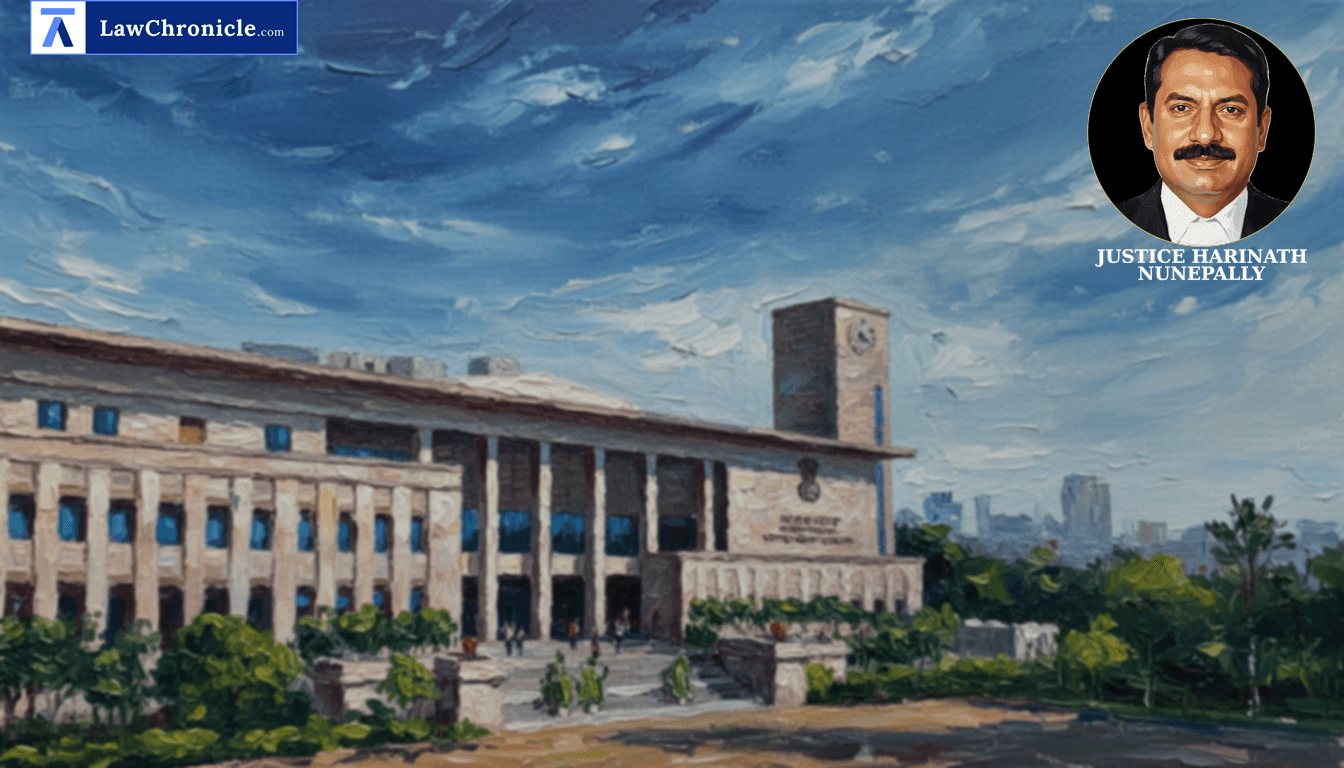
The Andhra Pradesh High Court has intervened to rescue the academic future of B.Ed. students by directing a University to permit semester examinations despite irregular admissions and conditional affiliation. Ruling that judicial orders and student careers cannot be held hostage to administrative delays and private litigations, the Court emphasized a pragmatic approach to rectify procedural deviations through penalties rather than academic forfeiture.
A Single Judge bench of Justice Harinath.N adjudicated on a challenge against conditional affiliation orders that effectively barred an entire batch of students from appearing for their professional examinations. The Court examined the friction between university administrative control and the mandatory recognition framework established under the National Council For Teacher Education Act, 1993.
Key Takeaways
Judicial Primacy over Administrative Delay
University delays in complying with Court-mandated timeframes for affiliation cannot be used to penalize students who were admitted following the restoration of recognition.
Recognition vs. Affiliation Hierarchy
Once the NCTE (Southern Regional Committee) restores recognition, a University cannot arbitrarily impose conditions that contradict High Court directions regarding admission eligibility.
Remedial Regularization
Procedural irregularities in the admission process, such as bypassing web-counselling, can be cured by the imposition of monetary penalties instead of nullifying the students' academic year.
Precedential Limitation
While granting relief, the Court clarified that such directions are based on the peculiar facts of the case and the urgent need to save student careers, limiting its use as a binding precedent for future irregular admissions.
Court Observations on University Conduct and Legal Remedies
The Court scrutinized the University's decision to grant affiliation with a "no admissions" clause for 2025-26, noting it stood in direct contradiction to prior judicial directions. The Court, in its reasoning, observed: "The proceedings dated 06.05.2026 granting/renewing conditional affiliation without admissions for the year 2025-26 are contrary to the order of the High Court of Delhi. It is not explained by the learned Government Pleader appearing for the respondent No.2 as to under what circumstances the order of this Court dated 09.02.2026 could not be complied with within the time frame prescribed by this Court."
Furthermore, the Court rejected the University's reliance on a pending civil suit (O.S.No.46 of 2024) involving a financial dispute between former management members as a valid ground for restricting college affiliations.
The Court has the following directions:
"The students of the petitioner-college be permitted to attend the next ensuing first-semester examinations, second-semester examinations, and subsequent semester examinations to complete their course. Taking the circular, i.e., Cir.No.APSCHE-CETs-2025-Deviation/2025, dated 04.02.2026, into consideration, the petitioner college shall have to pay a penalty of Rs.3,000/- per each of the irregular admission to the respondent No.3 and the petitioner shall have to upload the documents of the students admitted along with the penalty paid and on submission of the said documents, the respondent authorities shall permit the students admitted by the petitioner to appear for the semester examinations."
Ratio
Administrative bodies and Universities are bound by the timelines and directions issued by the High Court under Article 226 of the Constitution of India. Where an educational institution's recognition is restored by the statutory authority under the National Council For Teacher Education Act, 1993, the University must align its affiliation process with the restoration order; any procedural deviation by the institution in admissions may be regularized through prescribed penalties to protect the fundamental academic interests of the students.
Background
The petitioner, Raja Foundation College of Education, had its B.Ed. recognition withdrawn by the NCTE in 2020. Following a remand from the Appellate Authority and subsequent directions from the Delhi High Court in W.P.(C). No.19507 of 2025, the Southern Regional Committee of the NCTE restored the recognition on January 23, 2026.
However, the Yogi Vemana University (Respondent No. 2) issued a conditional affiliation on May 6, 2026, stipulating that no admissions should be made for the 2025-26 academic year. This was despite the fact that the Delhi High Court had already cleared the institution for participation in the admission process. The University argued that the petitioner unilaterally admitted students after the official cut-off dates and without participating in the centralized web-counselling. The petitioner contended that the delay was due to the University's failure to comply with a previous direction in W.P. No. 34315 of 2025 to decide on affiliation within eight weeks. The High Court, while acknowledging the irregular nature of the admissions, opted for a balanced solution to protect the students' future.
Case Details:
Case No.: WRIT PETITION NO: 17125/2026
Neutral Citation: 2026:APHC:46369
Case Title: Raja Foundation College of Education v. The State of Andhra Pradesh and Others
Appearances:
For the Petitioner(s): Thommandru V Saradhi
For the Respondent(s): GP For Higher Education, Venna Hemanth Kumar (Central Government Counsel), Rama Chandra Rao Gurram, K Radhika, V Venkata Naga Raju
Source: 2026 CaseBase(AP) 19883
Similar Articles
 Breaking News


