


Probate Limitation Period Starts From Necessity To Apply, Not Testator's Death: SC
 Copy Link
 Share
 Save
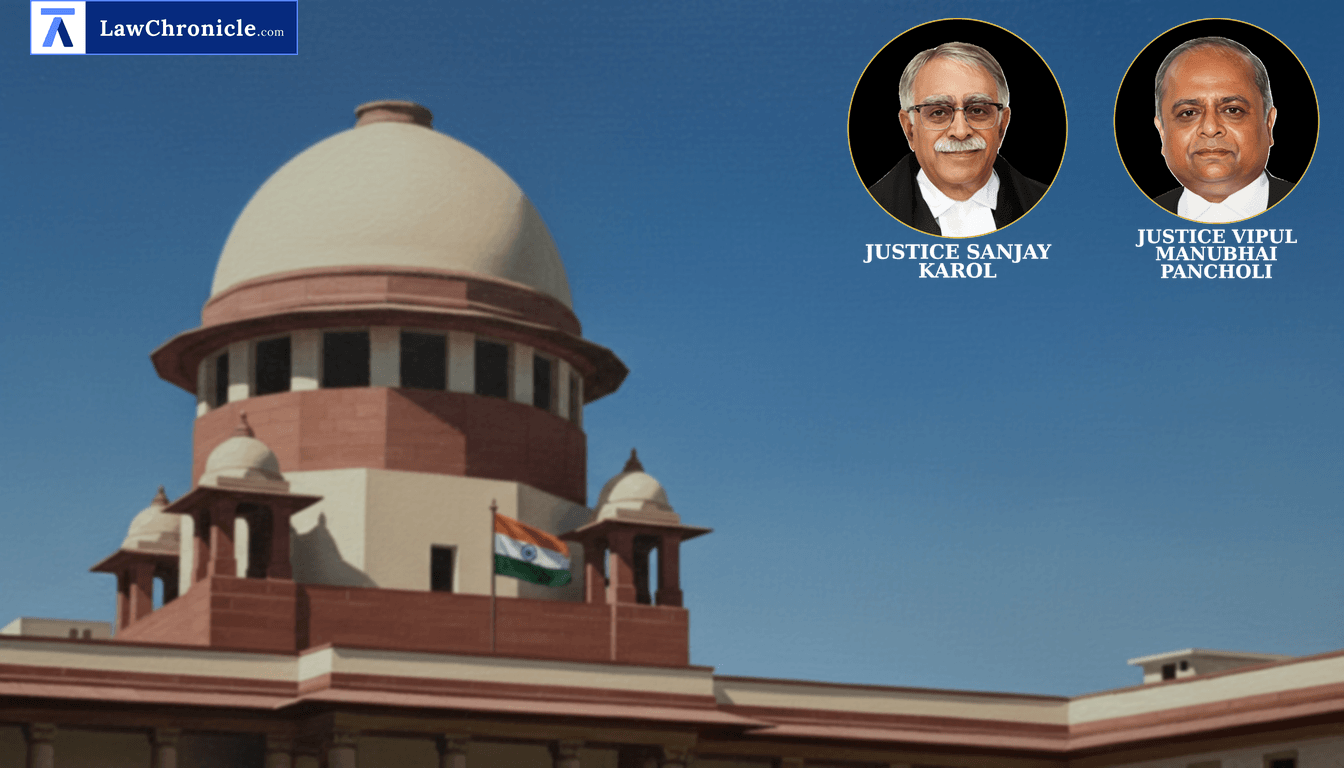
The Supreme Court has redefined the temporal landscape of testamentary law by ruling that the right to apply for probate is a continuous right which accrues only when the necessity to apply arises, effectively junking the notion that limitation begins immediately upon a testator's death.
A bench comprising Justice Sanjay Karol and Justice Vipul M. Pancholi heard the appeal against a judgment of the Jharkhand High Court which had affirmed the rejection of a probate application on grounds of limitation and merit-based suspicion under Order VII Rule 11 of the Code of Civil Procedure, 1908.
Limitation for Probate Applications under the 1963 Act
The Court clarified that since the Indian Succession Act, 1925 does not prescribe a specific timeframe for probate applications, the residuary Article 137 of the Limitation Act, 1963 applies. The Court emphasized that the three-year limitation period begins when the "right to apply accrues," which is a fact-dependent determination tied to the necessity of obtaining the probate rather than the mere date of the testator's demise.
The Court, in its reasoning, observed: "The right to apply would therefore accrue from the date that it becomes necessary to apply. This obviously need not be within three years from the death of the testator. In this case, then, the need to apply would commence from the date when the respondents took actions hostile to the position established by the Will..."
Applying this principle, the Court noted that while the testator died in 1995, the necessity to file for probate arose only in August 2005 when the respondents executed a General Power of Attorney hostile to the Will's provisions. Thus, the application filed in late August 2005 was well within the limitation period.
Scope of Order VII Rule 11 in Testamentary Proceedings
No Summary Adjudication on Will's Validity
The Bench rebuked the lower courts for entering into the merits of the Will specifically regarding whether it appeared "suspicious" while dealing with a summary application for rejection of the plaint. The Court held that such findings require evidence and cannot be determined at the threshold stage.
Referring to Salim D. Agboatwala v. Shamalji Oddhavji Thakkar ( "(2021) 17 SCC 100": 2021 CaseBase(SC) 1724) and P. Kumarakurubaran v. P. Narayanan ( "2025 SCC OnLine SC 975": 2025 CaseBase(SC) 927), the Court reiterated that when limitation involves a mixed question of law and fact based on the "date of knowledge," it becomes a triable issue that cannot be dismissed summarily.
The Court has the following directions:
"The order dated 31st July 2012 passed by the District, Deoghar, and the judgment dated 28th April 2022 passed by the High Court of Jharkhand are set aside. As having plainly erred in law, the appeal is allowed. The matter stands restored to the concerned Civil Court to proceed in accordance with law."
Key Takeaways:
Accrual of Right to Apply
Limitation for probate starts when the executor's right is challenged or a necessity arises, not from the date of the testator’s death.
Protection Against Threshold Dismissals
Courts cannot use Order VII Rule 11 to adjudicate the suspicious nature of a Will without a full trial and evidentiary appreciation.
Mixed Questions of Law and Fact
Where the bar of limitation depends on when a party gained knowledge of specific facts, it must be treated as a triable issue rather than a ground for summary rejection.
Ratio Decidendi:
The right to apply for probate under Article 137 of the Limitation Act, 1963 is a continuous right that accrues when it becomes necessary to apply; such necessity is typically triggered by an adverse action against the Will's intent. Furthermore, a probate petition cannot be dismissed at the threshold under Order VII Rule 11 of the Code of Civil Procedure, 1908 by adjudicating on the merits or suspicious circumstances of the Will, as these are matters for trial.
Background:
The dispute originated from an application filed in 2005 by Bhudeo Prasad Singh for the probate of a Will executed in 1995 by Shrilal Singhania. The District Judge of Deoghar rejected the application under Order VII Rule 11 of the Code of Civil Procedure, 1908, citing a decade-long delay from the testator's death as an unexplained bar of limitation. The High Court of Jharkhand upheld this dismissal, further observing that the Will appeared suspicious. The Supreme Court relied on precedents like Kunvarjeet Singh Khandpur v. Kirandeep Kaur ( "(2008) 8 SCC 463": 2008 CaseBase(SC) 2182) and Sameer Kapoor v. State ( "(2020) 12 SCC 480": 2019 CaseBase(SC) 2167) to clarify the distinction between the death of a testator and the accrual of the right to apply, ultimately setting aside the lower courts' findings and restoring the matter for trial.
Case Details:
Case No.: Civil Appeal No. of 2026 (SLP (C) No. 13473 of 2022)
NeutralCitation: 2026 INSC 708
Case Title: Sanjay Sharma @ Sanjay Bhardwaj v. Krishnadhan Khaware and Ors.
Source: 2026 CaseBase(SC) 657
Similar Articles



 Breaking News


