Project-Wide Parity Mandates Uniform Land Valuation: Supreme Court
 Copy Link
 Share
 Save
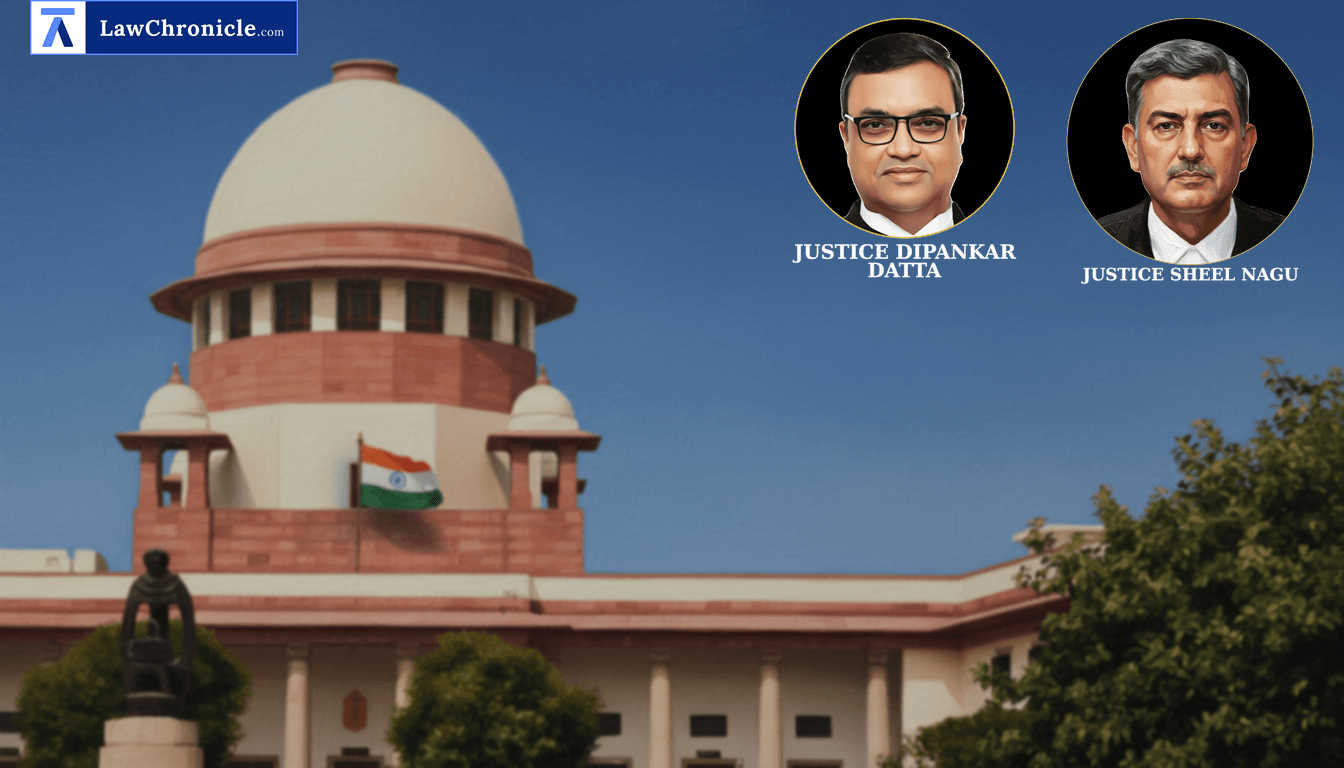
Erasing arbitrary radial pricing models that penalize border-adjacent agricultural tracts, the Supreme Court has restored uniform market compensation and fifty percent severance charges for landowners whose estates were fragmented by state canal projects.
A Bench of Justice Dipankar Datta and Justice Sheel Nagu delivered the decision while deciding forty-seven civil appeals filed under Constitution of India, 1950 challenging a common order of the High Court of Punjab and Haryana. The primary dispute centered around the valuation of land, orchard damages, severance charges, and the applicability of statutory solatium to auxiliary structures.
Key Takeaways
Restoration of Uniform Compensation: Reaffirming the doctrine of project-wide parity, the court eliminated radial step-down deductions, setting market valuation at uniform rates for contiguous lands.
Pleadings Bound Claims: Landowners cannot lead evidence or claim damages beyond their original reference petitions without formal amendments under Land Acquisition Act, 1894.
Severance Baseline Re-established: Severance damages under Section 23(1) Thirdly must be calculated on the remaining unacquired land, not on the narrow strip taken over.
Auxiliary Solatium Barred: Statutory solatium and additional interest apply strictly to bare land value and cannot be extended to auxiliary assets like tubewells or trees.
Supreme Court Analysis and Statutory Scheme
Evaluating the statutory scheme under Section 23 of the Land Acquisition Act, 1894, the Supreme Court stressed that contiguous lands acquired for a unified project must be treated with non-discriminatory parity. Citing Ali Mohammad Beigh and Others v. State of Jammu & Kashmir, Union of India v. Harinder Pal Singh and Others ( "(2005) 12 SCC 564": 2005 CaseBase(SC) 775), and Krishan Kumar v. State of Haryana ( "(2025) 5 SCR 2853: (2025 INSC 638)": 2025 CaseBase(SC) 887), the bench observed that artificial administrative boundaries or distance-based step-downs cannot override equality in land valuation.
The Supreme Court observed that "A fundamental principle in land acquisition jurisprudence is that lands with similar locational and developmental potential must be compensated equitably unless clear, objective distinctions justify otherwise... Arbitrary differentiation in compensation, based on superficial considerations, necessarily violates settled constitutional principles of fairness and equality."
Addressing the computation of severance, the Apex Court noted that constructing a massive canal splits contiguous holdings into isolated, unviable units. Referring to Smt. Tribeni Devi v. Collector of Ranchi and Walchandnagar Industries Ltd. v. State of Maharashtra and Another ( "(2022) 5 SCC 71": 2022 CaseBase(SC) 790), the bench held that severance charges must be assessed on the diminished unacquired portion. Regarding auxiliary assets, the Supreme Court affirmed the application of State of Punjab v. Amarjit Singh ( "(2011) 4 SCC 734": 2011 CaseBase(SC) 606), ruling that Section 23(2) solatium and Section 23(1A) additional interest cannot be claimed on structures or trees.
The Supreme Court issued the following directions:
"Let additional compensation be worked out and paid within six (6) months from the date of communication of this order, by the official respondents to the landowners in these 47 civil appeals."
"In case, from any landowners, after re-working the compensation amount as per this order, any amount becomes recoverable, then due intimation in writing shall be given to the respective landowners in these 47 civil appeals, and after affording due and sufficient opportunity to all concerned, the recovery shall be made within a period of nine (09) months, from the date of communication of this order."
Ratio
Land acquired under a unified scheme across contiguous revenue tracts requires uniform market valuation without arbitrary radial step-down deductions. Furthermore, severance compensation under Section 23(1) Thirdly of the Land Acquisition Act, 1894 must be calculated on the market value of the remaining unacquired land, while statutory solatium under Section 23(2) and additional interest under Section 23(1A) are strictly restricted to the core land valuation.
Background
The dispute stems from notifications issued under Section 4 of the Land Acquisition Act, 1894 in November 2000 to acquire lands across six contiguous villages in Fazilka, Punjab, for constructing the Aspal Extension Drain. The Land Acquisition Collector awarded a uniform market rate of Rs. 2,25,000/- per acre but denied severance charges.
In reference proceedings under Section 18 of the Land Acquisition Act, 1894, the Reference Court enhanced market compensation up to Rs. 5,00,000/- per acre for several villages, awarded fifty percent severance charges on unacquired lands, and expanded orchard damages by considering unpleaded tree losses. It relied on benchmarks like Udho Dass v. State of Haryana and Others ( "(2010) 12 SCC 51": 2010 CaseBase(SC) 356), Bhagwathula Samanna and Others v. Special Tahsildar and Land Acquisition Officer, Visakhapatnam ( "AIR 1992 SC 666; (1991) 4 SCC 506": 1991 CaseBase(SC) 70), and Improvement Trust, Jind v. Narinder Kumar ( "1990 (1) RRR 437": 1990 CaseBase(PNH) 27).
On appeal, the High Court introduced a radial hub-and-spoke pricing model reducing land valuation, lowered severance charges to forty percent calculated on the acquired strip by applying Tehal Singh v. State of Punjab through Collector Land Acquisition Drainage Circle Patiala, and standardized tubewell compensation to Rs. 50,000/-. It also applied Bachhaj Nahar vs. Nilima Mandal ( "(2008) 17 SCC 491": 2008 CaseBase(SC) 64) to limit tree claims strictly to pleadings and State of Punjab v. Amarjit Singh ( "(2011) 4 SCC 734": 2011 CaseBase(SC) 606) to deny solatium on auxiliary assets. Both parties appealed to the Supreme Court under Constitution of India, 1950. Citing principles from LIC v. Ram Pal Singh Bisen and Kunhayammed and Ors. vs. State of Kerala ( "(2000) 6 SCC 359": 2000 CaseBase(SC) 4) on evidence and discretionary jurisdiction, the Supreme Court partially allowed the appeals, restoring uniform land rates and severance calculations.
Case Details:
Case No.: Civil Appeal Nos. 3800-3803 of 2026
Neutral Citation: 2026 INSC 1068
Case Title: Surinder Ahuja & Anr. v. State of Punjab & Anr.
Appearances:
For the Petitioner(s): Sh. Ajay Tewari, Senior Advocate
For the Respondent(s): Sh. Sanjay Hegde, Senior Advocate
Source: 2026 CaseBase(SC) 8149
 Breaking News