Prolonged Separation and Denial of Sexual Intimacy Amount to Cruelty: Supreme Court
 Copy Link
 Share
Share Save
Save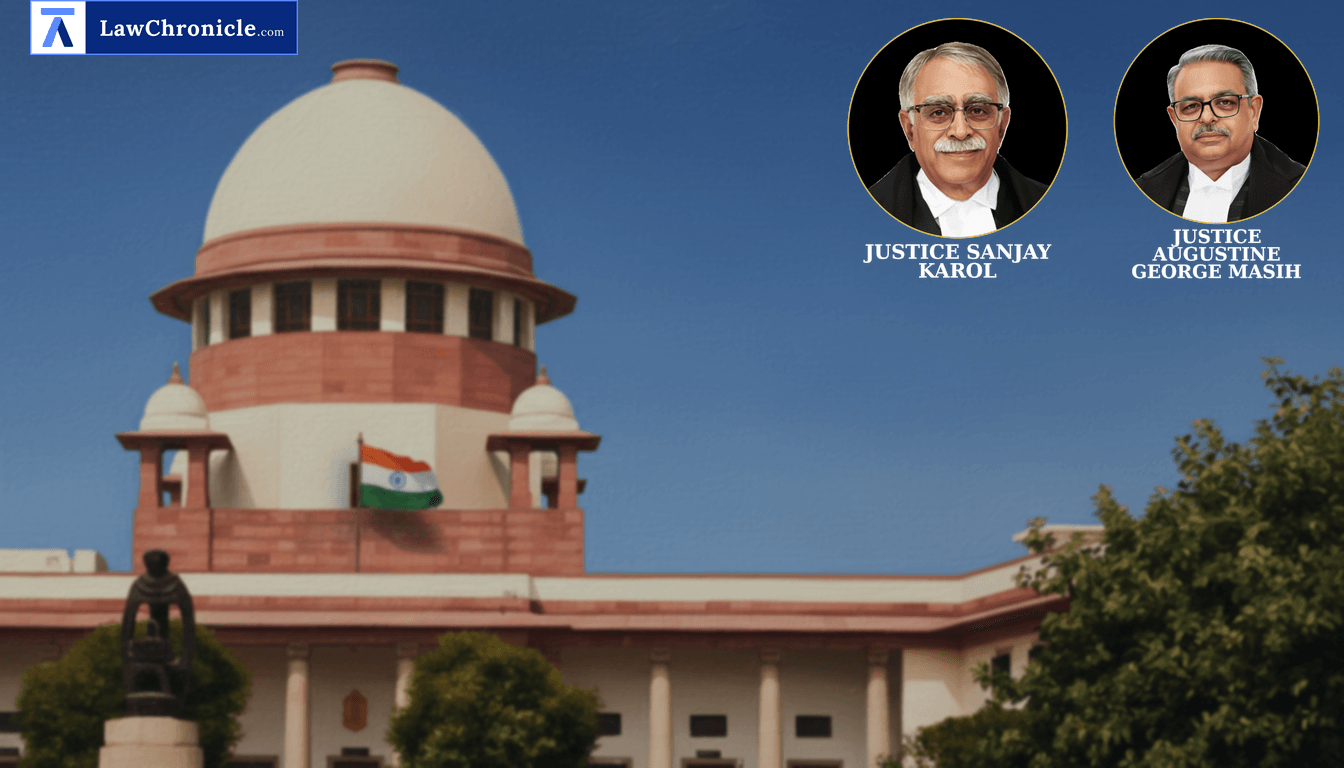
The Supreme Court in Sonal Talpada v. Veerbhan Singh held that prolonged continuous separation and the denial of conjugal rights amount to mental cruelty, rendering the marriage a legal fiction and justifying its dissolution to do "complete justice."
A bench of Justice Sanjay Karol and Justice Augustine George Masih heard the appeal against a Rajasthan High Court judgment that had granted a decree of divorce to a husband on the grounds of cruelty and desertion. The Court examined whether the long-term estrangement of over 15 years and the absence of cohabitation justified the permanent severance of matrimonial ties under the Hindu Marriage Act, 1955.
The Doctrine of Mental Cruelty and Conjugal Duties
The Court observed that while no uniform standard exists for 'cruelty', certain behaviours, such as the unilateral refusal of sexual intercourse and long periods of separation, are clear indicators of mental cruelty. Relying on the landmark precedent in Samar Ghosh v. Jaya Ghosh ( "(2007) 4 SCC 511": 2006 CaseBase(SC) 1119), the Court noted that when a matrimonial bond is beyond repair, the law does not serve the sanctity of marriage by refusing to sever the tie.
The Court, in its reasoning, observed: "Marriage, in its legal and constitutional dimension, can never be reduced to a mere contractual intersection of individual rights... It is a deeply personal and social partnership built on mutual respect, shared expectations and equal responsibility. When two parties enter into matrimony, they weave a tapestry of interdependence that demands a continuous balancing of interests. Conjugal rights do not exist in a vacuum; they are the structural counterparts to conjugal duties."
Irretrievable Breakdown as a Facet of Cruelty
While the Hindu Marriage Act, 1955 does not explicitly list 'irretrievable breakdown' as a ground for divorce, the Court highlighted that under Article 142, it possesses the discretionary power to dissolve a dead marriage. The bench referred to the Constitution Bench decision in Shilpa Sailesh v. Varun Sreenivasan ( "(2023) 14 SCC 231": 2023 CaseBase(SC) 872), which clarified that such power is exercised when a marriage is totally unworkable and emotionally dead.
Court Observations on De Facto Abandonment
The Court noted that even if 'desertion' was not formally pleaded as per Section 13(1)(ib) of the Hindu Marriage Act, 1955, the conduct of the parties maintaining separate domiciles and professional paths for 15 years established a "de facto abandonment of the matrimonial covenant."
The Court has the following directions:
"Accordingly, the marriage between the Appellant-wife and the Respondent-husband deserves to be dissolved in exercise of powers under Article 142 of the Constitution of India. As a consequence of the above, the present appeal stands dismissed."
Background:
The parties, both doctors, were married in 2007 but cohabited for only a few months. The husband alleged that the wife subjected him to cruelty by denying sexual intimacy and locking herself in a separate room. In 2009, he filed for divorce under Section 13(1)(ia) of the Hindu Marriage Act, 1955. While the Family Court dismissed the petition, the Rajasthan High Court reversed this decision, granting the divorce.
The wife appealed to the Supreme Court, contending she was willing to lead a matrimonial life. However, the Supreme Court found that despite mediation efforts, no reconciliation occurred in 15 years. Citing Nayan Bhowmick v. Aparna Chakraborty ( "2025 SCC OnLine SC 2798 : 2025 INSC 1436": 2025 CaseBase(SC) 1337), Vikas Kanaujia v. Sarita ( "(2025) 3 SCC 748": 2024 CaseBase(SC) 355), and R. Srinivas Kumar v. R. Shametha ( "(2019) 9 SCC 409": 2019 CaseBase(SC) 1908), the Court concluded that forcing the parties to remain legally wedded would only escalate frustration in a "stale and frozen relationship."
Case Details:
Case No.: Civil Appeal No. of 2026 (Arising out of SLP (C) No.10422 of 2025)
NeutralCitation: 2026 INSC 620
Case Title: Sonal Talpada v. Veerbhan Singh
Source: 2026 CaseBase(SC) 526
 Breaking News